Conservatives left grumbling after Trump’s welcome to Xi
President Trump’s warm embrace of Chinese President Xi Jinping last week has ruffled feathers in many corners of the GOP. Trump rolled out the literal red carpet for Xi, whose government has been accused of aiding Iran’s economy and military, in addition to decades of human rights violations and dictatorial rule. Republicans in Congress and…
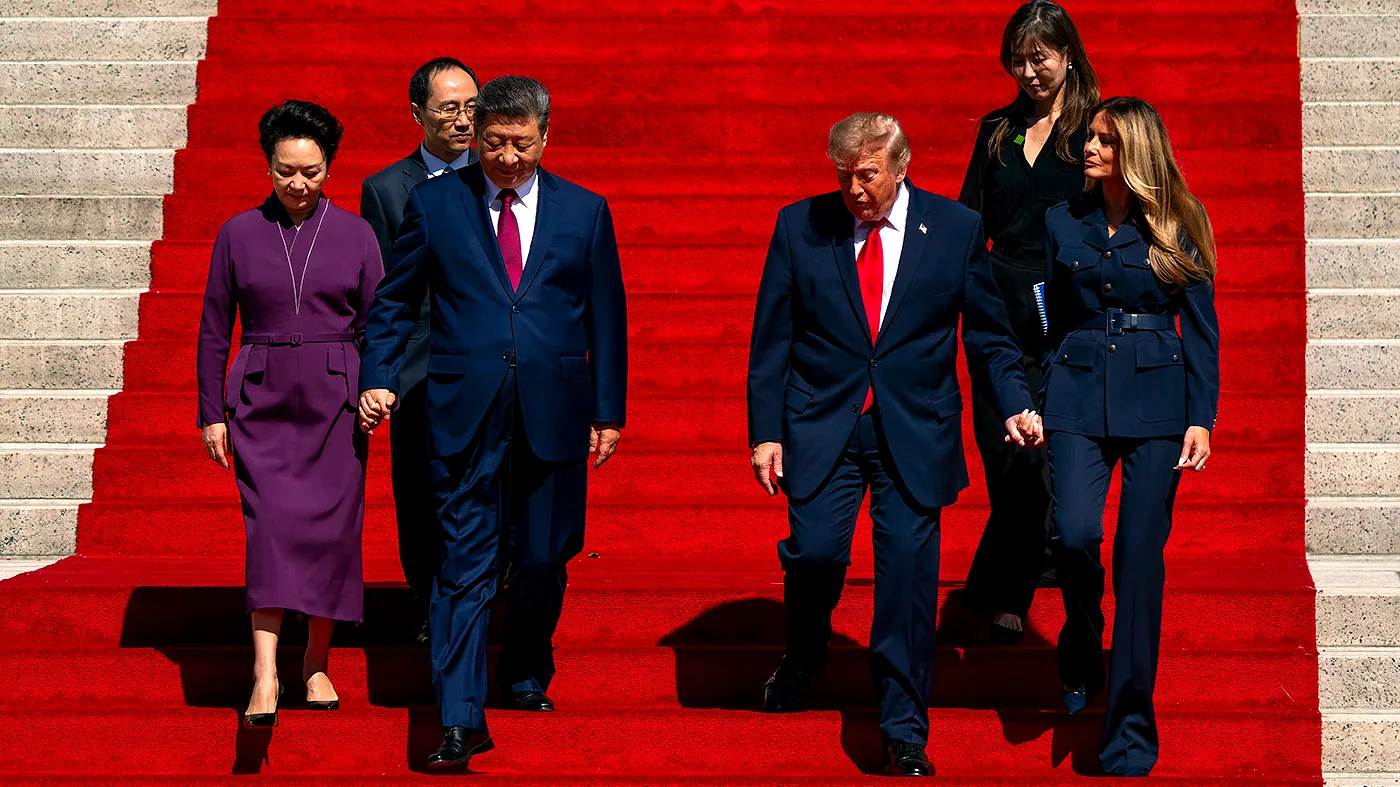
President Trump ’s warm embrace of Chinese President Xi Jinping last week has ruffled feathers in many corners of the GOP.
Trump rolled out the literal red carpet for Xi, whose government has been accused of aiding Iran’s economy and military, in addition to decades of human rights violations and dictatorial rule. Republicans in Congress and in Trump’s orbit, including MAGA-world figures like Laura Loomer , were vocal with their criticism of the state visit.
“We have midterm elections in less than 2 months and so many people who say they are anti-communism sure enjoyed taking selfies in the presence of Xi with their glitz and glam,” Loomer wrote on social platform X .
Although there are plenty of issues that animate different factions of the right about U.S.-China relations, it wasn’t a policy disagreement, for the most part, as much as resistance to the cushy diplomacy Trump displayed in welcoming the Chinese leader. Red carpet aside, that included a state dinner and a military flyover, as well as a visit to the National Archives to view the Constitution and Declaration of Independence.
“They were complaining over style,” said William Chou , a senior fellow at the Hudson Institute. “They were not complaining over substance, just because I think there wasn’t that much substance, there were no major deliverables that came out of the meeting.”
Several Republican members of Congress, including some who are not usually quick to criticize Trump, went public with their displeasure over the president’s treatment of Xi. Their views were especially shaped by a closed-door briefing last week, where administration officials told senators that China is likely deepening its military cooperation with Iran.
“Quite frankly, had the White House asked me for advice, I would have suggested the president not invite Xi Jinping to Washington for such a lavish welcome here in the United States of America, based on all of the troubling issues we have with President Xi and the Chinese Communist Party,” Sen. Roger Wicker (R-Miss.) , chair of the Senate Armed Services Committee, said in a floor speech before the summit.
The House Select Committee on China released a video shortly before the visit showing images of Xi, telling viewers that he is “the biggest opponent of freedom and liberty in the world” and “the #1 adversary of the American people and our national security.”
Lawmakers and others had a slew of issues they hoped Trump would bring up with Xi, including export controls, agricultural purchasing, artificial intelligence, Taiwan and the treatment of political prisoners. But it’s not clear which, if any, of those came up throughout the three-day summit.
Chou said the lack of substance isn’t surprising, as such summits are typically a chance for photo-ops while working-level diplomats hash out policy. Plus, Chou said, neither side has “much desire to rock the boat right now” with the American midterm elections coming up and two more international forums involving both nations still to come this calendar year.
Dan Blumenthal, co-director of the Coalition Defense of Taiwan project at the American Enterprise Institute, said in an article published Monday that Trump’s treatment of Xi “as an equal” was very good optics for Xi but bad for Trump and the U.S. He called for Trump to use more economic leverage over China in the coming months but suggested that’s not likely to happen.
“Trump and Xi are already scheduled to meet twice more this year—at the Asia-Pacific Economic Cooperation summit in November and the G20 summit in December—and there are indications that the US is ‘hollowing out’ the G20 agenda to turn the summit into a backdrop for another Trump–Xi meeting,” Blumenthal wrote. “For Xi’s part, he is happy to continue strutting down the red carpet so long as Trump is happy to continue rolling it out for him.”
Welcome to The Movement , a weekly newsletter looking at the influences and debates on the right in Washington. I’m Helen Huiskes, Senate reporter.
Send me tips, comments and suggestions: hhuiskes@thehill.com
This week marks 50 years since the first enactment of the Hyde Amendment, a piece of federal policy on annual government spending bills that prohibits federal funds from covering any abortion, with an exception for procedures that would save the life of the pregnant woman. The spending bill on which the first iteration of Hyde was attached became law on Sept. 30, 1976.
Anti-abortion groups are commemorating that anniversary, and Hyde’s endurance, with a rally at the Capitol steps Wednesday. The goal of the rally is to trumpet it as one of the most significant legislative achievements in the history of the anti-abortion movement and to urge Congress to hold fast on funding the government through regular order, full-year spending bills that keep Hyde intact.
“It has become consensus, or somewhat settled law, but it always does take a lot of work to keep it in there,” said Hannah Lape , legislative strategist at Concerned Women for America. “If we do lose the majority, the concern would be that either that the House would exclude Hyde or other members of the Hyde family of amendments from appropriations bills, and that would be something that we would have to go to bat for.”
Gavin Oxley , spokesperson for Americans United for Life, the group leading the rally, said there’s interest in “flexibility” on Hyde from both parties, which he said is “a losing strategy.”
“The Hyde Amendment has been the immovable red line of federal pro-life strategy for half a century, and it continues to serve as the backbone for defunding efforts that expand beyond direct subsidization of abortion,” Oxley said. “Popular opinion has been behind Hyde for 50 years, but politicians on both sides of the aisle seem to believe that abandoning public sentiment is good political strategy.”
The concern that lawmakers might compromise Hyde is not unfounded even with a Republican trifecta in power. Trump in January made waves when he suggested that House Republicans put aside their concerns about adding Hyde restrictions before extending or reforming expiring Affordable Care Act subsidies.
“Now, you have to be a little flexible on Hyde,” Trump told the lawmakers.
That comment sparked swift criticism from anti-abortion groups. Since then, Trump has nominated some allies of the movement to key Cabinet posts, including Todd Blanche as attorney general and Heidi Overton as Food and Drug Administration chief.
Some groups have gradually come back on board, but there’s still concern about whether the Trump administration will be aggressive enough on cutting ties between the federal government and Planned Parenthood or banning the mailing of mifepristone.
Concerned Women for America is also launching its regular election-year bus tour to encourage women to vote in the midterm elections, called “She Prays She Votes” and featuring a big pink bus. The tour will stop for rallies throughout October in Ohio, Michigan, Iowa, Texas, Louisiana, Alabama, Georgia, North Carolina and Virginia. More here .
American Compass published the first issue of its new online magazine, Commonplace. The magazine is intended to bring together essays from the right of center coalition and “be a home for development and advancement of its ideas and coalition.” The first edition includes pieces on conservative climate policy (by Chris Barnard), AI catastrophism (by Oren Cass) and much more. Read it here .
The U.S. Commission on Civil Rights released a report on the federal response to antisemitism on college campuses, the result of a bipartisan investigation into how the federal government and nine universities handled student protests, academic freedom issues, discrimination and vandalism, and other incidents in the wake of the Oct. 7, 2023, Hamas attacks on Israel. The commission highlighted inconsistent responses from the institutions and called for increased capacity and transparency from federal agencies. Read the report .
Stephanie Slade in Wall Street Journal Opinion: Meet the ‘Bronze Age’ Young Men of the New American Right
Topics in this story
Gathered from external sources. Rights to this text belong to whoever originally published it.