Senate Democrats pressure Schumer to cede more control over agenda
Democrats are using Sen. Chris Van Hollen’s (D-Md.) insurgent leadership challenge to pressure Senate Minority Leader Chuck Schumer (D-N.Y.) to give them more control over the Democratic agenda next year and to shift power away from the majority leader’s office. Democratic senators have grown tired of Schumer’s ironlike grip on the weekly discussions at the…
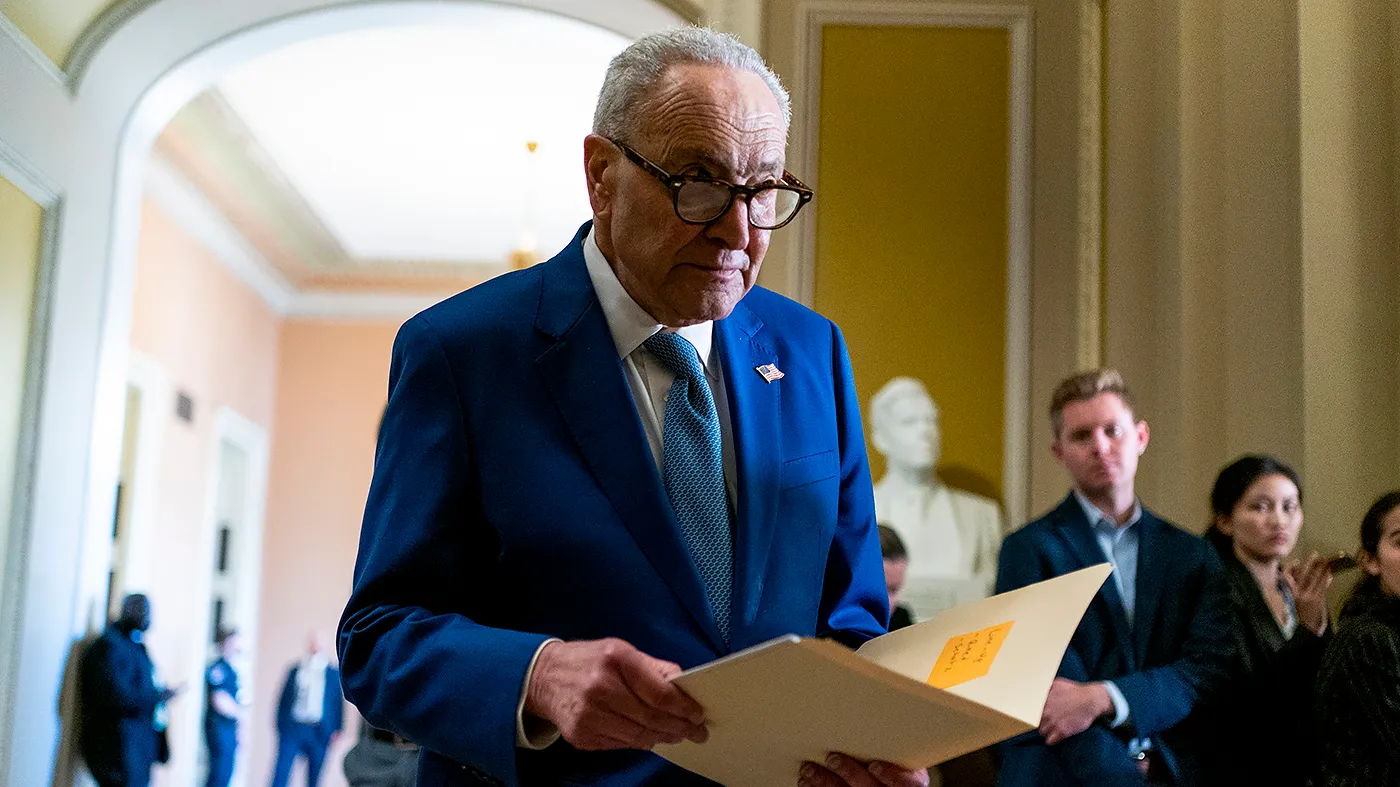
Democrats are using Sen. Chris Van Hollen’s (D-Md.) insurgent leadership challenge to pressure Senate Minority Leader Chuck Schumer (D-N.Y.) to give them more control over the Democratic agenda next year and to shift power away from the majority leader’s office.
Democratic senators have grown tired of Schumer’s ironlike grip on the weekly discussions at the Senate Democratic lunches, as well as what lawmakers describe as his obsessive control over the Democratic agenda.
The Senate Democratic caucus is filled with ambitious politicians who sometimes feels Schumer has too much control, and they want him to cede more of the spotlight if he is to return as leader.
“Everyone knows that he’s a lame duck,” said one Democratic senator who requested anonymity, predicting Schumer will not run for reelection in 2028.
Schumer hasn’t said what he will do when his Senate term expires in two years. He will turn 76 later this month.
The veteran New York senator likes to show up at almost every major Democratic press conference to help present a new proposal along with the measure’s sponsor. And sometimes he has a tough time giving up the microphone at Senate Democratic lunches, party sources say.
But even Democratic senators who are critical of Schumer’s leadership acknowledge he does some things very well.
They cite his impressive track record of raising hundreds of millions of dollars to help Democratic candidates match Republicans in television ad spending and his talent for crafting talking points to effectively counter the weekly Republican message.
At the same time, a significant number of Democratic senators feel they’re often sitting in the back seat and not playing enough of a role in making important political and policy-related decisions.
“I think that there certainly needs to be more input from the caucus — not just from the leadership — from those of us who have been here and fighting in the trenches, as well as the amazing freshmen senators” who just won their races, said Sen. Tammy Duckworth (D-Ill.), who hasn’t yet announced whether she’ll vote for Schumer or Van Hollen.
“I think that we need to take a look at the caucus rules and how we go about doing it,” she said. “When I served in the House, I was part of a leadership team that met with Leader Pelosi on a regular basis.”
One Schumer ally defended his outsized role as the chief spokesperson and public face of the Senate Democratic caucus by arguing he was serving as a “heat shield” for Democratic colleagues by absorbing GOP attacks when they were in the minority.
Sen. Andy Kim (D-N.J.) said he’s trying to push his own ideas about how the Senate Democratic caucus could improve its operations and performance.
“I certainly am raising with them what I hope we could do better with the caucus to make it stronger,” said Kim, who declined to get into the details of his ideas.
The New Jersey Democrat said he has ideas on “both policy as well as just things that I think can make the caucus work stronger.”
Kim hasn’t yet declared which candidate he will support in the leadership race. The Hill is keeping a whip list of the vote count. Fourteen senators are publicly backing Schumer, compared with five in Van Hollen’s column.
Sen. Martin Heinrich (D-N.M.), who’s in line to chair the Energy and Natural Resources Committee, said he wants to see committee chairs play a more active role in negotiating bills and bringing them to the floor in the next Congress.
“I think we do better work when committees are empowered. One of the things I want from leadership on both sides is to let their chairmen negotiate and get to actual good legislation. I think the more that the power is pushed down to the committee, where we have the most knowledge about how to come up with a good product, I think that benefits our ability to produce a product,” Heinrich said Tuesday morning at “The Bipartisan Blueprint: Advancing Permitting Reform for America’s Future,” an event sponsored by The Hill and JPMorgan.
Heinrich said he’s communicated his preference for giving committees more authority in the next Congress to both Schumer and Van Hollen.
“I’m making that pitch to all of the candidates,” he said.
Schumer let Sen. Elizabeth Warren (D-Mass.), the ranking member of the Senate Banking Committee, take the lead in working with Republicans to pass the 21st Century ROAD to Housing Act, and he allowed Heinrich and Sen. Sheldon Whitehouse (D-R.I.), the ranking member on the Environment and Public Works Committee, to negotiate the pending bipartisan permitting reform package.
Schumer is aware of the criticisms, and one senior Democratic aide predicted, “You’re going to see less of Chuck Schumer” next year when Democrats take control of the Senate and House.
But Schumer feels confident that he’s locked up the votes to beat Van Hollen and isn’t making any public concessions.
Asked Tuesday whether he’s willing to agree to caucus reforms if reelected leader, Schumer said he’s already locked down the votes to win.
“Look, I’m confident I’ll be the next leader. I have the votes. And we’re all going to roll up our sleeves and we’re going to focus on lowering costs, ending corruption. Those are the things we’re focused on.”
Schumer declined to address Van Hollen’s demand that the Democratic leader stay neutral in Democratic primaries.
Van Hollen has repeatedly hit Schumer for backing the more moderate candidates, Reps. Haley Stevens (D-Mich.) and Angie Craig (D-Minn.), in the Michigan and Minnesota Senate Democratic primaries.
The winners of those contests, Sens.-elect Abdul El-Sayed of Michigan and Peggy Flanagan of Minnesota, say they’ll vote for Van Hollen as leader.
Some Democrats are ready to vote for Schumer in next month’s leadership election, but they want an indication from Schumer that he will be ready to step down from leadership at the end of this Congress, according to Democratic sources familiar with internal caucus discussions.
Former Senate Democratic Leader Harry Reid (Nev.) signaled to Senate Democratic colleagues after the 2014 midterm election, when they lost nine seats and the majority, that he would only serve one more term as leader.
Reid announced his Senate retirement in March 2015 and endorsed Schumer to succeed him as leader.
Schumer, however, hasn’t yet made any promises about limiting himself to only two more years in leadership.
Counting a 56-seat Senate majority — assuming Democrat Mary Peltola is declared victorious in Alaska — Senate Democrats feel confident they could keep control of the upper chamber through 2032, especially in light of their recent victories in deep-red states such as Kansas, Mississippi, South Carolina and Texas.
Schumer appears reluctant to limit himself to only two more years in leadership when Democrats are feeling increasingly confident they could win control of the White House in the 2028 election, which would put them in position to pass landmark bills in 2029 and beyond.
Topics in this story
Gathered from external sources. Rights to this text belong to whoever originally published it.