The new class of Democrats won the Senate but they may struggle to find their power
Newly elected Democratic senators in Republican-leaning states face significant challenges in balancing party loyalty with the need to maintain diverse voter coalitions.
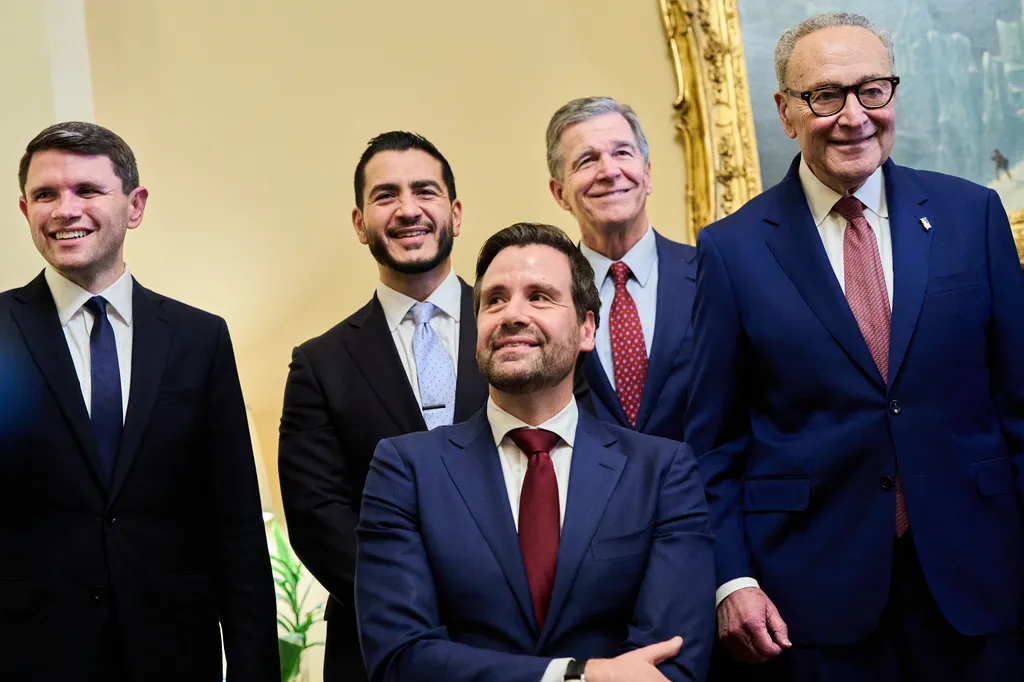
Democrats won control of the U.S. Senate, carving a path through Republican strongholds like Texas, Kansas, Iowa and South Carolina. These Democrats won in states long hostile to their party, with almost all of them offering a similar promise: independence from party leaders and cooperation across the aisle . Even still, several members of the new class are promising moderation, saying they oppose left-wing policies like Medicare for all.
Conventional political wisdom suggests that these promises of a new form of independence and moderation could make these senators some of the most powerful people in Washington. My research suggests that these senators should hit the brakes and reconsider.
The promise of centrism and the argument of their power in the Senate isn’t new; political scientists and politicos alike have long argued that centrists play a pivotal role in lawmaking and are often the proverbial kingmakers, as their vote is often the last needed to pass legislation or confirm a nominee. Others argue that polarization should strengthen the remaining moderates — as the center shrinks, their votes become essential, forcing party leaders to negotiate and giving moderates greater control over legislation.
My 2021 book, “ Life in the Middle: Marginalized Moderate Senators in the Era of Polarization ,” challenges this assumption; indeed, my findings largely contradict this expectation, suggesting that these newly elected senators have a difficult legislative path forward.
Through legislative behavior, voting records, and interviews with former senators and congressional staff, I found that moderate senators often failed to use this supposed leverage. Even still, one could argue that their influence lies behind closed doors — that because their vote is so pivotal to the passage of bills, they wield outsized influence — but my interviews with staffers and senators further suggested that no such influence exists.
Indeed, in my book, I found that on high-profile legislation that was central to their party’s agenda, moderate senators, on average, fell in line and voted with their party (think President Obama and the Affordable Care Act, for example), even if that vote was against their stated preferences. They broke from their party and demonstrated their independence when their vote was less pivotal and posed little to no risk to their party’s goals. Perhaps more revealing, moderates were also much less likely to propose amendments to help shape legislation or speak to defend or attack legislation on the Senate floor — activities that would suggest political power, or at the very least, political independence from the party brass.
All that is to say that moderates were most willing to exercise their independence when the political costs were low and relatively inconsequential. Why would senators with so much apparent leverage hesitate to use it?
The answer centers on what political scientists call traceability: the idea that voters can connect elected officials and their votes to policy decisions and their consequences. In other words, voters can see who helped produce a policy and hold that person responsible. Being visibly active in the shaping of legislation by publicly negotiating compromises makes that connection easier to draw.
For senators serving politically divided electorates, such visibility can carry serious risks.
Consider a Democrat elected in a reliably Republican state. Victory requires support beyond the Democratic base — from voters opposed to the other party and their goals (i.e. conservatives opposed to President Trump), voters drawn to the candidate personally, or those who are committed to particular policies.
Those supporters may disagree sharply about what their senator should do in office: if that senator casts the deciding vote on a controversial bill, support could alienate Republican-leaning constituents, while opposition could anger the Democratic base. Worse, compromise could disappoint both. As a result, for moderates, the question is not just which policy to support, but whether taking personal responsibility for it is worth the electoral cost. The safest course may be to keep one’s fingerprints off the legislation.
The 2026 elections set the stage for a new crop of moderates to navigate these precarious conditions. For example, in Kansas, Democrat Adam Hamilton — a mega-church pastor and former Republican — defeated Republican Sen. Roger Marshall to become the state’s first Democratic senator-elect in more than nine decades. During the campaign , he described himself as a “moderate or independent-minded Democrat” and pledged to work across party lines.
In Texas, James Talarico defeated Republican Ken Paxton, stressing his willingness to challenge his own party. At an October CNN town hall , he said he was running to represent Texans, not the Democratic Party, citing his bipartisan legislative record.
North Carolina’s immensely popular former governor and now Democratic Sen.-elect Roy Cooper emphasized his work with a Republican-controlled legislature, including on Medicaid expansion. During his Senate campaign, Iowa Democrat Josh Turek highlighted bipartisan accomplishments and his willingness to criticize Democrats when he thought they were wrong.
Winning in a Republican-leaning state does not necessarily make a senator moderate. According to one measure political scientists use to measure ideology , Democrat Sherrod Brown ignored the moderate playbook and had one of the most liberal voting records amongst all senators while he served in the Senate from 2007-2025.
Still, these senators share a challenge: retaining voters who agree on the need for change but disagree on what it should look like. The Democratic majority now faces pressure to advance an agenda and show it can govern, yet the senators who secured that majority in Republican states will have strong incentives to distance themselves from the party’s governing choices. Complicating things further, leaders will have to find 60 votes to overcome the legislative filibuster and navigate a hostile president’s veto threats.
For the Democrats who were successfully elected in Republican states, they will soon have to reconcile commitments to their coalition with party demands and Senate constraints. They will also learn that political power lies not with being the decisive vote, but with the willingness to own the consequences of being that decisive vote.
Neil S. Chaturvedi is director of the Weglyn Endowed Chair for Multicultural Studies and editor-in-chief of Political Research Quarterly.
Topics in this story
Gathered from external sources. Rights to this text belong to whoever originally published it.