Trump’s handpicked Kennedy Center board votes to immediately close venue for renovations
The board voted shortly after a federal judge rejected its latest effort to add the president’s name to the building’s facade.
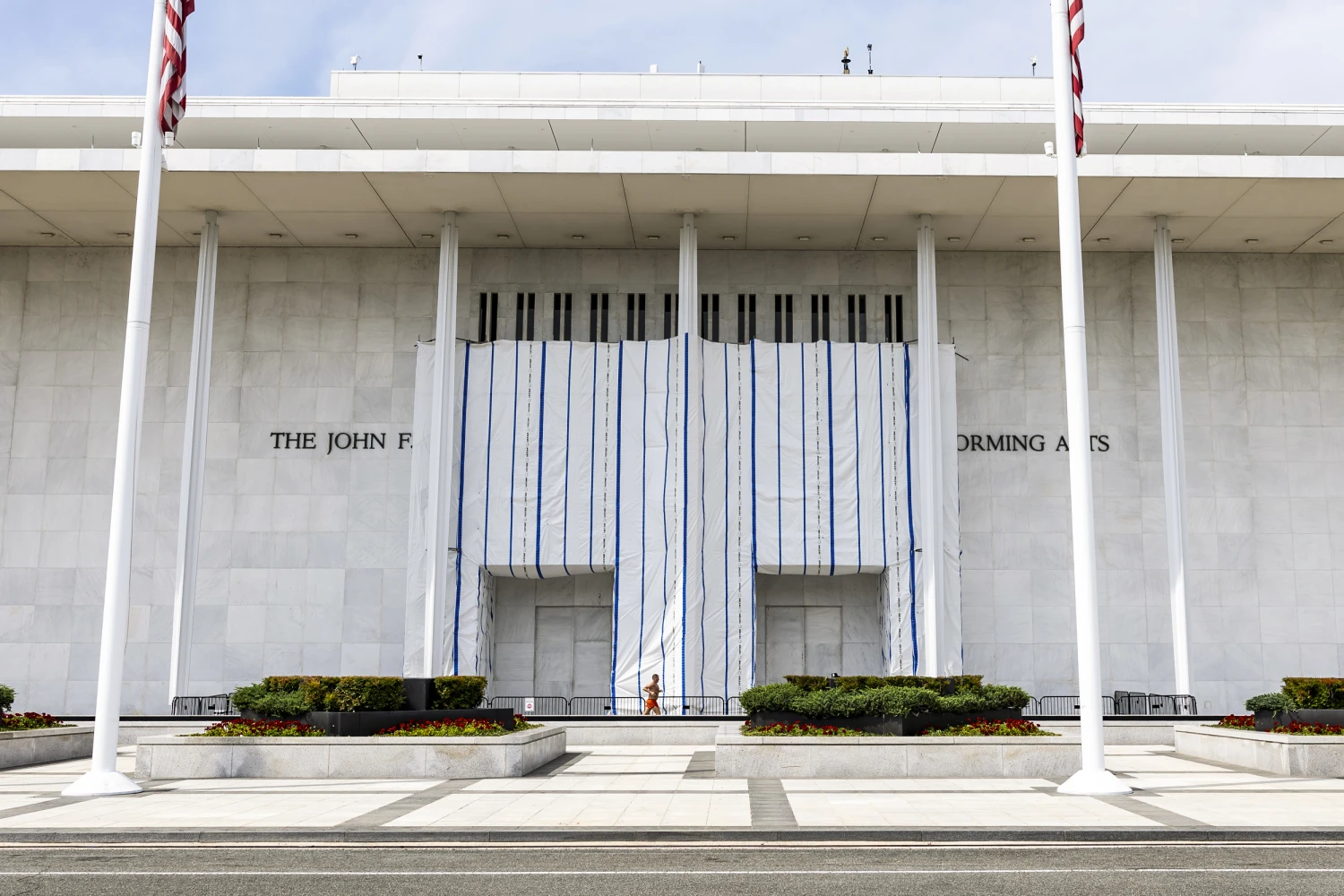
President Donald Trump’s handpicked Kennedy Center board voted Tuesday to immediately shutter the performing arts center, citing its “dire” financial and structural shape. The vote came shortly after a federal judge in Washington rejected the board’s latest effort to add Trump’s name to the building’s facade. A spokesperson for the center said it would appeal. Trump said on social media after the vote that renovations wouldn’t happen unless his name was added to the building. “The closing will take place immediately, however, the Renovation and Reconstruction, which is a very large and complex job, cannot begin until such time as the D.C. Circuit rules on the Board’s approved name,” Trump wrote on Truth Social. “If the ruling is a negative one, which it should not be, and is not overturned by the U.S. Supreme Court, the Reconstruction and the Renovation of The Kennedy Center will not take place.” “In the meantime, 17 Million Dollars, raised by President Trump, has been put into The Kennedy Center account to keep it afloat,” he added. Congress appropriated $250 million for the project last year. The board had cited a partial ceiling collapse in the center’s Grand Foyer this month as evidence that the center needed to be immediately closed for repairs. A construction consultant and the center’s director “consider the main building to be unsafe for continued occupancy, and anticipate further risk to the public and employees if the building is not immediately closed and renovations begun,” the board said in a draft resolution to close the center for two years. It was the third time since February that the board has voted to close the center for renovations for two years. Rep. Joyce Beatty, D-Ohio, an ex officio board member, has challenged those efforts in court, saying the board hadn’t done its due diligence before it decided it needed to close the venue. The center was initially scheduled to close July 5. Attorneys for the board have said the legal action has kept them from doing necessary repairs, but the judge presiding over the case noted at a hearing Tuesday — as he had previously — that his earlier order preventing full closure allowed for emergency repairs. Trump, who was elected chairman last year by the board he appointed, joined the closed-door meeting virtually and spent several minutes criticizing both Beatty and the judge who blocked his name from being added to the facade, according to a source who dialed into the Zoom meeting and who opposes the closure. That person described Trump as getting into a shouting match with Beatty, whom he blasted as an “obstructionist” who didn’t know how to get things done. Beatty countered that Trump was unprofessional, and at one point each accused the other of incompetence, the source said. During the tirade, Trump also suggested without evidence that the judge, Christopher Cooper, is compromised because his wife, an attorney, represented former President Joe Biden, the source said. Trump also suggested there was something untoward about the judge’s wife’s not using her husband’s last name, the source said. Attorneys for the center are expected to ask the judge to lift his block on closing the center this week. A source familiar with Beatty’s legal strategy said her attorneys will oppose the move and argue that the repairs can be done without shutting down the center. In a separate resolution that was originally scheduled to be taken up Tuesday, as well, the Kennedy Center said that it “is in a dire financial position” and facing potential bankruptcy after it “exhausted its fiscal resources” — and that only Trump can rescue it. The board had said that to do so, he would have to be recognized for his efforts on the exterior of the building. “The Kennedy Center is in such a precarious fiscal position that it will not be able to support its payroll obligations, nor routine maintenance contracts within a matter of weeks,” said the draft resolution, which was made public in a court filing. “While actively considering alternative means of fiscal survival, President Trump has offered to step in and raise the necessary funds to keep the Center from bankruptcy during its much needed renovation.” “With certain fiscal collapse within weeks, the board seeks to determine what recognition and acknowledgement will comply” with the judge’s earlier order banning the center from being renamed the Donald J. Trump and John F. Kennedy Center for the Performing Arts. The board didn’t vote on the resolution at the meeting because members said they needed to focus on the closure issue. The trustees had voted last month to instead add the words “renovated and restored by President Donald J. Trump” to the building and to rename the center’s grounds President Donald J. Trump Plaza by Sept. 8. The new draft resolution offered numerous similar suggestions. In a ruling issued just ahead of the board vote, Cooper, the judge, found the effort to add Trump’s name to the facade in a different way was also illegal. “Simply put, Defendants cannot install memorials for President Trump or anyone or anything else at the Kennedy Center without Congress’s blessing. The board resolution bucks a federal court order and a statute Congress enacted,” Cooper said. He also noted the board’s threat about fundraising — and its claim that the center might need to be razed if Trump’s repair plan isn’t followed — with skepticism. The “government offered ‘no proof that current or future donations hinge on President Trump’s name being on the building’ and ‘no competent evidence that removing the Trump name would prevent the Center from fulfilling its artistic mission, as it has done for the last sixty years,’” he wrote. Instead, Cooper suggested, the opposite could be true. “The renaming of the Center coincided with declines in revenue and contributions, as artists cancelled performances, the Washington National Opera ended its 50-year residency, and ticket sales and viewership of the Kennedy Center Honors broadcast dropped precipitously. The Board also has access to the $257 million that Congress appropriated for necessary capital improvements,” he wrote, but that’s “beside the point for present purposes.” And while cultural institutions often honor big donors by naming buildings or features after them, Cooper said, “Congress had other ideas for the Kennedy Center.” “It limited such memorials and donor recognitions to discrete (and discreet) areas, so as not to detract from the Center’s function as an ongoing memorial to President Kennedy. The current Board’s apparent disagreement with that approach does not change the law,” he wrote. Cooper said he could “not license a violation of those authorities under threat that some unidentified donors will withhold their largesse if the Board is not allowed to have its way. It can even less reward a decision by Board members, including the Chair, to curb the Center’s fundraising efforts because they cannot abide statutory restrictions on displaying his name.” Beatty praised Cooper’s ruling in a statement, saying: “The law is extremely clear: The John F. Kennedy Center is named for President Kennedy — and no one else. But President Trump is holding the Kennedy Center hostage unless he can put his name on this sacred memorial.” “This unlawfulness is as breathtaking as it is wrong, and it needs to stop,” she said. Her attorneys, Norm Eisen of Democracy Defenders Action and Nathaniel Zelinsky of Washington Litigation Group, said in a joint statement, “Legal sanity has once again prevailed over Trump’s vanity.” Roma Daravi, vice president for public relations at the Kennedy Center, said in a statement, “We intend to appeal today’s Court ruling and move forward with recognizing Chairman President Trump’s historic contributions to the revitalization of America’s Cultural Center.”
Topics in this story
Gathered from external sources. Rights to this text belong to whoever originally published it.