Rising prices, plunging ratings, lingering war: Trump's dinner plate is full
Since Labor Day, Trump traveled to Ireland and the United Nations, and hosted China's president, while voters say the cost of living is a top concern.
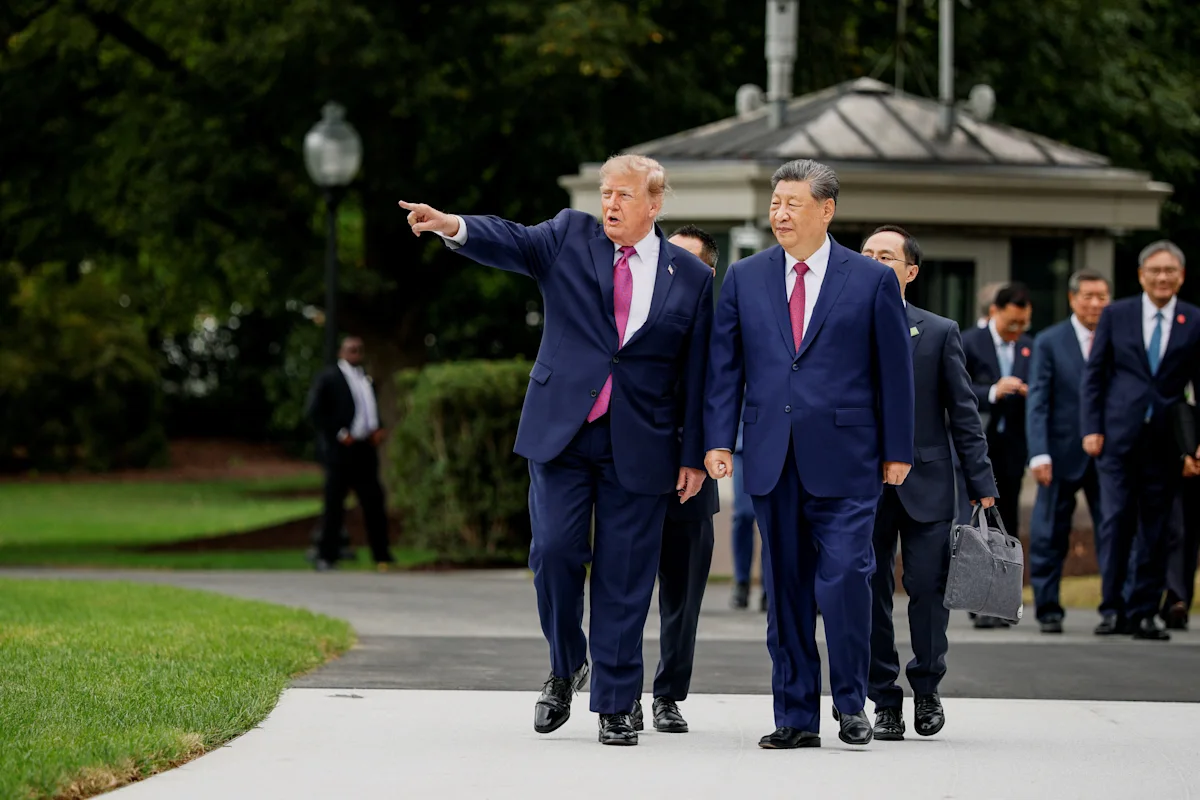
WASHINGTON – President Donald Trump's three-day visit with Chinese President Xi Jinping was filled with pomp and circumstance: a red-carpet arrival, a tour of the National Archives and a state dinner of yellow squash velouté and sesame crusted sea bass.
But the hearty welcome left a bad taste in the mouth of the Republican chairman of the Senate Armed Services Committee.
"Quite frankly, had the White House asked me for advice, I would have suggested the president not invite Xi Jinping to Washington for such a lavish welcome here in the United States of America based on all of the troubling issues we have with President Xi and the Chinese Communist Party," Mississippi Sen. Roger Wicker said on the Senate floor Sept. 22.
Chinese President Xi arrives in US for state visit hosted by Trump
Wicker, one of a growing number of Republicans who have publicly disagreed with the president, may also strike a chord with voters who have told pollsters that the cost of living will be their top priority in the upcoming elections. Lopsided majorities have disapproved of Trump's handling of foreign affairs and the economy.
Trump has pledged to campaign heavily during the month before the Nov. 3 midterm elections in about three-dozen competitive races, including traditional Republican territory in Alaska and Texas. "In some cases, you can be losing by a lot and we'll bring you over the line," Trump told Republicans at a Rose Garden dinner Sept. 2.
But since Labor Day, the traditional start of the campaign season, Trump has focused on foreign affairs. He traveled to Ireland on Sept. 12 and 13 for a meeting with the prime minister and a golf tournament. And he spoke at the United Nations on Sept. 22 , threatening to "annihilate" Iran and predicting the failure of Cuba's government.
Meanwhile, high gas prices and record-high diesel costs spurred some Republican candidates to distance themselves from Trump by calling for an end to the war on Iran or removing references to Trump's endorsement from campaign websites .
John Pitney Jr., a politics professor at Claremont McKenna College in California, said involvement in foreign affairs isn't a problem by itself for Trump because people expect presidents to manage foreign policy. But Trump's problem is what he says about foreign affairs, Pitney said.
"In May, he said he was focused on Iran and didn't care 'even a little bit' about the war's economic impact," Pitney told USA TODAY. "That hurts. The war itself hurts. People get a reminder of the cost every time they drive past a gas station."
Trump's hosting of China's Xi Jinping draws criticism from key Senate Republican
Trump said he had "a very good meeting" with Xi on Sept. 24 without elaborating. Key topics of conversation were about technology, security and artificial intelligence .
"As the leaders of our two nations, President Xi and I both understand that we represent different systems, but the ties between our people endure, and we've never gotten along better," Trump said.
"A lot of very positive things happened," Trump said Sept. 25 while hosting Xi for tea in the White House's Red Room, adding that farmers would be happy without elaborating. "Great things for both countries. It's been just very, very productive."
But Wicker said he hoped Trump would put the pressure on Xi over multiple issues "while the servers are switching from chardonnay to cabernet at the fancy state dinner." Wicker said Trump should press Xi on whether China provided Iran with satellite imagery that led to the deaths of American troops, harassment of Filipino fishermen and the status of Taiwan.
Asked about Wicker's comments, Secretary of State Marco Rubio told reporters it is vital for the leaders of the world's two largest economies and militaries to meet.
"The idea that we would not interact with them at the highest levels is irresponsible," Rubio said at the United Nations General Assembly on Sept. 23 . "It's outrageous."
Trump has argued that any hardship to the economy is worth the price of preventing Iran from obtaining a nuclear weapon. He predicted oil prices would fall sharply as soon as the war ends. Trump told reporters Sept. 25 while touring the National Archives with Xi that they had discussed the war with Iran.
"I think we're going to do great," Trump said.
Voters disapprove of Trump's handling of economy, foreign affairs: polls
Trump's approval rating fell to 32% – the lowest of his political career – as his fellow Republicans soured on his handling of the cost of living amid the unpopular Iran war, according to a Reuters/Ipsos poll of 1,277 adults nationwide released Sept. 21.
Just 17% of respondents approved of Trump's handling of the cost of living, which the poll found was the top issue Americans say will determine how they vote in November. Some 82% of poll respondents – including nine in ten Democrats and three-quarters of Republicans – said the conflict would likely go on for an "extended period of time."
The cost of groceries, gas and healthcare rank as top pain points for rural voters, according to an Associated Press poll, in partnership with KFF .
Nearly seven in 10 rural voters supported Trump in the 2024 election. But about two-thirds of rural voters were "very" or "somewhat" worried about being able to afford gas or healthcare, compared to about one-third who were not, according to the survey of more than 2,000 registered voters surveyed over two weeks in late August.
About 60% of voters were concerned about the cost of groceries or monthly utilities, compared to 40% who weren't, the poll found.
About two-thirds of registered voters disapproved of Trump's handling of the economy and the war with Iran, according to a Quinnipiac University poll that surveyed 970 registered voters Sept. 3 to 6.
About 60% of respondents disapproved of Trump's handling of Russia's war with Ukraine, trade with Canada and foreign policy.
"While neither (party) gets high marks generally, the Democrats are judged more empathetic when it comes to the concerns of voters," Tim Malloy, a Quinnipiac University polling analyst.
Trump touts investment in US and lower crime rate
Trump gave significant attention to domestic issues during his speech Sept. 22 to the United Nations General Assembly . He promoted investment in the United States, a lower crime rate and heightened border security. He has argued that eliminating taxes on overtime, tips and Social Security benefits, and negotiating lower prices for prescription drugs, should make for a winning ticket in November.
"America is rising. Our nation is growing. Our power is expanding," Trump said. "Our country is doing better than ever before, and our future is very, very bright."
But foreign affairs dominated the speech and headlines focused on his threat to "annihilate" Iran, his prediction that Cuba's government "will fall" and that the "spoils" of Venezuelan oil from removing that country's president "belong to the victor."
"While others have ignored threats, I have confronted them," Trump said. "While others have promised strength, I have used it to make America the most powerful country in the world."
Some GOP candidates distance themselves from Trump over Iran
Some fellow Republicans have lost patience with the war that began Feb. 28. Four Senate Republicans −Alaska's Lisa Murkowski, North Carolina's Thom Tillis, Kentucky's Rand Paul and Maine's Susan Collins −supported a resolution Sept. 24 to end the war, although the measure failed .
Trump initially said the war would last weeks. After six months, he predicted it would end soon after the Nov. 3 midterm elections for Congress.
Fuel prices are up significantly because of Iran's threat to commercial shipping in the Strait of Hormuz. Higher costs for diesel fuel ripple through the economy because of the higher cost of transportation.
Gas prices averaged $4.49 on Sept. 25 , compared to $2.87 in late January , according to AAA. Diesel fuel averaged $6.50 per gallon on Sept. 25, after breaking $6 on Sept. 11 for the first time ever.
Trump has said higher fuel costs are "a small price to pay" for preventing Iran from obtaining a nuclear weapon.
But former Rep. Mike Rogers, R-Michigan, who is campaigning to succeed Democratic Sen. Gary Peters, said on social media Sept. 21 and in a television ad that the Iran war needs to end.
"The war with Iran needs to end and end quickly," Rogers said in the ad, which features his first name in red and last name in blue.
Rep. Ashley Hinson, R-Iowa, who is campaigning to succeed GOP Sen. Joni Ernst, said on social media Sept. 21 that Iowans shouldn't have to foot the bill for the Iran war with higher grocery prices. But she also voted four times against resolutions to end the war immediately .
"Iowans are being squeezed and shouldn't have to foot the bill at the pump or the checkout line for the war in Iran," Hinson said.
Both candidates supported suspending the gas tax and diesel exports.
Fed raises interest rates days after Trump trip to Ireland
Another setback to Trump's domestic priorities came days after he returned from a trip to Ireland, when the Federal Reserve Bank raised interest rates Sept. 16 for the first time since July 2023.
Trump traveled to Ireland on Sept. 12 and 13 to meet Taoiseach Micheal Martin and attend the Irish Open golf tournament at his resort in Doonbeg. He advocated Irish reunification and ended tariffs on Irish whiskey, which he'd imposed.
Trump had earlier appointed a new chair, Kevin Warsh, to the Federal Reserve Bank's board and demanded lower interest rates. But the board voted Sept. 16 to raise rates for the first time since 2023.
Rep. Jason Smith, R-Missouri, who heads the Ways and Means Committee, which oversees taxes, echoed Trump in arguing that "interest rates should be coming down, not going up."
"American workers, families, and small businesses have waited long enough for relief from high borrowing costs that make it harder to buy a home, start a business, or get ahead," Smith said in a statement Sept. 16.
But the Fed typically raises rates to tame inflation by making borrowing more expensive, which can lead to less demand and eventually lower prices. The Labor Department's Consumer Price Index, a key measure of underlying inflation , posted its largest increase in four months on Sept. 11. Mortgage rates surpassed 7% for the first time in a year, making it harder to buy houses.
Trump told reporters in Ireland on Sept. 13 that the country "should be paying the lowest interest rate in the world," no matter what the Federal Reserve's data indicates about inflation and the economy.
"I know more about formulas than anybody, and with the best credit in the world, we make other countries rich," Trump said.
Topics in this story
Gathered from external sources. Rights to this text belong to whoever originally published it.