National security becomes Trump’s buzzword for legal fights
When President Trump announced he was kicking three news organizations out of the White House, he made clear it was because of his displeasure with their reporting. But days into the ban, he turned to a familiar argument to justify his decision. It was about national security. “Fake News people and publications that only write negatively,…
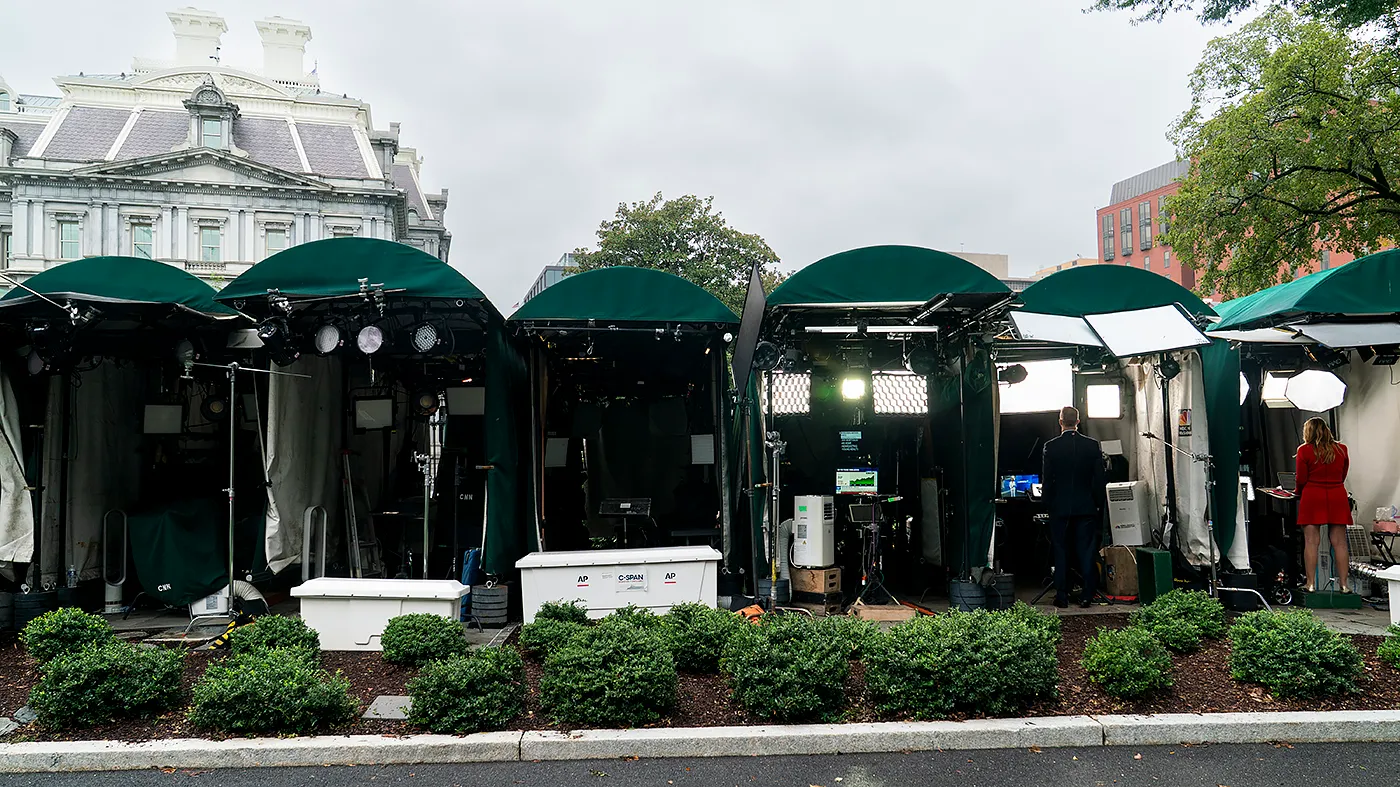
When President Trump announced he was kicking three news organizations out of the White House, he made clear it was because of his displeasure with their reporting.
But days into the ban, he turned to a familiar argument to justify his decision. It was about national security.
“Fake News people and publications that only write negatively, and who violate our National Security by writing false and defamatory stories with unknown ‘sources,’ shouldn’t be allowed access to the most important Office anywhere in the World,” Trump wrote in part in a Truth Social post Monday.
The shift mirrors a broader strategy that the Trump administration has embraced in recent months, invoking national security as a blanket rationale when faced with legal tests of its more controversial proposals.
But it’s an argument that some experts warn may be wearing thin with the courts.
To be sure, there have been successes for the administration in using the argument.
Matthew Waxman, a law professor at Columbia University and former national security official in the George W. Bush administration, noted that the Supreme Court tends to “avoid second-guessing” the executive branch on matters of national security.
It often grants the president wide deference on the issue, especially when it comes to protecting sensitive or classified information.
The Supreme Court leaned heavily on that idea when it upheld a travel ban that prevented nationals from several Muslim-majority countries from entering the country during Trump’s first term. The majority found that the government had provided sufficient national security justification that was rooted in improving the vetting process.
“Because there is persuasive evidence that the entry suspension has a legitimate grounding in national security concerns, quite apart from any religious hostility, we must accept that independent justification,” Chief Justice John Roberts wrote in the 2018 opinion.
But Waxman warned that when Trump stretches the argument, he could run into trouble.
Aside from attempting to block CNN, MS NOW and Politico from entering the White House on national security grounds, Trump has also recently discussed adding drones and snipers to a triumphal arch he is building, to some controversy, as an entrance to Washington, D.C.
“When the administration makes outlandish claims on the whole range of public policy matters, it’s natural that courts would scrutinize its national security claims more carefully,” Waxman said.
“The Trump administration’s absurd or demonstrably false claims are undermining arguments that the courts lack expertise to judge them and boosting arguments that national security deference is prone to abuse,” he added.
The second Trump administration has increasingly framed its major initiatives through that lens, citing it as a defense for imposing sweeping global tariffs, deploying National Guardsmen domestically and building a ballroom on the White House grounds.
“The President is the Commander-in-Chief of the Armed Forces, and it is a national security imperative to ensure the safety of the President, his family, and his Cabinet,” White House spokesperson Anna Kelly said in a statement. “As the multiple assassination attempts against the President’s life have demonstrated, there is a need for a secure event space to protect the President against potential threats.”
It has also labeled major tech start-up Anthropic as a national security risk.
Anthropic sued the administration in March over the Pentagon’s decision to designate the artificial intelligence company and its products as a “supply chain risk” after negotiations on safety guardrails collapsed.
The government argued that the firm posed a national security risk by not permitting its Claude model to be used for mass domestic surveillance or fully autonomous weapons. The Defense Department suggested this could hamper the agency’s defense work, while Anthropic alleged it was retaliation for the company’s viewpoint.
A divided panel for the U.S. Court of Appeals for the D.C. Circuit sided with the administration Friday, finding that there was “ample support” for the Pentagon’s decision.
“The Secretary reasonably concluded that removing Anthropic from the Department’s supply chain was necessary to protect national security by reducing supply chain risk to the Department’s information systems,” Judge Gregory Katsas, a Trump appointee, wrote for the majority.
The pattern has not gone unnoticed, with critics arguing that it’s being used as a catchall defense for measures that stretch far beyond traditional security concerns.
Ted Boutrous — an attorney representing CNN, Politico and MS NOW in their fight over access to the White House — called national security the administration’s “magic word” during a hearing on the ban last week.
The White House press office accused the trio of “trafficking in verifiable falsehoods about national security and other issues” in letters to each outlet, citing a handful of stories that it said threatened the president’s ability to safeguard the country.
“Reporters are acting against the interest of American national security by soliciting classified information in order to broadcast sensitive details to our adversaries,” Anna Kelly said.
But, as Boutrous pointed out, that justification came several days after the restrictions had already been imposed. And the federal judge in D.C. overseeing the dispute ultimately noted that he was skeptical of whether national security was the “actual motivation” for kicking the reporters out.
“For one thing, nothing in the record that predates this suit suggests that the revocation of Plaintiffs’ hard passes was motivated by national security concerns,” wrote Judge Timothy Kelly, whom Trump also nominated to the bench.
“Certainly, that is not what President Trump said when he announced that he was ‘banning’ Plaintiffs from the White House—instead, he focused on the alleged lack of truthfulness and negativity of Plaintiffs’ reporting,” Kelly continued.
Some lower federal courts have consistently acted as a check on the Trump administration’s rationale, intervening in situations like the media ban where national security appeared only tangentially related to the broader issue at hand.
But Waxman says it shouldn’t be left only to them.
“One frequent criticism is that courts should play a role as a constitutional backstop to prevent abuse or overreach,” he said. “That’s true to some degree, but Congress and political checks are supposed to do a lot of that work.”
Topics in this story
Gathered from external sources. Rights to this text belong to whoever originally published it.