Judge blocks Trump's White House ban on CNN, MS NOW and Politico
The banned news organizations had filed a federal lawsuit accusing the president of violating the First Amendment.
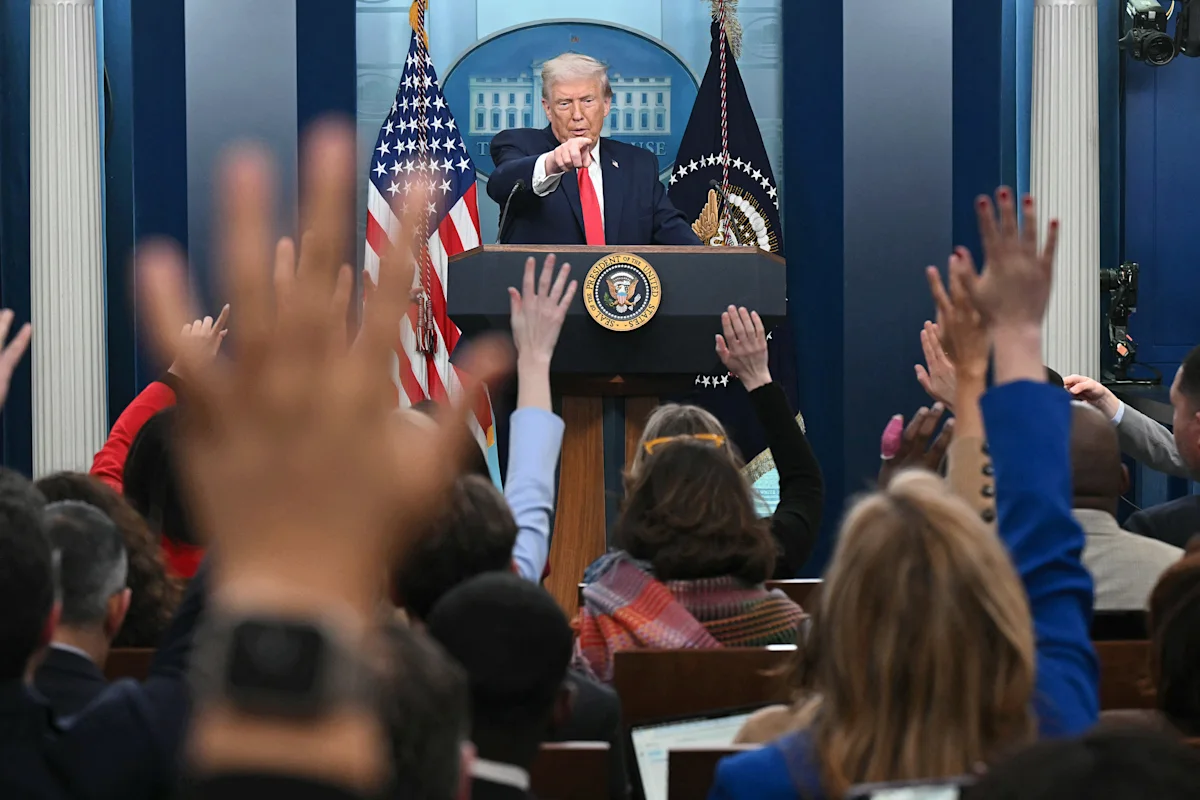
A judge has temporarily blocked President Donald Trump's White House ban on three news organizations, calling it likely unconstitutional and ordering their access be restored.
Trump announced a ban on reporters from CNN, MS NOW and Politico on Sept. 18, saying the outlets "constantly write or report fiction or lies" about his administration.
In response, the outlets filed a lawsuit against Trump and three of his top advisers in federal court on Monday, citing their First Amendment rights and demanding that access for their reporters be immediately restored.
In the complaint , the news outlets allege that Trump and the White House were retaliating against them for coverage they dislike.
The Justice Department's response to the suit argued that the ban did not violate the First Amendment. "Access to the White House is a privilege — not a right," the filing said. The DOJ contends that Trump "has 'compelling interest' in enforcing minimum standards for bona fide journalists and safeguarding national security information."
However, U.S. District Judge Timothy Kelly, a Trump appointee, blocked the ban for 14 days early on Thursday, describing it as likely unconstitutional and rejecting Trump's contention that it had been put in place on national security grounds.
The president indicated in a Truth Social post on Monday that he would appeal any ruling against him.
Trump's initial ban had prompted four major TV networks — ABC, CBS, NBC and Fox News — to refuse to participate in the White House pool, which is the rotating group of reporters, photographers and videographers that document the president's public events.
As a result, Trump was largely inaudible during a ribbon-cutting ceremony for the White House's new helipad on Monday, where he gave a brief speech without the microphone typically provided by the pool.
On Monday night, the White House launched a Trump TV YouTube stream. Branded " TRUMP TV: The Essentials Station ," the White House said in its description that it would run videos and highlights of "the Trump Administration's biggest moments all in one place." The first video showed Trump's remarks on July 3 at Mount Rushmore.
On Friday afternoon, Trump announced the ban in a Truth Social post , saying it was not prompted by any particular stories but was "a result of their constant 'reporting' FAKE NEWS!"
"It's really just cumulative stories over the last few years. You get sick of it," Trump said at an Oval Office event an hour later while explaining his decision to enact "the ban on the free press."
"There's something wrong with a country that can allow people to write purposely negative stories," the president said. "If they want to write them, that's fine, but I don't have to let them into my, into the people's house."
According to CNN , Trump's close aide Natalie Harp showed him clips of media coverage shortly before he announced the ban.
On Saturday, reporters from CNN, MS NOW and Politico were turned away from the White House by members of the Secret Service and had their credentials — so-called hard passes needed for access — confiscated.
The journalists — CNN's Betsy Klein, MS NOW's Akayla Gardner and Politico's Cheyenne Haslett — were listed as plaintiffs in the court filing.
The White House Correspondents' Association condemned the move, saying it violates the First Amendment.
"The American people, through a free and independent press, must be able to scrutinize those elected to power, regardless of whether government officials view it favorably," Jacqui Heinrich, Fox News senior White House correspondent and WHCA president, said in a statement . "That's why courts have repeatedly held that once the White House provides access to journalists, it cannot deny that access arbitrarily or based on the content of their reporting."
On Sunday, Trump posted what appeared to be an AI-generated image of trash bags bearing the logos of CNN, MSNBC (MS NOW's former name) and Politico outside the White House.
On Monday, the three news outlets — which are longstanding members of the White House press pool — sued Trump and other members of his administration.
"This morning, we notified the government that we are filing a lawsuit today to protect our First Amendment rights and defend the principle that the government does not decide what the press reports or publishes," CNN, MS NOW and Politico said in a joint statement.
According to the complaint filed in U.S. District Court in Washington, D.C., the news outlets allege that Trump and the White House are retaliating against them for coverage they dislike.
"President Trump has said in no uncertain terms that he would prefer only to be covered by news organizations and reporters who praise his administration," the complaint states.
The Washington Post , the New York Times and HuffPost each announced that they would not publish images of Trump's trip to New York on Monday in solidarity with the banned journalists.
Speaking with reporters after arriving at the United Nations on Tuesday, Trump appeared to take issue with the presence of CNN's Kaitlan Collins , saying he was "surprised" to see the journalist.
"You should not be here covering me," Trump said. "You said you weren't going to be covering me."
In a post on X , Collins said she was credentialed by the United Nations to cover the General Assembly.
Secretary of State Marco Rubio also defended the ban in an appearance on NBC's Today show. "We're not closing CNN," Rubio said . "There aren't a bunch of police officers or soldiers kicking down the doors of MSNBC or MS NOW, whatever it's called, and arresting people and unplugging it from the grid. They're just not allowed to work from the workspace at the White House."
On Wednesday, dozens of media organizations signed an amicus brief in support of CNN, MS NOW and Politico.
"The President has indicated that evictions of other news organizations will follow," it states. "The current ban — and any future bans — are intended to impair the critical work of news organizations covering the presidency if this Court does not immediately intervene."
U.S. presidents throughout history have complained about negative coverage of their administrations. In 2009, the Obama administration sought to exclude Fox News from a series of interviews with a Treasury Department official in the wake of the 2008 financial crisis, but backed down when the other major television networks objected.
During his first term in office, Trump continued the Oval Office's adversarial relationship with the media, referring to the press as "fake news" and the "enemy of the people." It has only escalated in his second.
In 2018, Trump administration officials revoked the press pass of then-CNN White House correspondent Jim Acosta after they said that he had interrupted the president during a news conference. The network sued, and a federal judge — also Timothy Kelly — ordered Acosta's credentials restored .
A similar situation played out the following year when the White House revoked Playboy correspondent Brian Karem's press pass over a verbal argument between Karem and Sebastian Gorka, a former White House aide, at a Rose Garden event. A federal judge ordered the White House to restore Karem's pass .
Last year, Trump barred Associated Press journalists from the Oval Office, Air Force One and some official events after the news service declined to refer to the Gulf of Mexico by Trump's preferred name, the Gulf of America. The AP filed suit and the case is ongoing.
In December, the Pentagon announced new restraints on journalists, who were asked to sign a pledge affirming that they would not gather unauthorized information for publication. News organizations refused to sign the pledge, and temporarily lost their credentials. The New York Times filed suit, and in March, a federal judge ruled that the Pentagon restrictions were unconstitutional. The Pentagon restored press credentials to the journalists who refused to sign the pledge, while imposing a new rule that they can only enter the Pentagon with an escort . The Times again filed suit and the case is ongoing.
In his first event without a network TV pool on Monday, Trump unveiled the White House's new helipad before departing for New York. His remarks were nearly inaudible on the White House video feed . Joe Reberkenny, a White House correspondent for the Washington Blade who was serving as the in-town pool reporter, said he couldn't hear Trump "over the sound of the helicopter."
Topics in this story
Gathered from external sources. Rights to this text belong to whoever originally published it.