Oil prices back up as U.S. and Iran trade threats to expand 7-month war
As Iran responds to Trump's threat of annihilation with its own warning of a possible "new front" in the war, global oil prices are rising again.
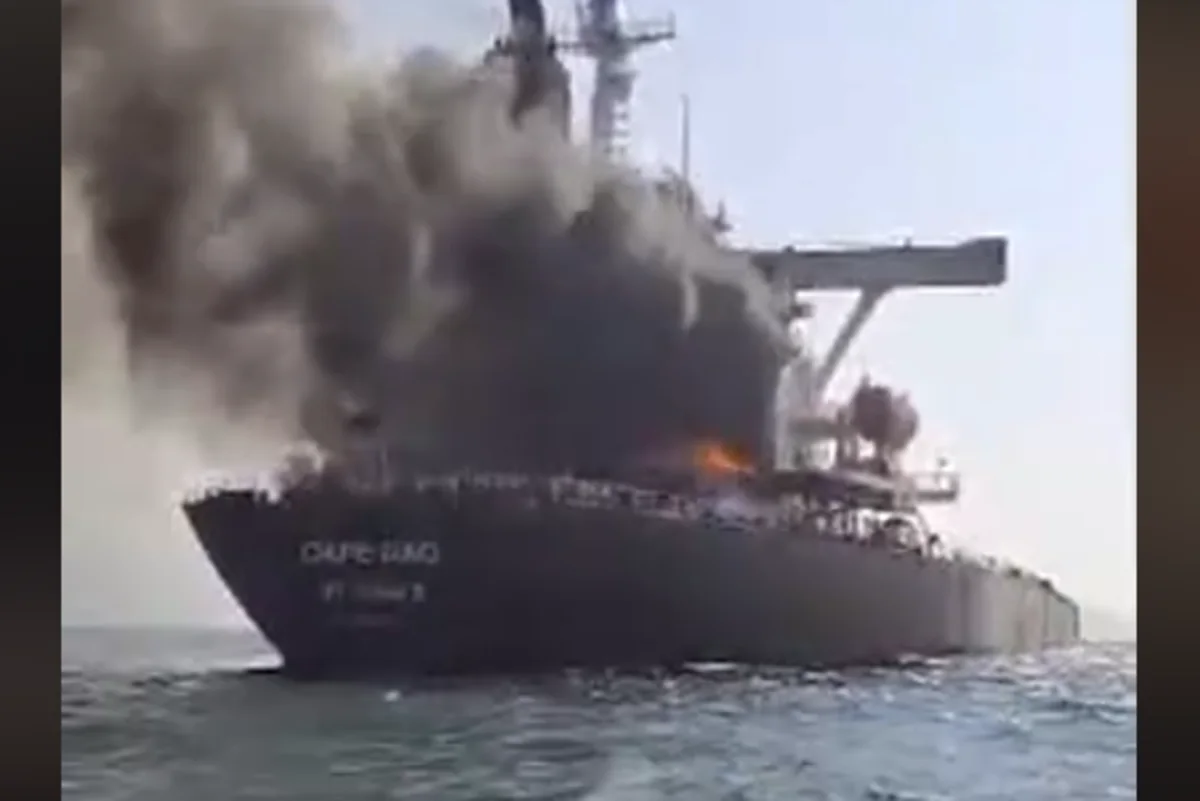
Brent crude, the international benchmark for oil prices, was trading over $105 a barrel again Thursday as the United Nations General Assembly brought little evidence of progress toward a peace deal. A senior adviser to Iran's supreme leader warned Thursday, after President Trump threatened the Islamic Republic with annihilation , that Iranian forces and their Houthi allies in Yemen could respond to any new U.S. attacks by opening "a new front" in the seven-month war , targeting energy supplies in the Red Sea. A commercial vessel was struck Wednesday in the latest attack in the Strait of Hormuz, killing one crew member and necessitating the evacuation of more than 20 more mariners, according to Oman's navy.
Iran's president says Trump's U.N. remarks forced him to change his own speech
Iranian President Masoud Pezeshkian said President Trump's remarks to the United Nations General Assembly on Wednesday, about deciding whether to "annihilate" Iran, prompted him to alter his own address to the summit.
"With regard to the statements made by the U.S. president, the text of the speech that had been prepared before the trip for presentation at the UN General Assembly was set aside," Pezeshkian told journalists in New York.
He said it prompted him to change the approach to discussing "ourselves, America's behavior and the actions that Israel is carrying out."
Criticizing Mr. Trump's remarks, in which the U.S. president said he had a "big decision" to make about whether to drive Iran "into hell," Pezeshkian said: "They cannot destroy Iran; Iran is a country that has roots in history."
Referring to Iran's diplomatic activity during the visit, he said meetings had been held with officials from several countries, including the Iraqi prime minister and the Swiss president, with "good understandings and areas for cooperation" discussed.
Through a translator, Pezeshkian told the summit Wednesday that Iran was a victim of Israel and the U.S., and that the U.S. is using the Strait of Hormuz "to impose their aggression upon us."
Iran "will never bow our head or bend at the knee. Iran must be understood by Mr. Trump and those who seek to bully us that we are ready for dialog and diplomacy and negotiations without accepting the language of force," Pezeshkian added.
Iran's IRGC posts video appearing to show cargo ship ablaze after deadly strike in Strait of Hormuz
Iran's Islamic Revolutionary Guard Corps posted a video Thursday on its Telegram social media channel purportedly showing the aftermath of its attack the previous day on a cargo vessel in the Strait of Hormuz.
According to the description provided by the IRGC, the video "confirms that at least one projectile struck the violating vessel on Wednesday morning."
Oman's navy said Wednesday that it had come to the rescue of the vessel's crew, one of whom was killed in the attack on the Antigua and Barbuda-flagged bulk carrier Cape Dao. Oman said 27 crew members were evacuated from the stricken ship.
The strike on a cargo vessel was first reported earlier Wednesday by the U.K. navy's Maritime Trade Operations center.
In its social media post Thursday, the IRGC said the ship was targeted for "transiting the Strait of Hormuz along an unauthorized and unsafe route."
Iran has demanded for weeks that all ships wishing to transit the strait seek permission from its military, rejecting repeated U.S. assertions that a southern route through the vital shipping channel, close to Oman's coast, is safe and available.
Oil prices jump as U.N. summit brings no sign of peace deal, Iran and U.S. threaten to expand war
Global oil prices jumped Thursday, with international benchmark Brent crude surging 3% percent to hit $106.24 per barrel before easing slightly as uncertainty swirled around the seven-month U.S. war with Iran.
Hopes for a deal to get Gulf oil and gas flowing freely through the Strait of Hormuz as global leaders gathered for the United Nations General Assembly in New York had sent oil prices down for about two weeks, until Wednesday.
But as world leaders offered little to suggest any progress toward ending the turmoil that has choked tanker traffic in the Middle East, crude oil prices renewed their ascent.
Benchmark U.S. crude rose about 2% to trade just under $94 a barrel early Thursday, while Brent remained up over 2%, selling at over $105 before markets opened in the U.S.
The price for Brent crude has remained much higher than the roughly $72 it cost before the U.S. and Israel jointly launched their war with Iran. Talks between the U.S. and Iran, via mediators, have resumed this week, but nothing concrete has come from the discussions.
The price rises also come as Iran warns that any renewed U.S. attacks — which President Trump has threatened repeatedly to order this week — could draw retaliation with expanded targeting of energy infrastructure and shipping in the Red Sea and possibly even the Indian Ocean.
Adviser to Iran's supreme leader warns new U.S. attacks could see expansion of war in Red Sea, Indian Ocean
Major General Yahya Safavi, a senior military adviser to Supreme Leader Ayatollah Mojtaba Khamenei, warned Thursday that any resumption of hostilities by the United States could see Iran and its allies expand their attacks on global energy supplies in the Red Sea and Bab el-Mandeb Strait, and possibly even stretch to the Indian Ocean.
"If the Americans start a new war, a new front centred on the Red Sea and the Bab el-Mandeb Strait may open before their eyes," warned Safavi, a former commander of Iran's Islamic Revolutionary Guard Corps.
The Bab el-Mandeb, the southern gateway to the Red Sea, is the Middle East's second major shipping chokepoint, and it has become vital to Saudi energy exports as the ongoing U.S.-Iran war severely impedes traffic in the Persian Gulf via the Strait of Hormuz.
"Are they prepared to enter a battle on this front? This is a question they should pay more attention to," Safavi said, asserting that the Houthis had "full control" over the Bab el-Mandeb and access to the Red Sea.
"I think that the connection between the Persian Gulf and the Red Sea, the Strait of Hormuz and the Bab el-Mandeb Strait, will change the battlefield," he said, stressing the link between Iran and its Houthi allies as "a shared destiny — both in terms of common interests and common threats."
"The war front could become broader," he said, extending even "to the Indian Ocean or elsewhere."
Already the Houthis have attacked Saudi ships in the Red Sea and infrastructure and vowed to impose a blockade of the kingdom's Red Sea ports. The group claims it is retaliation for ongoing Saudi military strikes in support of Yemen's government, which has been engaged in a civil war against the Houthis for more than a decade.
8 suicide attempts by U.S. sailors assigned to USS Abraham Lincoln strike group during its record-long deployment, Navy letter says
There were eight suicide attempts by sailors assigned to the USS Abraham Lincoln carrier strike group since it began its record-long deployment about 10 months ago, according to a letter from Acting Navy Secretary Hung Cao that was obtained Wednesday by CBS News.
CNN was first to report on the letter. A Navy official confirmed it was sent Tuesday.
The deployment of the Lincoln and its approximately 5,000 crew members came under scrutiny after family members of the sailors and members of Congress raised questions last month about the conditions aboard the carrier and concerns about the mental health of its service members.
The Lincoln and its strike group were sent to the Middle East after the Iran war broke out. It has since left the region and is returning to its home base of San Diego.
A defense official told CBS News two of the suicide attempts occurred during active fighting with Iran. The letter covers the entire length of the Lincoln strike group's deployment, which began in November of last year.
The strike group includes the carrier air wing, strike group and destroyer squadron staff, escorting destroyers and all the embarked aviation squadrons.
The letter was in response to questions from Democratic Sen. Kirsten Gillibrand of New York about reported conditions on the ship. In a statement provided to CBS News, Gillibrand said that what President Trump and Defense Secretary Pete Hegseth "dismissed as 'fake news' turned out to be serious and deteriorating conditions for our service members."
That the Trump administration "can find endless taxpayer dollars for bombs, ballrooms, and billionaires, but cannot take care of our service members, is completely unacceptable," she added.
U.S. blockade has redirected 115 commercial vessels, military says
The U.S. military blockade on the Strait of Hormuz has now redirected 115 commercial vessels entering or exiting Iranian ports, according to U.S. Central Command .
The total is an increase of five ships since Monday, when the military last provided an update.
The blockade has become a renewed topic of conflict as Iran and the U.S. renewed negotiations this week at the U.N. General Assembly. Representatives from the United States, including Jared Kushner and Steve Witkoff, met with Iranian officials on Tuesday and apparently found some common ground, with President Trump saying the meetings went well.
However, on Wednesday, Iranian Foreign Ministry spokesperson Esmaeil Baqaei reiterated that no deal will be signed until the U.S. removes the blockade on the Strait of Hormuz.
White House responds to Iranian president's speech at U.N.
President Trump is "courageously" fighting against the Iranian regime, the White House said Tuesday in response to a question about Iranian President Masoud Pezeshkian's speech at the U.N. General Assembly.
"The Iranian regime has murdered thousands of its own people, killed Americans overseas, executed acts of terrorism in the Strait of Hormuz, and launched indiscriminate attacks against its neighbors in the region," Anna Kelly, White House principal deputy press secretary, said in a statement. "The President is courageously ensuring that such an evil country never possesses a nuclear weapon, which will make the entire world safer and more stable."
Through a translator, Pezeshkian said Iran was a victim of Israel and the U.S., and the U.S. is using the Strait of Hormuz "to impose their aggression upon us."
Iran "will never bow our head or bend at the knee. Iran must be understood by Mr. Trump and those who seek to bully us that we are ready for dialog and diplomacy and negotiations without accepting the language of force," Pezeshkian said.
Canada imposes new sanctions on Iran officials, entities
The Canadian government announced new sanctions Wednesday against several senior Iranian officials and state-run entities "for their role in the Iranian regime's brutal repression of its population."
The sanctions target five senior Iranian security and government officials and five state-run entities, the foreign ministry said in a statement, without providing specifics.
"These individuals and entities have contributed to Iran's efforts to suppress dissent and restrict fundamental freedoms of Iran's population, including through digital surveillance, censorship, unlawful violence, arbitrary detention and intimidation," the ministry said.
A protest movement in Iran sparked in late December by grievances over high living costs rapidly evolved into widespread anti-government demonstrations that peaked on Jan. 8 and 9.
Iranian authorities reported more than 3,000 deaths from the unrest, attributing the violence to "terrorist acts" orchestrated by the United States and Israel. Rights groups based abroad put the toll higher and accused security forces of firing at demonstrators.
Massive protests also erupted in Iran in Sep. 2022 following the death in custody of Iranian Kurdish woman Mahsa Amini, who had been arrested for allegedly violating strict dress rules for women.
UAE sanctions local branches of Iran's Bank Melli
The UAE central bank said Wednesday that it had imposed sanctions on the Emirati branches of Iran's Bank Melli, accusing it of violating local laws on money laundering, terrorism and arms proliferation.
The bank said in a statement that "it has been decided to prohibit all branches of Bank Melli Iran operating in the UAE from conducting any financial transactions to and from Iran, including trade finance and fund transfers."
It cited "non-compliance with the regulations, laws and supervisory decisions in force in the UAE, including the requirements and obligations set out under the legislation related to combating money laundering, the financing of terrorism and proliferation financing."
The announcement comes against the backdrop of the Middle East war, which began with U.S.-Israeli strikes on Iran in late February, as well as Washington's more recent economic pressure campaign against the Islamic Republic.
As part of that stepped-up campaign, the U.S. announced new measures at the end of August targeting Iran's trading partners, and sanctioned the director of the Dubai branch of Bank Melli.
Last month, the United Arab Emirates announced the suspension of trade and financial exchanges with Tehran.
German foreign minister: "Iran must engage constructively" in negotiations
Germany's foreign minister, Johann Wadephul, offered a direct criticism of Iranian negotiations in a meeting with his counterpart, Abbas Araghchi, on Tuesday at the U.N. General Assembly.
"Iran must engage constructively in talks for a sustainable solution to end the conflict in the region & unconditionally open the Strait of Hormuz, ensuring free, safe and toll-free navigation for all," he said on social media .
Wadephul's comments came as Iran continues to take a hard line in negotiations, demanding the U.S. remove its blockade on the Strait of Hormuz, end the war on all fronts, release frozen or restricted assets and agree to the Oman-Iran negotiated passage through the strait, according to Iranian Foreign Ministry spokesperson Esmaeil Baqaei .
Araghchi has yet to comment on the meeting with Wadephul, though the government shared photo of the two meeting on the sidelines of the U.N. General Assembly.
Tehran reviewing U.S. response to its proposal, senior Iranian official tells Reuters
Iran is reviewing a U.S. response to its plan to end the fighting between the two countries, a senior Iranian official told the Reuters news agency on Wednesday, adding that many differences remain between the two sides.
The reopening of the Strait of Hormuz and the ending of the U.S. naval blockade of Iranian ports and vessels were subjects discussed during indirect talks with the U.S. on Tuesday, the official said.
Iran's Supreme National Security Council Secretary Maj. Gen. Mohsen Rezaei said Wednesday in a long interview aired by state television network IRIB that the Strait of Hormuz would remain closed until the U.S. met Iran's long-stated conditions.
"There is no staging or step-by-step process," he said. "Iran is trying to have this implemented within three or four days, within four or five days, for example."
"The next step will also be determined and specified by the Islamic Republic of Iran," Rezaei said.
Iran has long demanded the U.S. lift its blockade and return to the terms of the Memorandum of Understanding signed in June by President Trump and his Iranian counterpart, which Tehran quickly accused the U.S. of breaching by keeping the blockade in place.
1 dead, 27 evacuated from vessel struck in Strait of Hormuz, Oman navy says
One crew member is dead and 27 others have been evacuated after a commercial vessel was struck by a projectile in the Strait of Hormuz, Oman's royal navy said on social media , accompanied by a photo of the burning ship.
The crew member who was killed was a native of India, according to that country's Ministry of External Affairs . Twenty of the people on board the ship were Indian nationals, the agency said.
Oman identified the ship as the Antigua and Barbuda-flagged merchant vessel Cape Dao.
The strike on a cargo vessel was reported earlier in the day by the U.K. Maritime Trade Operations Center. The attack happened at about 7:30 a.m. local time.
The report from the UKMTO noted the ship was on fire and adrift, with Oman saying the ship was in the area of 2.5 nautical miles off the coast of the governorate of Musandam, which would correlate with the southern, U.S.-directed route through the Strait of Hormuz.
Iranian students return to schools and universities after war closures
Students in Iran returned to schools and universities Wednesday after months of closures due to the war with the United States, which has seen major attacks including a strike on the first day of the conflict that hit a school, killing about 150 people.
Parents walked hand-in-hand with their daughters, in mandatory headscarves and uniforms, as they arrived at a girls' primary school in western Tehran for the first day of the new academic year.
Classes were canceled after the U.S. and Israel jointly launched strikes on Iran, igniting the war, on Feb. 28. It was in that first wave of strikes that a school in the southern city of Minab was hit, leaving 120 children among the dead. A preliminary U.S. assessment not long after determined that American forces were "likely" responsible for the strike, though the school was not deliberately targeted.
In Minab on Wednesday, Iran's vice president for science and technology, Hossein Afshin, rang a bell at another primary school to signal the start of the new term. The bell-ringing, normally carried out by Iran's president, is part of traditional celebrations to welcome Iran's 16.5 million children back to school.
A ceremony featuring Masoud Pezeshkian was held two days early this year, before he left for the United Nations General Assembly in New York.
On Tuesday, a statement attributed to Iran's Supreme Leader Mojtaba Khamenei addressed the reopening, saying "the absence of some students, professors, and teachers" would be felt, referring to those killed during the conflict.
"This sorrow will guide our minds toward the true nature of the conflict between good and evil," the statement said.
U.S. soldier died in non-combat related incident en route to Mideast, defense official says
The U.S. Army has identified a soldier who died last week as a result of a non-combat related incident. A defense official told CBS News the soldier died due to a medical emergency while en route to the Middle East.
Capt. Bianca C. Wilkerson, 37, of Norfolk, Va., died on Sept. 18, 2026, according to a statement from the Army.
Wilkerson's death is counted on the Defense Casualty Analysis System under Overseas Operations , which brings the total number of U.S. military personnel killed during the war with Iran to 19. That tally includes deaths recorded by the Pentagon as occurring as part of Operation Epic Fury, the former name for the offensive against Iran, and under the broader Overseas Operations category.
Two additional non-combat U.S. personnel deaths that do not appear to be reflected in the DCAS system have been announced by the Pentagon, one of them a soldier supporting the ongoing U.S.-led mission against ISIS who died in "a training-related incident" in northern Iraq on May 31, and the other a New York National Guardsman who died of undetermined causes at Camp Buehring in Kuwait on March 6.
Iran president tells U.N. his country "victims of terrorism"
Iranian President Masoud Pezeskhian said in a Wednesday address to the United Nations General Assembly that his country had been a victim of terrorism, disputing President Trump's earlier accusation that Tehran was guilty of inflicting terror.
"We have been the victims of terrorism," Pezeshkian told world leaders gathered in New York. "I come from an Iran in which our esteemed supreme leader was assassinated without any legal framework or reason. I come from an Iran where, in truth, they bombed a school," he said, referring to strikes on a school in the southern city of Minab that killed about 170 people , mostly school girls between 7 and 12, on the first day of the war.
A preliminary U.S. assessment not long after determined that American forces were "likely" responsible for the strike, though the school was not deliberately targeted.
"Iran has never ever been an aggressor, has never started a war and has always shown her commitment to the negotiating table," Pezeshkian said. "They imposed the war on us, but we proved that we're not afraid of fighting."
Cargo vessel struck by unknown projectile in Strait of Hormuz, 2 casualties reported
A cargo vessel was struck by an unknown projectile in the Strait of Hormuz Wednesday, leaving the vessel "on fire and adrift," according to a British military monitor.
"All crew have been evacuated with two casualties reported," the U.K. navy's Maritime Trade Operations center said in a bulletin, adding that authorities were investigating the incident.
Vessel traffic through the strategic waterway has slowed to a crawl with Iran and the U.S. still quarreling over control of the strait.
At least 169 people killed in 3 days of fighting in Yemen
As many as 169 people have been reportedly killed in Yemen in the last three days as the Iran-aligned Houthis battle Saudi-backed government forces for control of strategic territory along the Red Sea coast, according to figures provided by both sides in the conflict.
Houthi military officials said at least 118 people had been killed in clashes as well as Saudi air and artillery strikes on Taiz, al-Jawf, Marib and Saada provinces since Sunday, the AFP news agency reported, while Yemeni government sources said at least 36 others had been killed.
According to the United Nations, at least 28 civilians have been killed and 82 injured since the latest escalation in Yemen began in August. The figure was reported by the U.N. Human Rights Office (OHCHR) and reiterated during a Sept. 22 U.N. Geneva briefing.
The U.N. stressed that it is not a comprehensive death toll and that the actual number is likely higher because access to information and verification remain severely restricted in Yemen.
Iranian flight lands in China despite U.S. sanctions threat, says tracker
A Mahan Air flight from Tehran landed in China's Guangzhou, tracking data by FlightRadar24 said on Wednesday, according to the AFP news agency, on the day Washington had threatened to "shut down" Tehran's carriers and punish anyone doing business with them.
Treasury Secretary Scott Bessent warned this week that any countries which provided Iranian planes with "landing services" would be "knocked out of the dollar system," but did not give further details.
The flight was not listed on the official website of Guangzhou Baiyun airport, which was the location shown as the landing site of the Mahan plane.
Iran's Civil Aviation Agency has said that flights from Tehran to Baghdad, Muscat and Ankara would be cancelled from Wednesday.
Around half of Iran's damaged South Pars gas field capacity restored, says official
Around 50% of the damaged production capacity at Iran's South Pars gas field has been restored, according to a senior oil ministry official cited by Iran's semi-official Fars news agency.
Ahmad Zeraatkar, Deputy Oil Minister for Planning, told Fars that efforts to restore production capacity began following damage to South Pars facilities early in the war, with some units back online ahead of schedule.
In March, Israel struck South Pars , part of the world's largest natural gas field, spiking global energy prices and drawing a rebuke from President Trump .
"By the end of September, around 50% of the damaged capacity had returned to service, and production in this section had resumed," Zeraatkar said.
Zeraatkar said the planned restoration targets had been achieved and that all scheduled measures would be completed before the start of winter.
He also called on consumers to help the effort by reducing energy consumption.
Countries suspend Iranian airline flights as U.S. sanctions take effect
Several countries began suspending flights operated by Iranian airlines to their airports on Wednesday as new U.S. sanctions targeting the country's aviation sector took effect.
The Trump administration announced earlier this month that Iran's entire air transport sector would be subject to sanctions. U.S. Treasury Secretary Scott Bessent warned that Iranian airlines would face difficulties operating globally from Sept. 23.
Georgia has banned flights operated by Iranian carriers from the country, while Iran's Mahan Air suspended flights to Turkey at Ankara's request .
Azerbaijan has also suspended Iranian flights, citing the new U.S. sanctions.
Iraq ordered the suspension of Iranian flights to Baghdad International Airport from Wednesday, according to the Reuters news agency. Iraqi authorities were, however, considering redirecting the flights to the central city of Najaf, an important Shiite Muslim pilgrimage destination.
"The decision does not mean a complete suspension of flights to Iraq, and that flights to other airports, including Najaf airport, will continue to operate as usual for all Iranian airlines," Iraqi Civil Aviation Organization spokesman Majid Akhavan said in remarks to Iranian media .
Iran's Civil Aviation Organization said flights from Tehran to Baghdad and Muscat , Oman, were canceled from Wednesday, while other remaining international flights, including those to Istanbul, would continue according to schedule.
It added that Iranian passengers were not being allowed to enter Oman's airport, with consultations underway on the issue.
Houthis threaten to target U.S. interests in Mideast if Washington intervenes in Yemen's civil war
The Iran-backed Houthi rebels in Yemen will attack U.S. interests in the Middle East if Washington intervenes in the conflict in support of Saudi Arabia, including by attempting to thwart Houthi efforts to blockade Saudi shipping through the Bab el-Mandeb Strait , a military adviser for the group told the AFP news agency Wednesday.
"If America dares to intervene militarily with its fleets or tries to take control of Bab el-Mandeb, it is a red line for them and anyone else … we will fight over it," Houthi military adviser Abed Mohammed al-Thawr told the AFP.
The Houthis have dislodged Saudi-backed government forces from Yemen's Red Sea coast in recent weeks in fighting that has left hundreds dead. Houthi drones and missiles have also targeted Saudi sites, including the capital Riyadh, for the first time in years.
Saudi Crown Prince Mohammed bin Salman requested help from President Trump in fighting the Houthis earlier in September, two sources familiar with the matter told CBS News. Yemen's government also made the request, a well-placed source told AFP.
The Houthis say Saudi Arabia has conducted hundreds of strikes in Yemen since fighting resumed in July, effectively ending a four-year truce.
"If America gambles on supporting Saudi Arabia with airstrikes or air support ... We will consider any American interests around us to be targets and we will not exclude anything," Thawr told AFP, adding that the group would "close Bab el-Mandeb completely to American ships."
Thawr denied receiving directives from Iran, but said they were "one alliance and one body."
"Iran is a friendly, allied, and brotherly country to us, but it does not direct us. We are independent in our decisions and in our sovereignty," he said.
Iran calls Trump's U.N. speech "a sign of desperation"
Iranian Foreign Ministry spokesman Esmaeil Baqaei has said that President Trump's remarks to the U.N. were "a sign of desperation."
Speaking to state news agency IRNA, Baqaei also confirmed the talks held between U.S. and Iranian envoys on Tuesday took place via Qatari mediators.
"The Iranian delegation conveyed its views and its conditions very explicitly and clearly to the American side through the mediators," he said.
Addressing Mr. Trump's remarks about his pending "big decision" on whether to make a deal with, or "annihilate" the Iranian regime, Baqaei said: "The impression among diplomats and delegations from many countries here was that these remarks did not stem from strength, but from desperation … Threatening a country with military attack is an admission of the nature of the current U.S. ruling establishment."
U.S. and Iranian negotiators "successfully completed" indirect talks in NYC, Witkoff says
U.S. envoy Steve Witkoff said American and Iranian negotiators "engaged in lengthy talks" on the sidelines of the United Nations General Assembly.
In a post on X late Tuesday, Witkoff said the two sides spoke through mediators over the course of the day. He did not describe the substance of the talks, but said they "successfully completed a round of discussions that we hope will prove constructive and promising."
President Trump told reporters earlier Tuesday that Witkoff and U.S. envoy Jared Kushner had a "very good meeting," and the two sides "have another one scheduled in the very near future."
Trump meets with Gulf leaders on sidelines of U.N. General Assembly
President Trump joined a meeting of the Gulf Cooperation Council on the sidelines of the U.N. General Assembly, where the president said there's a "lot of momentum" for Iran to make a deal. Countries represented in the meeting included Jordan, Saudi Arabia, Qatar and Turkey.
"I like these people," the president said of the leaders around him.
The president said Iran's economy is in bad shape, and he hopes they do something good for their people.
"I don't think about the election at all when I think about ending the nuclear threat from Iran. I just think about ending the nuclear threat from Iran," he said.
U.S. delegation, including Kushner and Witkoff, met with Iranian officials, Trump says
President Trump said U.S. and Iranian officials met on Tuesday, shortly after threatening in his address to the U.N. General Assembly that he may "annihilate" the Islamic Republic if a deal isn't reached soon to end the nearly seven-month war.
Mr. Trump told reporters the meeting happened, and ended "about an hour ago," but offered few details about the talks.
"It was a very good meeting," Mr. Trump said. "They have another one scheduled in the very near future."
The meeting lasted about three hours, Mr. Trump said, and his son-in-law, Jared Kushner, and special envoy Steve Witkoff were part of it.
Witkoff echoed that the meeting went well, saying "I feel very good right now," but provided no further details.
Iran and U.S. held peace talks Tuesday, Trump says
The U.S. and Iran held talks Tuesday while both countries are at the U.N. for this week's General Assembly, President Trump said. He also said he believes the U.S. will come to an agreement with Iran, though he did not specify when.
"I think that a settlement is going to be reached," Mr. Trump said during a bilateral meeting with U.K. Prime Minister Andy Burnham. "They want to talk to us. They have been talking to us. Even today, they've been talking to us, and the relationship is developing, let's say."
Mr. Trump was not more specific about what he meant by the "relationship is developing," or put a time frame on when the agreement would come. Earlier in the day, however, he expected the deal to come after the midterm elections.
The president also seemed to say Iran had agreed that it would not pursue a nuclear weapon.
"They understand that we can't let them have a nuclear weapon, and there's a price to pay for that," Mr. Trump said.
The Iranian delegation is expected in New York City for the U.N. General Assembly on Wednesday, though it's not yet clear whether Mr. Trump will meet with either their president or foreign minister.
Trump says deciding between deal or driving Iran "into hell"
President Trump told the United Nations General Assembly Tuesday that he had to choose whether to "annihilate" Iran if it fails to make a deal to end the Iran war.
"I have a big decision to make – will a deal be made with Iran that lets them rebuild and create a far greater country than it ever was before, maybe one of the greatest in the Middle East or even the world?" Mr. Trump said.
"Or do I annihilate the Islamic Republic and do it quickly, never giving them a chance to kill and destroy people and countries again?" he said. "Do I drive them into hell with no chance of survival and no hope of future greatness or generations?"
The president also reiterated that he believes an agreement is possible before U.S. midterm elections in November, in which his Republican Party faces losing control of Congress at least partly due to high fuel prices caused by the war.
"I believe we'll make a deal right after the election because it doesn't make sense for them not to," he said.
"They're waiting to see how I do in the midterm election. What they don't realize is that I'm not running. I did that already, and won in a landslide," he said.
Mr. Trump said Sunday he would "probably" meet on the sidelines of the U.N. summit with Iranian President Masoud Pezeshkian, who is attending along with the country's Foreign Minister Abbas Araghchi.
Topics in this story
Gathered from external sources. Rights to this text belong to whoever originally published it.