Drone warfare could save NATO
Imagine how Russia would fare against 32 Ukraines.
Since its creation in 1949 , NATO has been history’s most successful and longest lasting military alliance. Now, that is changing — and for the wrong reasons. For the only time in its 77 years, NATO is threatened not only by an external adversary but, frighteningly, from within. And this new threat is very real.
President Donald Trump’s administration has made several unambiguously clear demands on NATO. First, European members must assume greater, if not virtually all, responsibility for the defense of Europe. This will allow the U.S. to focus on its main priorities of homeland defense and averting a Chinese invasion or assault on Taiwan. The Pentagon is also finalizing plans for redeployment of U.S. troops from Europe to reinforce the other two actions.
It is possible that for the first time the next Supreme Allied Commander Europe will be a European, not an American . If that occurs, the link with NATO’s Article Five guarantee that “an armed attack against one NATO member shall be considered an attack against all members,” and the U.S. nuclear deterrent, could be severed.
Concurrently, European NATO members are increasingly wary and indeed worried that Russia may launch a military offensive against the alliance. This fear may be voiced to delay possible U.S. troop withdrawals. Some argue Russia could attack the Baltic States and seize an island in the Baltic or Norway’s Svalbard as a fait accompli to break alliance cohesion. Then, Russia would use its sole military advantage of overwhelming nuclear weapons superiority to prevent any NATO response.
Meanwhile, Russian “ active measures ” to disrupt and divide the alliance continue with cyber strikes, propaganda, sabotage, drone and aircraft territorial violations and threats to use nuclear weapons.
Given this dual challenge to the alliance’s future, what can and should NATO do to maintain its relevance? In addition to taking immediate counters to Russian active measures, only one viable option exists to prevent a possible fatal rift in the alliance: a program to integrate unmanned air, land and sea drones to NATO’s defense kits. Unmanned is a bit misleading. People will still need to sustain, repair, maintain and deploy unmanned systems.
Iran and Ukraine have shown how war can be transformed by cheap drones in large numbers. That a relatively tiny state could fight a far more powerful Russian enemy to a standstill for nearly five years is a tribute to Ukrainian courage, resolve and employment of drone-based war. As quickly as possible, NATO must follow suit but with a new strategy that capitalizes on the operational and cost-effective asymmetries offered by unmanned resources.
NATO’s Supreme Allied Commander, U.S, Air Force Gen. Alexus G. Grynkewich, laid out his theory of victory in Poland last week. In a speech that has not been released, the general called for a strategy to “ blunt, block and break” any Russian attack. This concept is a variant of a “ Porcupine Strategy ” that we have previously proposed.
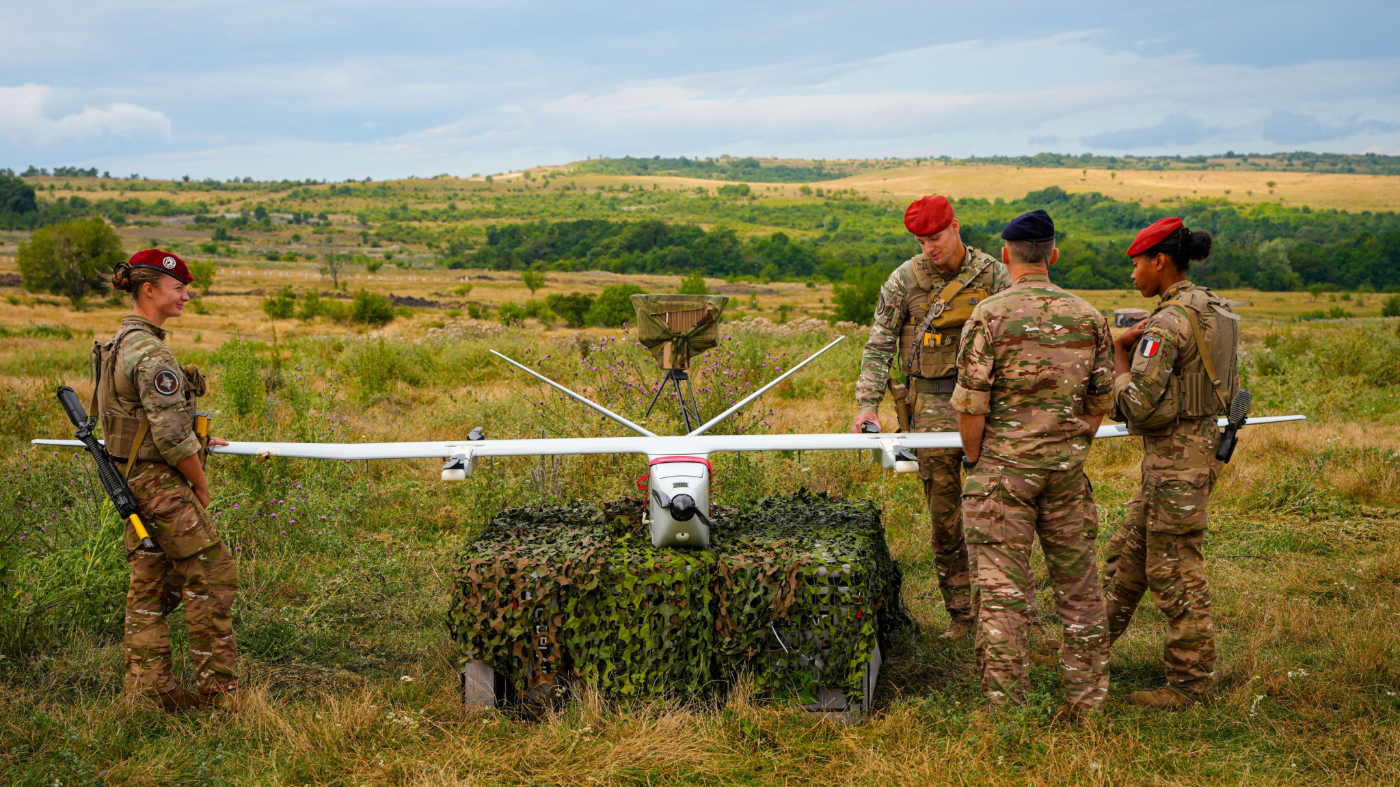
A Porcupine Strategy would make any initial aggression so costly it would become unacceptable. Here, vast numbers of inexpensive unmanned vehicles are central. NATO’s 32 members can deploy many tens of thousands of unmanned vehicles on its flanks and in central Europe.
Imagine how Russia would fare against 32 Ukraines.
Unmanned vehicles would be stationed throughout Europe. In the northern flank, the United Kingdom, Greenland, Iceland, Norway, Sweden and Finland would base these units. Likewise, in the Baltic, Mediterranean and Black Seas, the Balts, Greece, the Balkans, Turkey, Bulgaria and Romania could serve as unmanned bases. In central Europe, unmanned vehicles will be powerful blunters, blockers and breakers against any aggression.
The strategic value of unmanned vehicles extends far beyond a Porcupine Defense. They will reduce the demand for U.S. manned forces in Europe and absorb any redeployments or shifts to Asia. Unmanned vehicles operating across the entire European continent, in and over the land and under the oceans, would make a Porcupine Defense a highly cost-effective means for preventing and disrupting any attack Moscow might contemplate.
Virtually every military is scrambling to determine where and how unmanned vehicles can augment or replace traditional defenses. Lessons from the war in Ukraine are largely unique to that conflict. However, the application of unmanned resources, in conjunction with artificial intelligence, offers NATO the most economically sound strategy to deal with both the old and newer threats.
The question is whether NATO will exploit this opportunity.
Harlan Ullman Ph.D. is chairman of a private company, and principal author of the doctrine of shock and awe. Field Marshal the Lord David Richards was the United Kingdom’s former chief of the General Staff and chief of Defense. Their next book due out this winter, is “Who Thinks Best Wins: How Decisive Strategic Thinking Will Prevent Global Chaos.”
Topics in this story
Gathered from external sources. Rights to this text belong to whoever originally published it.