Judge rules officers have no standing to sue over Capitol Jan. 6 plaque
A federal judge ruled Wednesday that two police officers who defended the U.S. Capitol on Jan. 6, 2021, have no standing to sue over their names — and those of other first responders — not appearing on a plaque commemorating law enforcement’s response to the attack. U.S. District Judge Dabney Friedrich said she would grant…
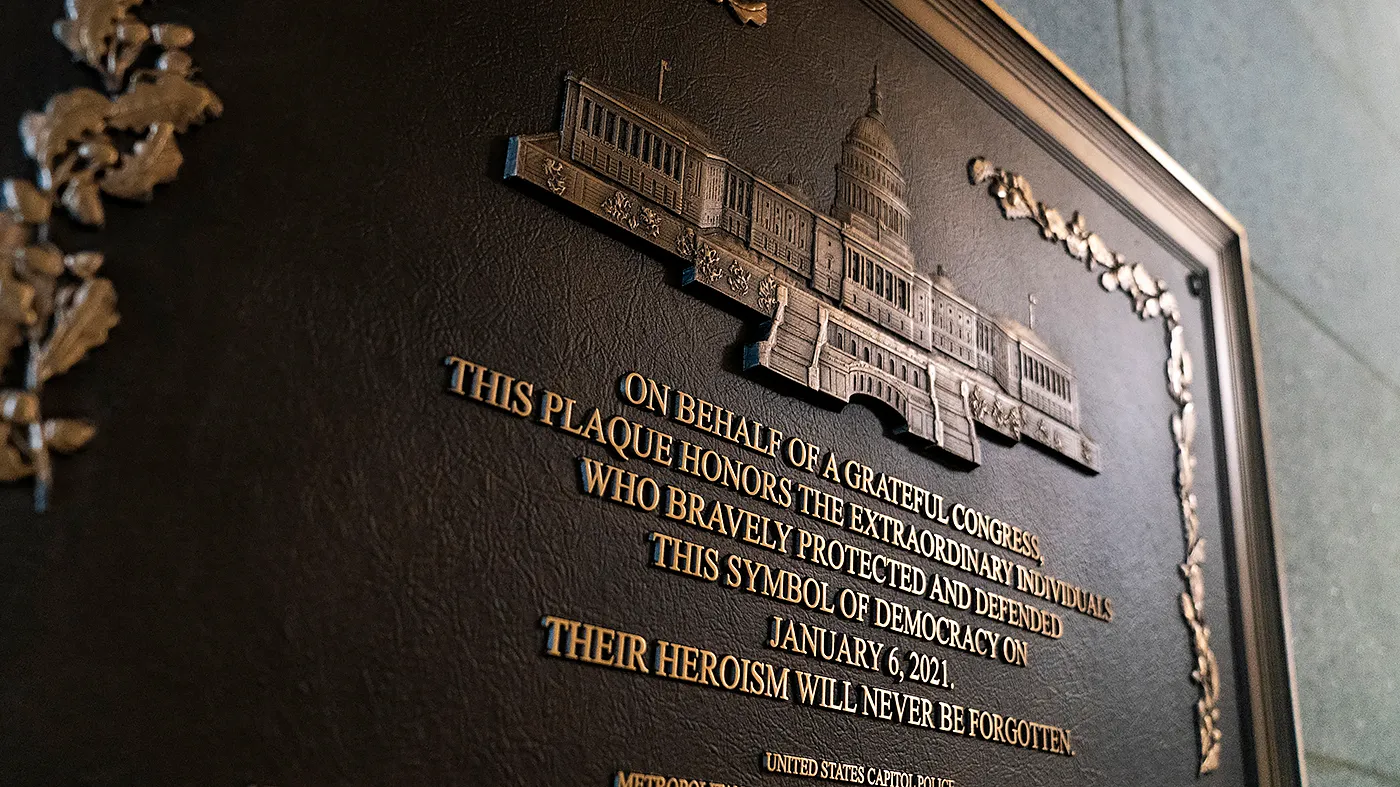
A federal judge ruled Wednesday that two police officers who defended the U.S. Capitol on Jan. 6, 2021, have no standing to sue over their names — and those of other first responders — not appearing on a plaque commemorating law enforcement’s response to the attack.
U.S. District Judge Dabney Friedrich said she would grant the Architect of the Capitol’s motion to dismiss the pair’s lawsuit “for lack of jurisdiction.”
The two officers, former U.S. Capitol Police officer Harry Dunn and active District of Columbia Metropolitan Police officer Daniel Hodges, sued the architect over the missing names, as the plaque only lists law enforcement agencies and organizations that sent personnel to defend the Capitol “alongside a QR code that visitors may scan to access the officers’ names,” court documents show.
Text on the plaque reads: “On behalf of a grateful Congress, this plaque honors the extraordinary individuals who bravely protected and defended this symbol of democracy on January 6, 2021. Their heroism will never be forgotten.”
The plaque was also planned to be permanently visible “on the western front of the Capitol” but has been temporarily displayed in “the non-public Senate wing” as of March.
Friedrich, an appointee of former President George W. Bush, noted that standing is “assessed from the time of the complaint.”
“Because the officers lacked standing when they commenced this action, this court lacks subject-matter jurisdiction and must dismiss the case,” she wrote.
She asserted that neither officer had a cognizable injury at the time of the plaque’s installation and dismissed their argument that the architect had “exacerbated ‘psychic injuries'” they have experienced since Jan. 6. Dunn and Hodges also argued that not recognizing individual service emboldened others to “harass them and disparage” the officers’ response.
“To be sure, the officers have a far more personal connection to the plaque than the public at large,” Friedrich wrote. “They are not ‘just any person’ … they are among the very officers Congress sought to honor. That gives them an understandable and deeply personal interest in whether the government recognizes their service in the manner Congress prescribed.”
“But Article II standing ‘is not measured by the intensity of the litigant’s interest, ‘ ” she continued. “It requires an injury in fact … Even if the Architect’s failure to install the plaque contributed to the officers’ injuries, the officers would need to show that mandating its installation would be ‘likely’ to alleviate those injuries.”
The officers initially filed a lawsuit over a delay in installing the plaque. Former President Biden signed a law in 2022 requesting a plaque to honor the officers who defended the Capitol during the attack, giving its installation a one-year deadline. But the plaque was never erected.
It was finally installed in March of this year, with the years-long delay prompting Hodges and Dunn to separately sue the Architect of the Capitol to “prominently display” the memorial in a “publicly accessible” area in the Senate wing. The officers argued that the plaque was “ hidden .”
Topics in this story
Gathered from external sources. Rights to this text belong to whoever originally published it.