The legacy of Clarence Thomas will be declining trust in the Supreme Court
Supreme Court Justice Clarence Thomas faces a complicated historical legacy marked by record declines in public trust in the judiciary.
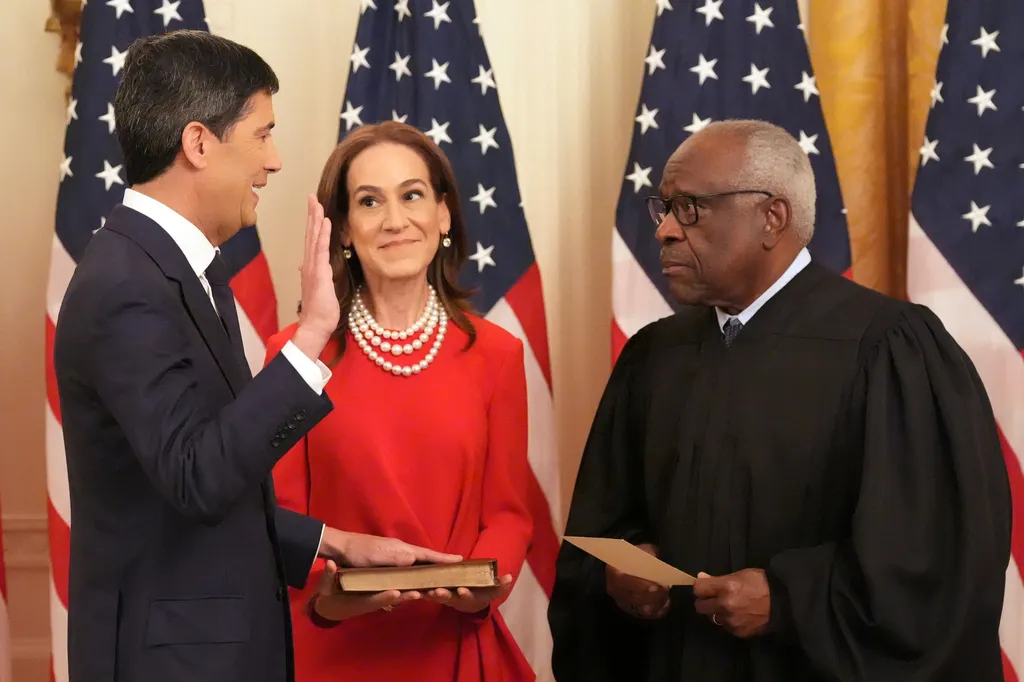
Supreme Court Justice Clarence Thomas is a singular figure in U.S. history. If he remains on the bench for the next two years, he will be the longest-serving justice in American history.
But his singular place in history is now tragic.
First, he is at the heart of a historic decline in public trust in the Supreme Court. Second, as the most powerful Black Republican in national politics, he has damaged trust in Black conservatives as a source of innovative thinking for dealing with racial problems.
Thomas’s singular status in history is being confirmed thanks to a biography written by right-wing Sen. Ted Cruz (R-Texas). The fawning tract celebrates Thomas as a rightwing hero. It was recently the number one book on the New York Times bestseller list .
Thomas is also in the news as one of only two justices to vote in support of President Trump’s gambit to skew the midterms in Republicans’ favor by restricting mail-in voting.
And he will go into history books as the Black justice who voted to weaken the Voting Rights Act, opening the door to eliminating Black-majority districts this year as part of a GOP effort to hold the House.
History will also note that several Democrats running in the midterms appear focused on Thomas as they propose ethics codes, term limits and even adding more seats to the court to restore ideological balance.
That political push began after investigative reports showed Thomas accepted, without disclosure, luxury vacations , help with tuition for a relative and real estate funding for his mother from a wealthy Republican.
That legacy is at the heart of declining trust in the Supreme Court.
Thomas’s damaged political profile is also evident in his decision to enter Trump’s political orbit. He has been featured at the swearing-in of a half dozen top Trump administration officials. In a role normally performed by the vice president, Thomas is the president’s preferred choice to stand in the Oval Office for swearing-in ceremonies and photographs — most recently with Kevin Warsh , the new chair of the Federal Reserve.
Thomas’s close ties to Trump comes as the president’s favorability with Americans has fallen to 29 percent . Two years ago, a USA Today poll showed the justice’s favorability “cratered,” The Hill reported , after the disclosures about personal gifts to Thomas from wealthy patrons.
His decline in approval fits with the Supreme Court’s overall approval falling to a “record low,” of 33 percent, according to a July poll by Gallup .
With a six-member conservative majority, the high disapproval of the court by Democrats is not surprising.
What is surprising is that approval of the court as a fair arbiter of the law has fallen among Republicans to 58 percent, down 21 percentage points since 2025.
A majority of Americans, 57 percent, now “see the justices as more motivated by politics.” And most Democrats and Independents agree, “the court is going out of its way to avoid a ruling against Trump,” according to a September Marquette Law School poll .
One Thomas vote stands out as accelerating declining confidence in the court. After saying he believed in upholding precedents, he became a leading voice as the court’s conservative voting bloc ended 49 years of constitutional protection for abortion rights.
History will also note that investigations into the violent effort to overturn the 2020 election at the Capitol on Jan. 6, 2021, text messages revealed that his wife, conservative activist Ginni Thomas, had earlier urged Trump officials to “ release the Kraken and save us from the left taking America down .”
Later Thomas refused to recuse himself from Jan. 6 cases that came to the court.
Thomas was also one of the votes rejecting a Colorado case arguing that Trump should be prohibited from running for reelection in 2024 because of his role in the insurrection.
History will also note that 35 years ago next month, Thomas was confirmed as the second Black person on the court.
He took the seat once held by another history maker, Thurgood Marshall.
Thomas is making history as the model of Black political power in the Trump era. In place of an earlier generation of renowned Black conservatives — from William Coleman to Thomas Sowell to Colin Powell to Condoleezza Rice — Thomas’s imprint is on a less impressive set of Black Republicans.
They include Leo Terrell, a former television provocateur, now at the civil rights division of the Justice Department; scandal tainted, former professional football player Herschel Walker who is now ambassador to the Bahamas; and Rep. Byron Donalds, who has removed some references to Trump from his website as he runs for governor in Florida.
Over the last five years, I have thought of a warning from former Rep. Liz Cheney (R-Wyo.).
Cheney said at the outset of the Jan. 6 hearings: “Tonight, I say this to my Republican colleagues who are defending the indefensible: There will come a day when Donald Trump is gone, but your dishonor will remain.”
That fits Thomas, too. There is no denying he is a historic figure. But his longest-lasting legacy may well have nothing to do with his race, his conservatism, or the sexual harassment claims raised at his controversial confirmation hearings.
His legacy will be declining trust in the court and appeals for reforms aimed to restore its integrity.
Juan Williams is senior political analyst for Fox News Channel and a prize-winning civil rights historian. He is the author of the new book “ New Prize for These Eyes: The Rise of America’s Second Civil Rights Movement . “
Topics in this story
Gathered from external sources. Rights to this text belong to whoever originally published it.