Republican midterm convention 2026: What to know about Trump’s Dallas event
Trump and JD Vance headline the unusual two-day Republican convention before the November midterm elections.
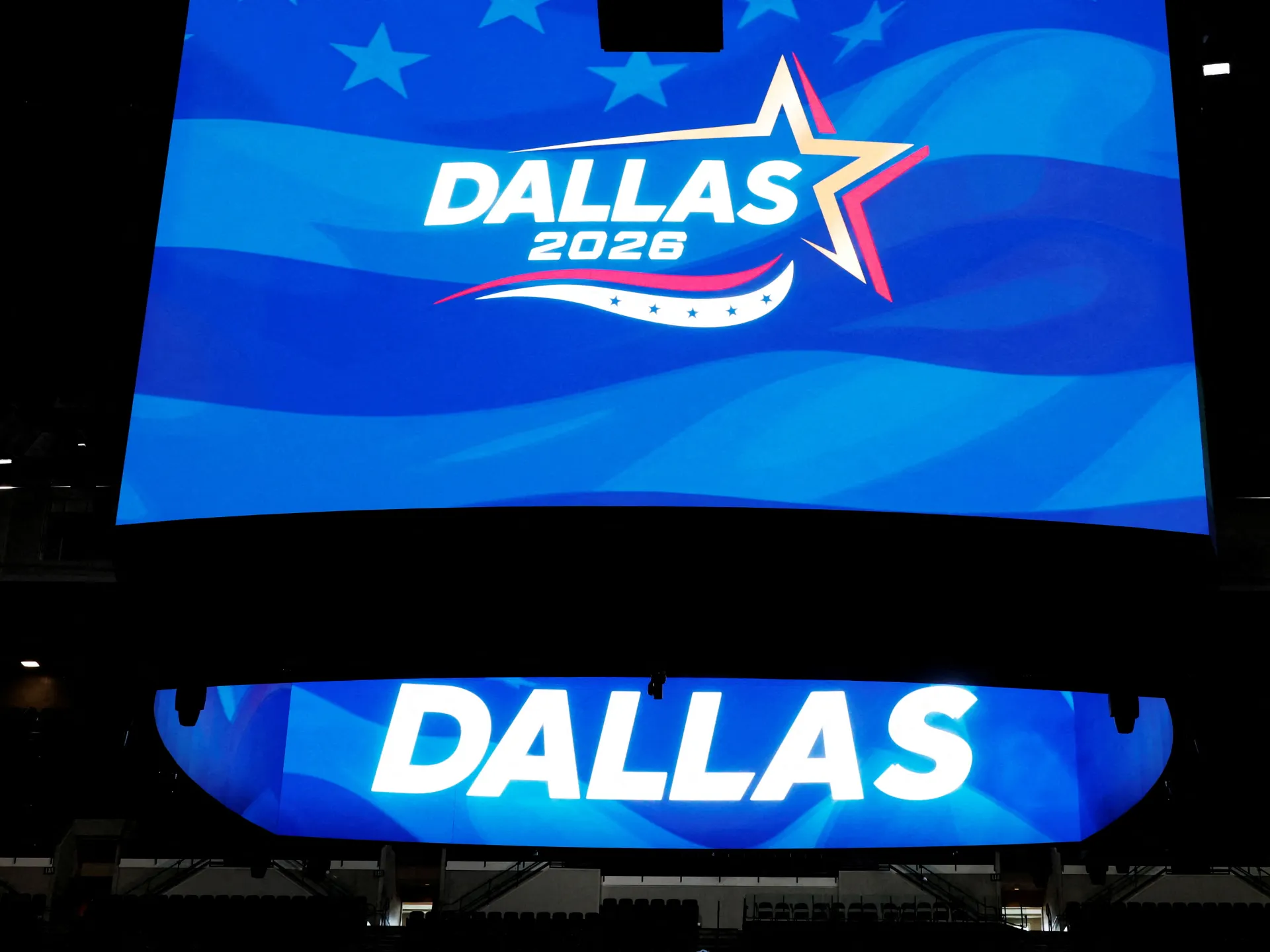
The United States Republican Party – and its talisman President Donald Trump – is descending on Dallas, Texas, to host a rare convention before the midterm elections in November.
Usually reserved for presidential election cycles, Trump’s call to hold the high-cost event before the November 3 midterm vote has underscored both the president’s unorthodox campaign style and the urgency of the political moment for his Republican Party.
Trump’s approval rating has tanked in the lead-up to the midterm vote, with polls pointing to a panoply of factors, most notably the US-Israel war on Iran and its knock-on economic effects for US consumers.
The lack of enthusiasm threatens what are already considered long-shot odds in the Republicans’ effort to hold on to control of the House of Representatives. Shifting public opinion has also put control of the Senate increasingly in play, although Democrats still face an uphill battle to pull off an upset.
A loss of control in either chamber would serve as a major check on Trump’s authority in the final two years of his second term.
But not all Republicans have bought into Trump and the party’s claims that the convention will spur voter turnout.
Several, particularly those in the tightest races, have kept the event at arm’s length amid concerns that associating with the president could only further mobilise his detractors.
When and where is the Republican midterm convention?
The convention will be hosted at the American Airlines Center in Dallas, Texas, on Wednesday, September 9 and Thursday, September 10.
The event is expected to run from 3pm to 9pm Central Time (20:00 to 02:00 GMT) on both days.
Trump is scheduled to speak on both nights, including a Wednesday address and the convention’s closing keynote on Thursday from 8pm to 9pm Central Time (01:00 to 02:00 GMT on Friday).
US Vice President JD Vance will close out night one with a speech.
The Republican National Committee (RNC), the party’s official organising body, has billed the Dallas midterm convention as a “first in American political history”.
Both Democratic and Republican national conventions have historically capped the primary season before a presidential election. The emphasis has historically been on the presidential nomination process during the largely ceremonial events.
During those conventions, so-called “delegates” from every state pledge their votes for a candidate based on the primary election outcome from their home state.
A candidate who secures the required majority of delegates formally becomes the party’s presidential nominee at the convention.
Parties also typically hold several smaller meetings surrounding the event to establish and release the party’s official platform.
Why are Republicans holding a midterm convention in 2026?
To start with, there will be no nominating process – presidential or otherwise – during the event, as there is no presidential election in 2026.
Instead, the convention has taken the shape of a supercharged campaign rally and fundraiser.
It has been pitched as an opportunity to introduce candidates in punishing races to potential donors and to give a clear, if Trump-dominated, party message as the races enter their final stretch.
The RNC has promised “a primetime showcase for President Trump’s success, candidates, and causes that have propelled the 2026 midterms to unprecedented focus”.
There will be quite a lot. The official programme lists “53 items and speakers” on night one, followed by 56 more on night two.
The first night will focus on issues including tax cuts, healthcare affordability, immigration, border policy, trade and domestic manufacturing.
The second night will focus more on affordability and families, including policies related to taxes on tips, overtime and Social Security.
The subject areas hew closely to Trump’s wider political messaging.
The official programme gives relatively little attention to several other subjects. The US-Israel war with Iran and Trump’s aggressive tariff policy receive scant mention.
Trump and Vance are the convention’s marquee speakers, but an array of prominent Republicans and candidates are expected to feature across the two-day programme.
Texas Attorney General Ken Paxton is likely to get a healthy amount of stage time. Paxton is running for Senate against Democrat James Talarico, whose early lead in polling has raised alarm bells for Republicans. A Democrat has not won statewide office in Texas since 1994.
“We’re going to have a lot of speakers, and the ones we want to focus on will be obviously Ken Paxton,” Trump told reporters last week. “We gotta get him elected.”
The race is particularly personal for Trump, who endorsed MAGA-aligned Paxton over Republican Senator John Cornyn, a four-term incumbent seen by many as the surest challenger for Talarico.
Will Trump’s convention help Republicans in the midterms?
It remains to be seen whether the convention will help to turn out voters in a meaningful way.
Trump has proven a canny campaigner in the past, leveraging his eye for television spectacle to build support and turn out low-propensity voters. But several factors could limit the impact.
Trump’s Thursday night speech conflicts with the opening games of the National Football League (NFL) season. The event also runs up against several memorial events for the September 11, 2001 attacks throughout the week.
Some Republican officials have also reportedly criticised the hasty announcement of the event, which Trump called for in late June, raising questions over whether organisers will indeed be able to achieve the spectacle envisioned.
For his part, Trump enters the convention with his approval rating continuing to tank, hovering at a 38 percent average in major polls. Several of the most recent polls, including a Reuters-Ipsos poll and a Financial Times-Focaldata poll conducted in late August, reflected only a 33 percent approval.
Trump entered office in January 2025 sitting at about 52 percent approval.
To be sure, several Republicans in key races have said they will attend the convention.
They include former Congressman Mike Rogers, who is running against Democrat Abdul El-Sayed for an open Senate seat in Michigan; Ohio Senator Jon Husted, who is facing an unnerving challenge from former Democratic Senator Sherrod Brown; and Georgia Congressman Mike Collins, who is seeking to unseat Democratic Senator Jon Ossoff.
Trump’s policies in his second term have cast a long shadow, leaving many candidates calculating whether attendance could backfire and instead energise voters opposed to Trump.
Democratic primary turnout in several key states – including Michigan, Wisconsin, Texas and Georgia – has soared this year, while Republican turnout has remained steady but unextraordinary, as reported by The Associated Press news agency. That has been a worrying sign for Republicans.
Maine Senator Susan Collins, a Republican incumbent seen as vulnerable in her race against Democrat Troy Jackson, has been among those who have said they will not attend.
Several candidates in key House races have pointed to prior commitments.
Representative Mariannette Miller-Meeks told The Bulwark she preferred to spend her time in her home district in Iowa, where she faces a challenge from Democrat Christina Bohannan.
“Because I have a district that I have to be in and take care of, so I’ll be in my district,” she explained about her decision.
Miller-Meeks eked out a victory over Bohannan in 2024, winning by a margin of just 0.1 percent.
Several left-leaning groups are organising protests.
House Democratic leader Hakeem Jeffries has announced that four Democratic lawmakers will travel to Dallas for counterprogramming during the Republican convention.
However, the cash-strapped Democratic National Committee (DNC) has avoided holding its own midterm convention.
The committee went into debt in the wake of the 2024 presidential election, even putting up its Washington, DC-based headquarters as collateral for a $15m loan, the NOTUS news site reported in July.
The RNC has not yet released a final price tag for its convention.
Topics in this story
Gathered from external sources. Rights to this text belong to whoever originally published it.