White House press ban - what is the pool and why is it in a row with Trump?
The White House press pool is at the centre of a major row between President Donald Trump and TV networks. What is it?
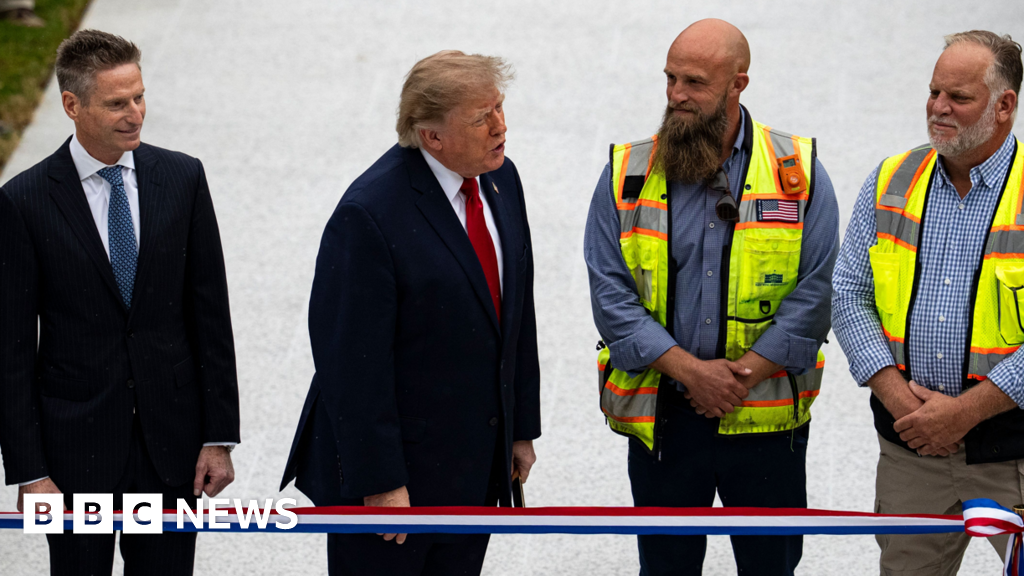
When Donald Trump unveiled a helipad at the White House on Monday, his remarks were barely audible in live footage of the event.
This was due to a row over an institution that rarely makes the news – the White House Press pool.
Yet it is at the heart of relations between the US president and the media, and this dispute could have constitutional implications.
Coverage of upcoming presidential engagements, which include the UN General Assembly in New York, could be affected.
It is a group of news organisations that combine resources to follow presidents wherever they are - in the Oval Office, at state dinners, on Air Force One or on holiday.
There are separate pools for TV, photographers and print and radio outlets, as well as a "new media" category.
The idea, conceived decades ago, is that having a pool saves on costs and space and it's not practical for hundreds of media outlets to follow the president around.
Members of the pool share their material - pictures and descriptions of the president's movements - with the wider media.
The pool is always on standby in case an event requires the president to speak to the nation.
This latest row centres on the TV pool which has five members - CNN, ABC, CBS, Fox News and NBC.
It began on Friday when Trump said he was banning three outlets - CNN, Politico and MS NOW - from the White House, accusing them of spreading "fake news" and "fictions and lies" about his team.
A day later, reporters from those organisations found that their entry badges to the White House had been disabled.
On Monday, all the major US TV networks decided to pull out of White House pool duties - in effect boycotting presidential events.
That afternoon came the first test of this post-pool era - the new helipad at the White House.
With no pool cameras present, much of the media did not carry any pictures and for those that did, there was no microphone to clearly pick up the president's remarks.
But there were no such problems at Trump's meeting later that day with New York Mayor Zohran Mamdani, because it was not dependent on pool cameras and lots of media were there.
Why did US networks pull out of filming Trump?
Fox News Washington bureau chief Bryan Boughton, who currently holds the rotating role covering the White House, wrote in an email seen by the BBC that "effective today, the TV pool will not be covering events designated as pool coverage" of President Trump.
In a joint statement, the five networks said: "The public has a vital interest in receiving accurate, independent information about its government.
"No administration should restrict a news organisation because it objects to its reporting."
The First Amendment of the US Constitution protects speech and press freedoms.
It forbids the government from "abridging" the freedom of the press - language that courts have traditionally interpreted as preventing the government from discriminating against the media based on the content of their coverage.
CNN, Politico and MS NOW have filed a lawsuit against the Trump administration to "defend the principle that the government does not decide what the press reports". A hearing is scheduled for Wednesday.
In a joint statement on Monday, they said: "Without notice or process, the White House revoked our journalists' credentials because it objected to our reporting.
"Left unchallenged, this threatens press freedom and the public's right to independent journalism free from government interference."
Trump's speech to the United Nations on Tuesday will be unaffected by the boycott because it will be carried by outlets which are not part of the pool.
But the president's movements to and from his various New York events, which are usually filmed, could be subject to the blackout.
How has Trump reacted and what is Trump TV?
Responding to news of the lawsuit, Trump called the outlets "Third Rate Clowns" and "Crooked and Corrupt Press" that "trivialise and demean" his achievements.
"Fake News people and publications that only write negatively, and who violate our National Security by writing false and defamatory stories with unknown 'sources,' shouldn't be allowed access to the most important Office anywhere in the World," Trump wrote on his Truth Social platform.
He added that his team would file an appeal. Meanwhile the White House has launched Trump TV, a 24/7 stream on YouTube.
Its description reads: "Watch the Trump Administration's biggest moments all in one place."
So far, the channel has primarily consisted of replays of previous Trump speeches and rallies.
For now, the White House media slot has remained vacant and instead the conservative TV outlet, Real America's Voice, was listed as "secondary" crew on Trump's trip to New York.
Unlike the traditional pool, however, that outlet is under no obligation to share material with others and has operated unilaterally for its audience.
Have there been previous examples of White House media bans?
In February, the White House announced it was taking control of the press pool which has access to Trump and had for more than a century been managed by the White House Correspondents' Association.
The same month, the administration moved to bar Associated Press reporters and photographers from spaces where access is limited, such as the Oval Office or Air Force One, because of the outlet's usage of the term "Gulf of Mexico" instead of "Gulf of America". AP filed a lawsuit and the case remains ongoing.
There have been a few instances of other administrations attempting to limit certain outlets' access.
The Obama administration tried to exclude Fox News from participating in a press pool interview with an administration official in 2009.
But after pushback from the other four networks in the pool, Fox News was granted access. Unlike with Trump's exclusion of CNN, MS NOW and Politico, the Obama administration did not try to bar Fox News from all pool coverage, just one specific interview.
Topics in this story
Gathered from external sources. Rights to this text belong to whoever originally published it.