Apartment Rent Growth Strengthens as US Supply Cools
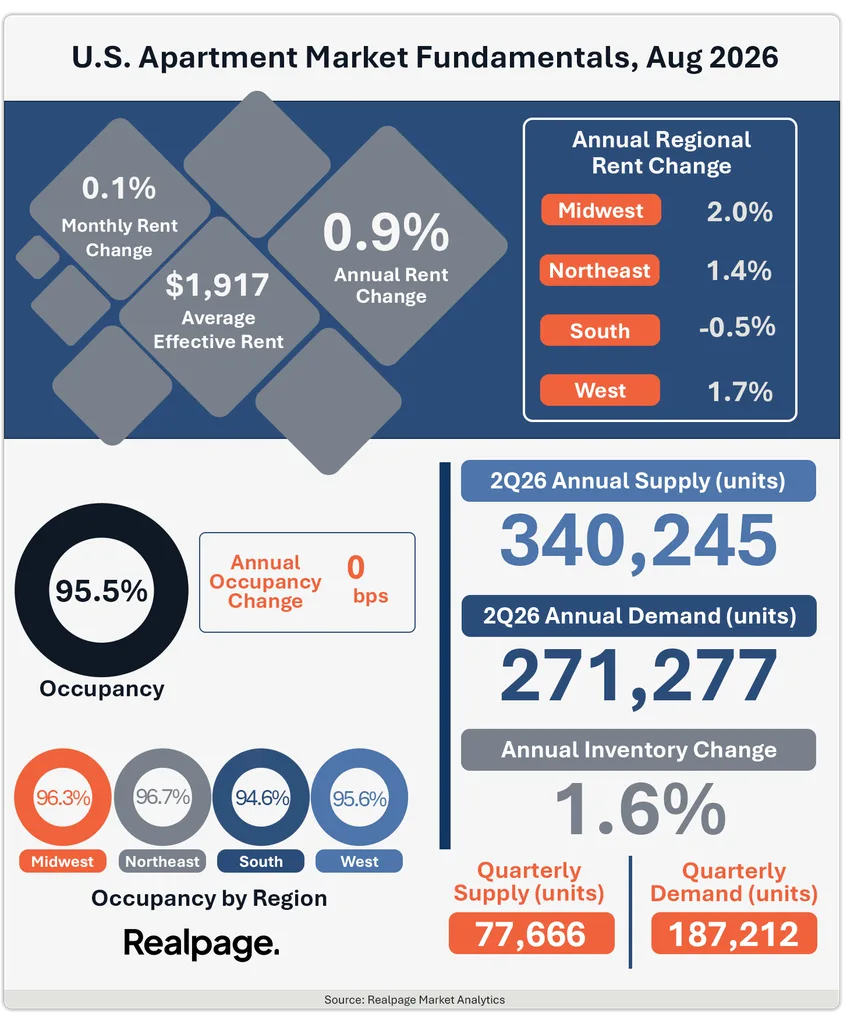
Apartment rent growth reached 0.9% in August as occupancy held at 95.5%, while coastal markets outpaced supply-heavy Sun Belt metros.
This story was originally published on CRE Daily . Join 70,000+ commercial real estate professionals getting daily news, market insights, and industry analysis delivered straight to their inbox with the free CRE Daily newsletter .
Same-store effective asking rents rose 0.9% year over year in August, while monthly rents increased 0.1%.
US apartment occupancy held at 95.5%, after improving 90 basis points during the first eight months of 2026.
San Francisco led major-market rent growth at 14%, while the South remained the only region with annual rent declines.
Apartment rent growth strengthened again in August as the US market extended its gradual recovery. RealPage's August apartment-market update shows same-store effective asking rents up 0.9% year over year. Monthly rents increased just 0.1%, meaning part of the annual improvement came from weak 2025 comparisons rolling out of the calculation. Occupancy held at 95.5%.
August marked the eighth straight monthly rent increase of 2026. Those gains have ranged from 0.1% to 0.6%. That follows a run of small monthly declines during the second half of 2025.
Occupancy has also recovered. The national rate matched July and the prior year's 95.5% reading, but it has climbed 90 basis points since the start of 2026. The improvement follows a steady occupancy decline in the back half of last year.
The annual acceleration should be read with that base effect in mind. August's year-over-year gain does not reflect a sudden monthly surge. It reflects eight consecutive positive months combined with weaker late-2025 rent readings dropping out of the comparison.
Leasing demand strengthened during the spring. The US absorbed more than 187,000 apartment units in Q2 2026, one of the strongest spring leasing seasons in recent years.
Annual demand remains below normal because of net move-outs recorded late in 2025. Roughly 271,300 units were absorbed in the year ending Q2, compared with a decade average near 340,000 units.
Supply is also easing. About 340,200 units were delivered during the year ending Q2. That volume fell below the decade average for the first time in roughly three years, after annual completions peaked near 588,000 units in late 2024.
The supply decline is an important part of the recovery. Deliveries remain high in many metros, but the national total is moving down from the late-2024 peak. That gives improving absorption more room to translate into occupancy and rent growth.
Gathered from external sources. Rights to this text belong to whoever originally published it.