Democrats rode rural frustration to Senate wins. Now farmers want results
Democrats flipped Senate seats in previously deep-red territory such as Kansas and Texas in part by criticizing Trump administration policies that helped create high diesel and beef costs. Now they’re going to be under pressure to deliver for farmers, who want the party to put words into actions once they take control of the House…
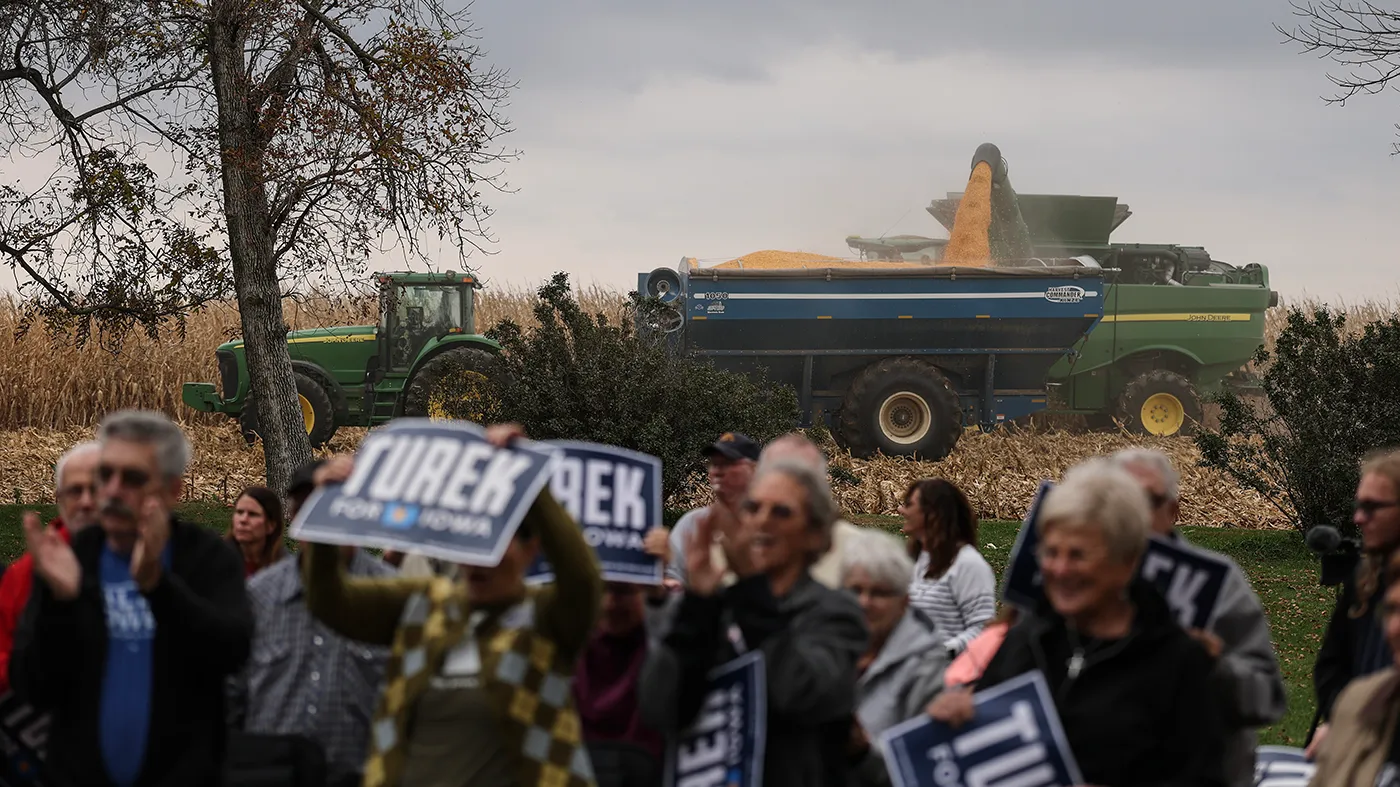
Democrats flipped Senate seats in previously deep-red territory such as Kansas and Texas in part by criticizing Trump administration policies that helped create high diesel and beef costs.
Now they’re going to be under pressure to deliver for farmers , who want the party to put words into actions once they take control of the House and Senate .
To put it more bluntly, Democrats are facing “a lot of pressure,” Democratic strategist Maria Cardona told The Hill.
“But Democrats are looking at it as a tremendous opportunity to show the country not just what they can do, but to contrast it with what Republicans have done,” she continued.
The most immediate step Democrats can take to lower diesel and fertilizer prices is force President Trump to wind down the Iran conflict .
Since Trump launched the war in late February, fuel prices have skyrocketed — a gallon of gas and diesel are about $1.02 and $2.56 more expensive, respectively, than they were a year ago, according to AAA .
The increase in diesel prices particularly hurt farmers , who rely on the fuel to operate tractors, combines and other heavy-duty machinery.
“Take away funding for the war, and push on a war powers act,” Cardona said, regarding what Democrats should propose. “That will also put pressure on this administration to end the war in Iran, stop spending $2 billion a day.”
She added, “That will start to relieve pressure on gas and diesel.”
Beef prices have also risen during Trump’s second term , as the country’s herd size is declining and the president’s tariffs have dealt a blow to ranchers. Before the election, cattle ranchers criticized the president for boosting imports of foreign beef via lower tariffs.
Brendan Steinhauser, a Texas-based GOP strategist, said diesel and beef prices are a “complicated, entangled issue.”
But he noted lawmakers in the next Congress can rein in Trump’s tariffs and force him to end the eight-month war to lower beef and diesel prices.
“It’s hard and it’s complicated and it takes time. But those are probably the first two things that they can do,” Steinhauser added.
High prices for diesel and beef, along with Americans’ overall concerns about inflation and elevated gas prices, led to this week’s Democratic midterm rout , including in farm country.
Voters in Kansas and Texas elected Democrats to the Senate for the first time since 1934 and 1988, respectively, as Adam Hamilton (D) unseated Sen. Roger Marshall (R-Kan.) and state Rep. James Talarico (D) knocked off Texas Attorney General Ken Paxton (R).
In farm-heavy Iowa, a state former President Obama won twice but one that had not sent a Democrat to the upper chamber since 2008, state Rep. Josh Turek (D) defeated Rep. Ashley Hinson (R-Iowa) in Iowa’s Senate race .
David Kochel, an Iowa-based Republican strategist, told The Hill that high diesel prices were “very consequential” in Turek’s victory, arguing the Democrat did not have to do “anything” to capitalize on them.
“It didn’t require any strategy on his part,” added Kochel, who led former Sen. Mitt Romney’s (R-Utah) ground game in Iowa during the 2008 and 2012 presidential campaigns.
Even in Mississippi, where Democrat Scott Colom led Sen. Cindy Hyde-Smith (R) by around 1,900 votes with more than 95 percent of the vote counted as of Thursday evening, high beef prices made a difference .
Colom specifically targeted Hyde-Smith for saying Mississippians “have so many proteins to choose from” in an ad he released last month . The ad featured Colom saying Mississippi should “pick another senator.”
Once the 120th Congress begins in January, the onus will be on Democrats in Congress and the Trump administration to provide relief for farmers. Outside of ending the war and reining in the president’s tariffs, experts say it is time for lawmakers to address deeper issues facing the industry.
Charlie Decker, the advocacy coordinator for the National Farmers Union, recently called on the Environmental Protection Agency to cease exempting large oil refineries from federal requirements regarding production of biodiesel and renewable diesel.
“Currently, the only alternatives to petroleum-based fuels available to American farmers and consumers are biodiesel and renewable diesel,” Decker wrote in a blog post last month.
Decker also backed federal investment in renewable, low-carbon fuels and the “permanent authorization” of year-round sale of E15 fuel — or gasoline blended with 10.5 percent to 15 percent ethanol.
Dr. Faith Parum, the deputy chief economist at the American Farm Bureau Federation, backed changes to renewable fuel standards to “benefit American feedstocks” such as corn, soybeans and canola oil.
She also said the annual farm bill, which the full House passed and Senate Agriculture Committee advanced earlier this year , will help farmers in the form of a higher credit limit for the first time since 2018 if the upper chamber passes it.
Regarding beef prices, analysts from watchdog Farm Action have called on policymakers to restore mandatory country-of-origin labeling for meatpackers, establish a heifer cow retention tax credit for ranchers and expand independent and regional processing capacity.
“Congress should also consider federal price-gouging authority for concentrated food markets during emergencies or severe supply disruptions,” they wrote in June .
Whether such proposals can get through a Democratic-controlled Congress defined by various ideologies is unclear. Then, there is the question of Trump, who could kill any bills Democrats pass without a veto-proof majority — which would require GOP support.
Cardona, who advised the national Democratic Party on Latino outreach this cycle, acknowledged any Democratic-led measure will likely get vetoed by Trump. But she said the party must still be “transparent” on where it stands on lowering costs, including for food and fuel.
“Democrats have to be very aggressive on that end. … I think it’s also an opportunity for us to say, ‘Look, we have a mandate. Americans [were] absolutely very clear in who they chose to help change things in this country,’” she said.
Topics in this story
Gathered from external sources. Rights to this text belong to whoever originally published it.