How Stocks Perform After Fed Rate Decisions
How stocks perform after Fed rate decisions and how bearish investor sentiment could impact returns
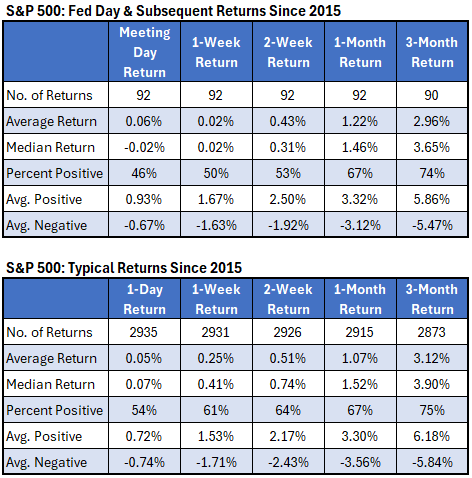
The Fed meets next week and there's more uncertainty than usual heading into the interest rate decision. Betting odds put the chance of a rate hike at a little over 60%. I gathered return data on the S&P 500 Index (SPX) on meeting days and the days that followed, going back to 2015. The table below summarizes the results.
The SPX has averaged about the same return on Fed meeting days compared with a typical day. However, Fed meeting days have been positive less often but have shown more upside when stocks rise compared with typical days. In the week after Fed days, the SPX has underperformed. The index barely broke even on average, with just half of the returns positive. Typically, the SPX averages a return of 0.25%, with 61% of returns positive. For the time frames beyond one week, the returns following Fed days are close to normal.
In the rest of the article, I'll break down the returns in this first table to align with the current market environment. Hopefully, this gives us some insight into what to expect from the stock market next Wednesday and in the weeks and months that follow.
The uncertainty surrounding the Fed's decision leads to uncertainty in the market. There has been a big difference in how stocks performed after the Fed raised rates compared with when it kept rates the same.
From the tables below, in the week following a meeting in which rates were raised, the SPX declined 0.54% on average, with 40% of the returns positive. When rates were kept steady, the index averaged a gain of 0.23%, with 54% of the returns positive. Stocks started moving higher after that first week, but the underperformance was still present three months later.
The day of the meeting is also interesting. The SPX was positive on just 35% of Fed days in which rates were raised, compared with 49% of days when rates were kept the same. However, when the SPX rose on rate-hike days, it averaged an impressive 1.8% gain, leading to an overall average return of 0.10%, the same as when rates were maintained.
There was also underperformance after rates were cut, but that's not a consideration for next week.
Here's some good news. The American Association of Individual Investors (AAII) poll is showing pessimism among its members. Each week, the AAII surveys its members online about where they think the stock market is heading in the next six months. Over the past four weeks, the poll has averaged more bears than bulls. On Fed days and in the weeks following, the AAII poll has been a good contrarian indicator.
Gathered from external sources. Rights to this text belong to whoever originally published it.