Why Gen Z needs a different approach to education
For generations, education followed a predictable path. Learn what is taught, complete a degree, find a job and build a career.
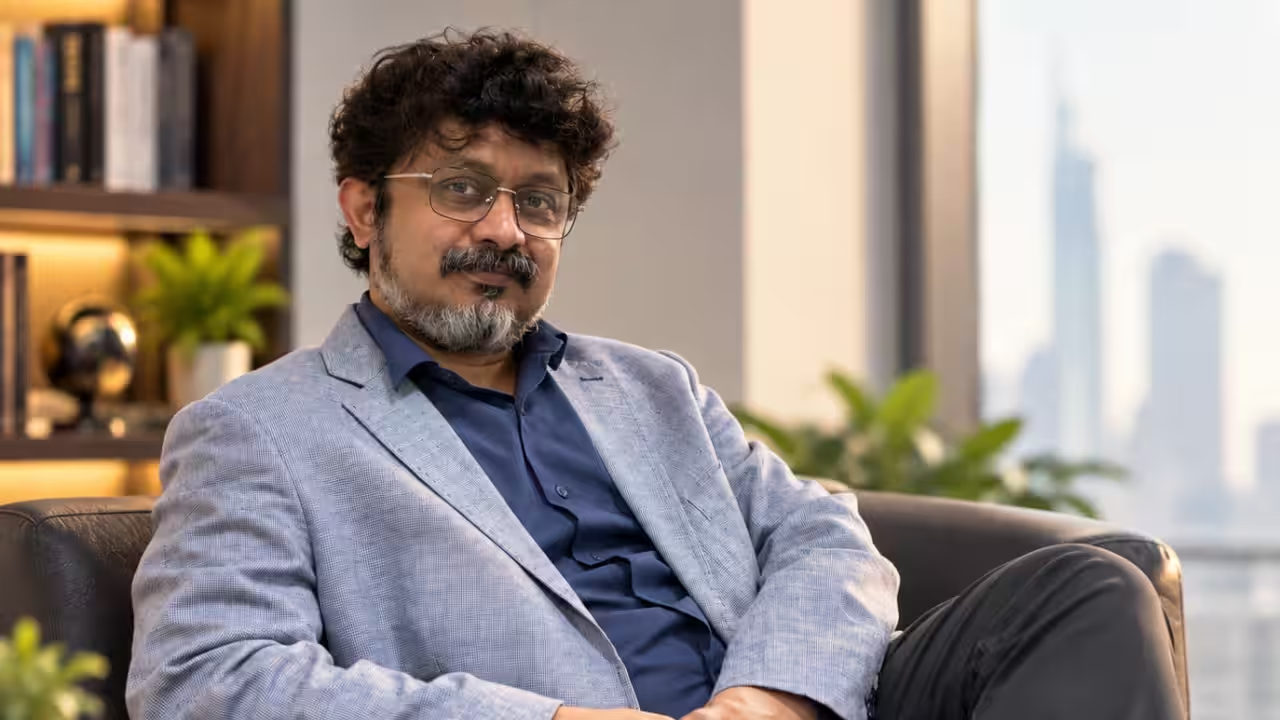
For generations, education followed a predictable path. Learn what is taught, complete a degree, find a job and build a career. But Gen Z is entering a world where artificial intelligence, automation and evolving skill requirements are reshaping that journey.I believe education must respond by combining strong academic foundations with the ability to apply knowledge in unfamiliar situations.Information is available almost instantly. Students can access lectures, research and practical demonstrations from across the world. The greater educational challenge is helping them interpret that information, question assumptions and use it well. My experience in management education has reinforced a simple principle: students need opportunities to apply, experiment, reflect and improve throughout their studies.Measure learning through capabilityCompleting a syllabus does not necessarily mean a student can analyse a business problem, communicate an idea or lead a team. We need to judge education by the capabilities students develop, alongside the knowledge they acquire.Outcome-based education provides a framework for this shift. It asks what students should be able to demonstrate after a course, then connects teaching and assessment to those outcomes. In management education, these may include analytical thinking, financial understanding, communication and effective teamwork.I have emphasised internships, corporate interaction and project-based learning throughout my academic leadership. Case studies, simulations and live projects give concepts a practical context. They also allow students to encounter problems without a single textbook answer. Academic rigour becomes more meaningful when students can use it to explain a decision or develop a solution.Recognise the individual learnerStudents bring different strengths, interests and ambitions to the classroom. Some are drawn to entrepreneurship; others excel in analysis or communication. Many need support in identifying a career direction.Personalised learning does not require a separate curriculum for every student. It requires attention to the individual behind the qualification. Mentoring, career counselling, psychometric assessment and development tailored to a student’s profile can help them understand their strengths and make informed choices. Education should help students explore the professionals they could become, as well as the degrees they can complete.Teach students to think with technologyAdding AI or robotics to a curriculum is only a starting point. Students also need to understand how technology affects business models, professional decisions and careers.When a tool generates an answer, the learner must still judge whether the question was useful, the answer is sound and the application is appropriate. Critical thinking, creativity, communication and ethical reasoning therefore belong at the centre of technology education.My research and academic work1 2 3 increasingly intersect with digital transformation and emerging technologies. That experience reinforces my view that technical familiarity must be accompanied by judgement. Students need to understand how to think with technology and use it responsibly.Develop initiative and global capabilityEntrepreneurship education extends beyond starting a company. It develops the habit of identifying problems, testing solutions, accepting uncertainty and creating value. I have advocated for students to become creators of opportunities. That mindset is equally useful within an established organisation, where an employee may spot a problem and develop a better way of working.Global exposure also needs a clear educational purpose. Travel alone cannot create global competence. Students need opportunities to understand different markets, cultures and ways of thinking through exchanges, international collaborations and cross-cultural projects.In my academic leadership experience, international partnerships have created opportunities for student and faculty exchanges, joint programmes and collaborative research. Their educational value lies in helping participants work across differences and apply what they learn in a globally connected environment.Prepare students to keep learningA graduate’s first job may not define their eventual career. As industries and roles evolve, the knowledge gained at the beginning of working life will need to be revisited. Education must develop the confidence and habits to learn, unlearn and relearn.This requires classrooms that remain connected to the world outside them. Real business problems, industry interaction and opportunities to experiment should be part of the learning experience. Strong conceptual knowledge provides the foundation; practical experience helps students test and deepen their understanding.I believe educators must ask whether our education systems are ready for the students we teach. Our responsibility is to develop people who can think independently, apply knowledge and continue learning long after graduation. For Gen Z, that is the educational experience we need to build.This article has been contributed by Dr. Amol Gawande, Director of Brookstone Institute of Global Studies, Dubai, and an Executive Board Member of the Association of Indian Management Schools (AIMS)References:Digital Transformation and Consumer Behaviour (2025): Machine Learning Algorithms (2021), listed in the institutional publication records: ResearchGate academic profile: These references document his contributions to technology-related academic publications and research.Disclaimer: The above content is non-editorial, and TIL hereby disclaims any and all warranties, expressed or implied, relating to it, and does not guarantee, vouch for or necessarily endorse any of the content.You use AI every day. Now get your AI Quotient. Take the AIQ test.
Topics in this story
Gathered from external sources. Rights to this text belong to whoever originally published it.