Aliens, Bigfoots, and Monsters… Remembering the Age of the Weirdumentary
In the conspiracy-minded 1970s, monster ‘documentaries’ were a huge hit at the box office.
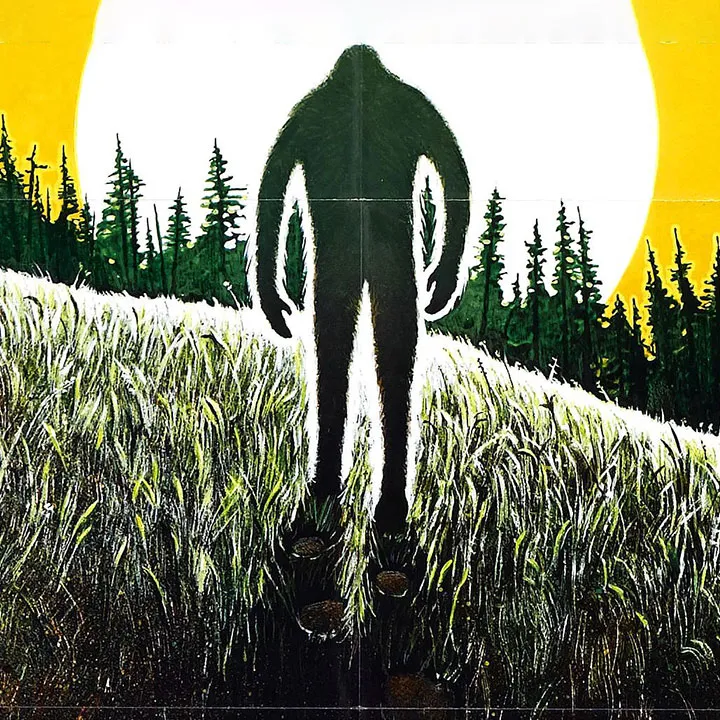
“Scientists representing the world’s foremost research centers took part in the examination of the evidence. The facts that will be presented are true. This may be the most startling film you’ll ever see.” -Peter Graves, The Mysterious Monsters (1975)
During the turbulent era of Vietnam and Watergate, the happy veneer of America in the 1950s and ‘60s gave way to the conspiracy-minded ‘70s. Dark revelations about the government, justice system, military, and police made the public begin to rethink their perceptions about a great many things. This led to renewed interest in occult matters like ESP, UFOs, and cryptozoology. These subjects, along with other pseudoscientific phenomena like near-death experiences or the Bermuda Triangle, became the bread and butter of a Utah-based production house called Sunn Classic Pictures. The company made a fortune releasing partially-dramatized “documentaries” that tantalized viewers with possibilities of what could be out there beyond the veil.
“I think it was people just questioning what the norm was… what is real, what isn't real,” James L. Conway, who worked as a writer/producer/director at Sunn Classic, tells IGN. “There were very few outlets back then to experience these things, very few TV channels. Through a theatrical window, we were able to make movies about these subjects. They were incredibly popular because there was no other place for people to get knowledge about this… no YouTube, no Wikipedia, no social media. If you wanted to see something that was on the unusual side, it was a theatrical motion picture.”
Conway was a college senior at the University of Denver around 1971 when he was in the Mass Communications Department and the phone rang. It was Charles E. Sellier Jr., who ran an industrial film and commercial company in Denver.
Continues Conway, “Chuck was looking for cheap labor to edit his industrial films. I said, ‘I'm your guy.’ While I finished college I worked for Chuck, and after about three months I said to him, ‘You know, I can direct these shows better than the people you're hiring.’ Total chutzpah. He gave me a shot, I did really well, and that began our relationship.”
After producing a western comedy called The Brothers O'Toole, Sellier connected with Sunn Classic Pictures, which at that point was a distribution outfit in Utah and a newly-founded division of the Schick razor company. They had made several well-attended hunting pictures like The Life and Times of Grizzly Adams, and decided their next avenue would be a series of pseudoscience documentaries kicked off by a re-edited and English dubbed version of the 1970 German doc Chariots of the Gods . Based on Erich von Däniken’s popular claptrap supposing celestial beings who seeded early humanity, in 1973 it grossed over $25M and was nominated for an Oscar.
Noted film scholar Dr. Gary D. Rhodes recently published a book titled Weirdumentary all about this era of strange docs throughout the ‘70s, of which he claims Chariots of the Gods is the urtext: “The fact that it was nominated for an Academy Award suggests how many more people were taking these ideas seriously. I hesitate to think a documentary on that subject now would get an Academy Award nomination. From the late ‘60s we see a rise in interest in everything from occultism and psychic phenomena, new age philosophies, magic, astrology, paganism, life after death, anti-materialism, holistic medicine, reincarnation… there's a desire to find alternate ways of examining our experiences that is unique to that era, including academia. You would not find many parapsychology departments in today's world.”
Once they found the winning formula, Sunn Classic released a wave of documentaries including 1975’s The Mysterious Monsters, where Mission: Impossible actor Peter Graves hosts a Whitman’s Sampler of cryptids.
“For me as a little kid, I certainly loved Mysterious Monsters the most of any of them because it was the era of fascination with Bigfoot, widespread belief that there might be such a creature,” says Rhodes. “There was equal interest in the Loch Ness monster and the Yeti. There were documentary films individually about all of those monsters, but here it was like the Universal monster rally films where you were getting all of them at once.”
The film was actually an amalgam of a few previously-released TV documentaries including CBS’ Monsters! Mystery or Myth, which helped popularize the supposed veracity of the Roger Patterson/Robert Gimlin footage of Bigfoot strolling through the woods. Narrates Graves, “If this film is legitimate, then there can no longer be any question about Bigfoot’s existence.”
Because Sunn Classic was a Mormon-run company, Rhodes says they “wanted to tap into films where everybody from a little kid to the grandparents could go and not feel out of place or offended.” Sellier himself called this demographic “the lost audience” who felt left behind by both the kiddie fare of Disney and the blood-and-nudity-soaked visions of New Hollywood auteurs (Taxi Driver, The Exorcist, etc.). Sunn’s product even included a few movies which attempted to present scientific evidence for aspects of the Christian faith. The most successful was In Search of Noah’s Ark, co-written and directed by Conway based on a book by Sellier and David W. Balsiger. It posits that (conveniently inaccessible) evidence exists that the remains of Noah's Ark lay on Turkey’s Mount Ararat. It includes several non-Russell Crowe re-enactments, as well as a supposed photograph that became the lynchpin for “proof.”
Intones narrator Brad Crandall, “The answer came in late September of 1974 when an expedition from the Holy Ground Mission in Frankston, Texas, scaled Mount Ararat, shooting across the Ahora Gorge with a 35MM Minolta camera. They took this picture that shows what looks like the fore part of a great vessel. The prow can be seen sticking out of the rocks 2000 feet above the location of the Eryl Cummings photo. When studied under photographic enlargement, the outline of the ship is not only clear but planking can actually be seen… the planking of Noah's Ark.”
“We didn't doctor anything… we had a photo that had been in other pieces of research,” Conway explained to us. “In those days, every expert you go to has their own data to support what they believe. Whether it's pseudoscience or not, all these people had books or research they could point to proving their point. A lot of it is things people wanted to believe, and so they'll accept the research more readily than a scientist might. I actually just saw there was a report on the Today Show last week about how they found this thing near Mount Ararat that they think is Noah's Ark. It just never goes away.”
Adds Rhodes of the questionable flood geology, “There's something atop Mount Ararat, and we think it's wood, and then this one explorer went up and claims to have seen it, and another explorer got close, but he couldn't quite get there. For some people, that's still tantalizing.”
Sunn Classics had several innovations to make and market their movies. They would often spend tens of thousands doing market research on whether a subject was viable for public interest. Once a film was complete, they would circumvent Hollywood distribution through a practice known as four-walling.
Conway claims that when Sunn approached local theaters, “They’d say, ‘We're going to pay you $25 cash for Friday night, $25 cash for Saturday night. We control the box office. Everything that comes in is ours.’ Because it was four-walled we did very heavy television commercials. We would only have, let's say, 300 prints of the movie. It would go into a city like Chicago, play two nights at this one theater, three nights at a different theater, four nights at another theater, and the commercials would list all the different movie theaters it was going to be on each night. They were enormously successful. On In Search of Noah's Ark I think our budget was $600,000 and it grossed $55 million. It was the 9th highest grossing movie of 1976.”
“Four-walling was a brilliant strategy,” opines Rhodes. “Sunn Classic were, in some respects, using old tricks of the trade not unlike the roadshow cinema of the early 20th century. In other respects, they were way ahead of their time. They were using surveys, polling at shopping malls: ‘What kind of film do you want to watch?’ They would look at advance weather reports in tandem with four-walling to try and avoid a snowstorm in the weeks ahead.”
“It may start in the Bible Belt, but it was huge everywhere you went,” continues Conway. “It was a huge hit, quite remarkable. That taught us that if you have a great commercial hook you can get a great box office return. That's where a lot of the supernatural elements come in, because there was an appetite for it. It's very easy to do a 15- or 20-second hook in a commercial to get people's interests up. It was so successful that theater runners made us go back to the standard splitting the box office, which was bad for us, good for them.”
Another “bad for us, good for them” was producer Alan Landsburg bringing the formula to television with an In Search of… docuseries hosted by Leonard Nimoy from 1976 to 1982. Landsburg helped popularize the style with the earlier docs In Search of Ancient Astronauts (1973), In Search of Ancient Mysteries (1974), and The Outer Space Connection (1975), the latter made and released by Sunn Classic. The show’s subjects (Extraterrestrials, Magic & Witchcraft, Missing Persons, Myths & Monsters, Lost Civilizations, Special Phenomena) were the same as Sunn’s, as was the format of a celebrity host.
“He came after us with the In Search of… television series, basically ripped off our In Search of Historic Jesus and In Search of Noah's Ark,” says Conway. “He made it a TV series that was very successful, but that came after we had done our stuff.”
Many others were tapping into the same material, including the Oscar-winning insectsploitation doc The Hellstrom Chronicle (1971) and the Rod Serling-hosted UFOs: Past, Present, and Future (1974), but Rhodes says that “Sunn Classic was at the core of the weirdumentary.” The one defining aspect of all these sensational films was selling the audience on realms of existence which, whether truthful or not, absolutely fall into the category of “fun to believe.”
“Belief was not essential,” Conway says of his Sunn projects, which included The Lincoln Conspiracy (1977) and Beyond and Back (1978). “Some I believed in more than others. An example is Beyond and Back, which we did about life after death and near-death experiences. As I was interviewing all these different people, I became more of a believer in it. Some of the other things we did, the more people I talked to the less I might have actually believed it, but you still present it.”
Although Sunn had researchers on staff, the scientific accuracy of these movies was debatable. It seems the real science lay in how the movies were made, or – as Conway explains – edited: “We were one of the first people to do a lot of audience testing. We would make a film, and then we would screen it and people would have dials. If they like something they would go right, didn't like it, go left. We would actually adjust the editing based on if something just completely sucked.”
Much of the filmmaking in the dramatizations of Sunn movies is very effective, with Rhodes stating that “Beyond and Back shows the ingenuity of Conway because at times they were actually able to muster really good special effects on low budgets.” Another example is their take on Charles Berlitz’s wildly popular supermarket paperback The Bermuda Triangle (1979), where the famous disappearance of Flight 19 in 1945 – linked to UFOs – is told with eerie lighting and sound effects that transcend the cheapness.
Still, critics were not typically kind, with Variety stating of The Bermuda Triangle, “As with the other Sunn films, recollections from people, both living and dead, who have experienced the phenomenon in question, are reenacted in a silly, unconvincing fashion. So-called experts with degrees and credentials are carted out in front of the camera to add weight to the arguments. Brad Crandall narrates, tying together the bits and pieces.” Yet as Rhodes writes in his Weirdumentary book, “To lesser men we leave these petty slights. As I see it, Sunn had perfected an art form, a very profitable art form, crystallizing a new genre for a new age.”
Eventually conspiracies and psychic phenomenon and weird creatures were no longer controversial, they were part of the norm… hence no longer a viable attraction for theaters. Big movies like Close Encounters of the Third Kind (which tied elements of Bermuda Triangle lore into UFO mythology), Carrie (telekinesis a-go-go), and The Amityville Horror (ghostly possession) made formerly exotic pseudoscience mainstream… and perhaps less exciting. Eventually Sunn and Conway moved on to fictional feature films like Hangar 18 or The Boogens before eventually being folded into the now-defunct Taft Entertainment, acquired by Aaron Spelling and finally Paramount.
“Once Hollywood realized how popular these subjects were, they were suddenly everywhere,” said Conway. “They were TV movies, they were episodes. The Landsburg television show was on every week exploring another mystery from this, that, or the other. Once it became more easily available, there wasn't as much hoopla. When they first happened, they fed on each other… it gave you ink in magazines and newspapers. They kept feeding it and finally ran out of things to exploit. You can only do so many ghost stories, so many UFO things. The first time you're exposed to it, it's all fresh and fascinating and leads you down a lot of rabbit holes. Rabbit holes are much easier now than they used to be to go down.”
Even though we live in an information age, audiences continue to buy into the myths perpetuated during the Weirdumentary era, as exemplified by the continued popularity of such pseudoscience programs on Discovery or The History Channel, covering everything from UAPs to skinwalkers. There’s also a legion of podcasts and blogs which dedicate whole episodes to, say, disappearances in national parks or the history of ghost sex. Ancient aliens is a mini-industry unto itself, despite von Däniken’s work having long ago been exposed as fraudulent. Although it was thought to be a vanished victim of the Bermuda triangle, the SS Cotopaxi was eventually identified in January 2020 off the coast of St. Augustine, Florida. Even the famous Patterson-Gimlin footage of Bigfoot seen in The Mysterious Monsters has now been debunked in this year’s documentary Capturing Bigfoot , where verified rehearsal footage of their Bigfoot costume is revealed. For some, even this has not been enough to dissuade people from believing in the footage.
“Certainly as kids these subjects resonated because you are more naïve,” says Rhodes. “There's always one more piece of possible evidence to be tantalizing. ‘Even if one thing was faked, that doesn't mean it's all fake. What about these others?’ There is a kind of whataboutism. If some UFO footage was fake or a photograph was fake, now we have Air Force footage that's been released that looks – perhaps to some – compelling. We have new Bigfoot recordings, so even if Patterson-Gimlin faked it, that's just their footage. Some of the shows I've been on – Coast to Coast or whatever – the people that speak to me are more interested in the topics than the actual films as films, right?
“From a historical film perspective, these movies are fun,” concludes Rhodes. “There's a nostalgia factor. James Conway, Charles Sellier, Alan Landsburg, Wheeler Dixon… they're heroes to me. They made incredibly fun movies, even if I disbelieve the subjects. They're wonderful.”
Topics in this story
Gathered from external sources. Rights to this text belong to whoever originally published it.