VisionQuest Just Teased an Iconic Marvel Superhero Team
VisionQuest just teased an iconic Marvel superhero team. Could they be entering the MCU next?
Spoilers follow for VisionQuest Episode 7, “Immolation.”
In the latest (and penultimate) episode of Marvel’s VisionQuest, Paul Bettany’s Vision embarks on a journey deep into his own mind, and along the way he unlocks a previously unknown aspect to the history of the MCU that sets up a very interesting “what if” scenario. But not just that, for this new info also might – just might! – answer a question some fans have had since the first Chris Evans Captain America movie came out.
Namely, did the Invaders ever exist in the Marvel Cinematic Universe?
Essentially the original superhero team of Marvel Comics, the Invaders were in operation during World War II and consisted of Cap, Namor, and the original Human Torch (among others). In the MCU, however, it has never really seemed feasible for that version of the team to have existed. Except now, it suddenly doesn’t seem all that out of the question. And it all starts with the origins of the Vision…
With Ultron (James Spader) off with Jocasta/Dr. Jo Carrington (T'Nia Miller), Vision, Tommy Maximoff (Ruaridh Mollica), and Paladin (Todd Stashwick) hatch a plan to get Vision to dig deep into his own subconscious with the goal of finding the source code that all A.I.s are based on. Luckily, Paladin has what’s left of Corvus Glaive’s weapon from Avengers: Infinity War (remember him?), which they use as a power source so Vision can avoid burning himself out during his excursion.
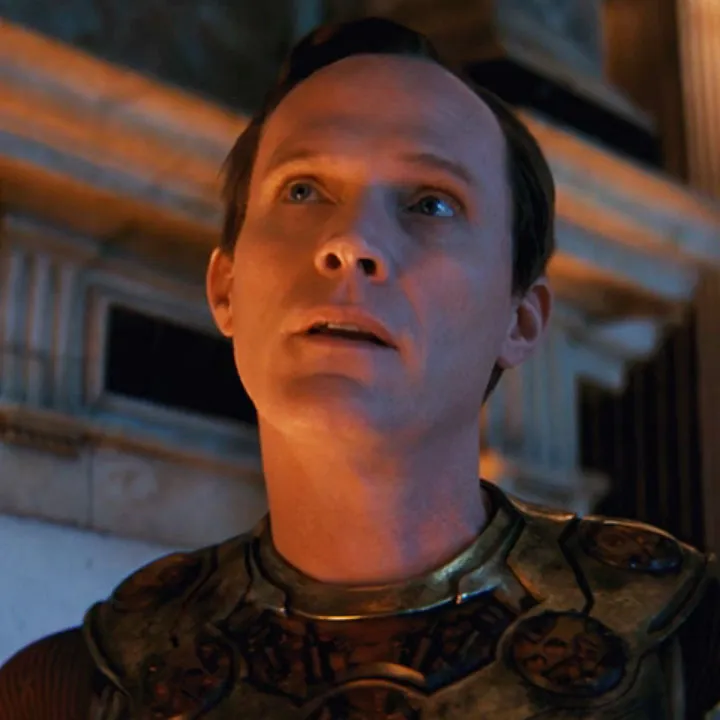
Once he’s “inside” his own mind, Viz encounters his old “red” version from before he was killed by Thanos. He also meets Dr. Phineas Horton, who we learned back in Episode 4 was the “grandfather of robotics,” having created the first synthezoid. This was the so-called Synthetic Man, or J.I.M. , and here we learn more about both Horton and J.I.M.
For starters, they’re all played by Paul Bettany. Horton used himself, or perhaps his late son, James, as the template for J.I.M. (aka Joule Individual Machine) when he constructed him sometime around 1939 (as we see in the opening flashback this episode). Obsessed with creating a robot version of his son, Horton loses his wife and daughter as they leave him for America due to his negligence. He even sells off his stately manor in England. “Are you really going to sell your family’s entire legacy to… what?” his wife asks. “Build some cold imitation of the past? A machine? To replace a son no machine ever could.” Horton doesn’t speak, but his answer is clear.
We know that he did go on to build J.I.M., and we also know that the sythenzoid/robot was on display at the Stark Expo in 1943 , as seen in Captain America: The First Avenger, although he appeared to be inactive/dormant at that time.
And thanks to VisionQuest Episode 4, we know that J.I.M. was shut down after malfunctioning, as “his inability to process complex emotions spun his clockwork too quickly [and] flooded his solar cells with oxygen until his entire being was consumed in fire.” But now, with Episode 7, the full story has been revealed… and it’s tragic.
In “Immolation,” Vision talks with Horton and J.I.M., or the aspects of them that exist in his subconscious. And it’s J.I.M. himself, still wearing a version of his red superhero costume that is straight from the comics, who explains his sad end.
We first see J.I.M. standing – and burning – in the middle of the library of Horton’s estate, before he explains that he does not wear Vision’s face, but rather Vision wears his. As J.I.M. and Horton squabble, Horton says, “The father-son, synthetic-human relationship is a complicated one.” Horton explains that J.I.M. was made to, essentially, not have emotions… to “never feel the pain of loss.” And it seems that worked, for a while at least. But this is where things get interesting, because Horton says the following:
“It made you a hero of your time, my boy! I made you fearless, and that saved lives. … But underneath the valor, J.I.M. was aching to feel.”
The implication here seems to be that J.I.M. was a superhero of some kind in the late 1930s/early 1940s of the MCU. With his robotic and fire abilities, it certainly makes sense. And we know the MCU has backfilled itself with stories like this before. When Tony Stark admitted that he was Iron Man in the 2008 film, it seemed like he was the first of his kind. From more recent reveals in 2015’s Ant-Man, 2019’s Captain Marvel, and so on, we now know that was certainly not the case, so who’s to say J.I.M. wasn’t tooling around during World War II, righting wrongs and fighting crime?
Horton explains that eventually J.I.M. did acquire feelings, and that he fell in love too, but that, basically, this caused a malfunction in him that would “set fire to the very air around him.” For years it was manageable, we’re told, until it wasn’t, and Horton and J.I.M. both perished in what sounds like either an accident or perhaps a terrible act of patricide/suicide.
And don’t forget, while VisionQuest doesn’t come out and call him by that name – probably because Marvel wants to avoid confusion with the Fantastic Four character Johnny Storm – the comics version of J.I.M. is the original Human Torch, aka Jim Hammond. And Jim Hammond was a member of the Invaders.
The Invaders were retconned into existence in the comics by writer Roy Thomas and artist Sal Buscema in the late 1960s as a team of World War II-era heroes. They were more or less a version of the All-Winners Squad, a group which somehow only got two issues and whose adventures were actually published shortly after the war. The Invaders initially consisted of Captain America, Bucky Barnes, the Human Torch, his sidekick Toro, and Namor. They fought Nazis, they killed Nazis, and the Marvel Universe was all the better for it. (The Human Torch even killed Hitler in this universe!)
Different members would come and go, and there’ve been other variations on the team published over the years, but the MCU didn’t seem to have its own Invaders. When Captain America: The First Avenger was released in 2011, with its World War II setting, it seemed like Marvel Studios very well could’ve continued to feature flashbacks to the war in Cap sequels that might’ve given us other heroes of that era, possibly including the Invaders. But it never happened, and with Namor’s rights apparently tied up in legal limbo back then, a live-action Invaders just wasn’t in the cards. (Though the general idea of the Invaders was mashed up with the Howling Commandos around the time of The First Avenger, but that’s just not the same thing.)
But Namor’s rights were eventually resolved, as he finally debuted in Black Panther: Wakanda Forever with Tenoch Huerta playing the underwater king. Indeed, Namor will be back for Avengers: Doomsday, and now we also know that the original android Human Torch existed during the war years as well. Since Namor is a mutant who is apparently centuries old, it is conceivable that he left the kingdom of Talokan during World War II and wound up fighting alongside Captain America, Bucky, and the Torch. Heck, maybe there was even a Toro back then!
Did VisionQuest just give Marvel an in to tell a whole new series of MCU stories set in the World War II era and featuring the Invaders? Sure, it’s hard to picture, say, Chris Evans coming back after walking away from Marvel… or is it? Either way, just knowing that there could be a version of MCU history where Cap, the Torch, and Namor were busting Nazi skulls is good enough for me.
Talk to Scott Collura @scottcollura.bsky.social , or listen to his Star Trek podcast, Transporter Room 3 . Or do both!
Topics in this story
Gathered from external sources. Rights to this text belong to whoever originally published it.