Trump finds close ally in Nvidia’s Huang at key AI juncture
Nvidia CEO Jensen Huang is becoming one of President Trump’s fiercest allies on AI at a critical juncture for the industry. In the face of mounting concerns over the future of AI, Huang is one of the few tech executives standing fully behind the president’s push to continue full steam ahead on AI, while others…
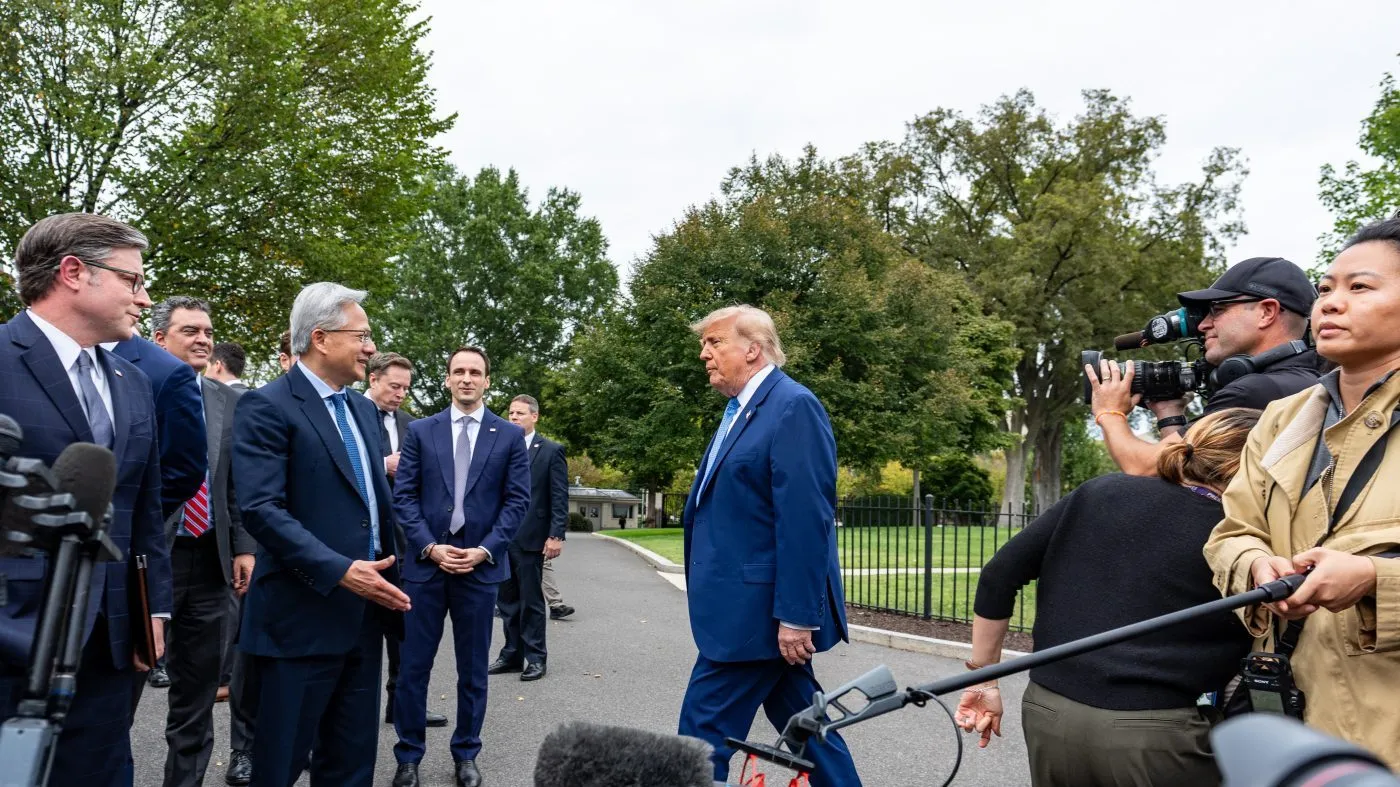
Nvidia CEO Jensen Huang is becoming one of President Trump’s fiercest allies on AI at a critical juncture for the industry.
In the face of mounting concerns over the future of AI, Huang is one of the few tech executives standing fully behind the president’s push to continue full steam ahead on AI, while others advocate for new safety guardrails or a development slowdown.
Despite meeting less than two years ago, Trump and Huang’s relationship quickly took off, proving mutually beneficial for the two leaders. With the explosion of the AI safety debate over the past few months, their allyship is on full display.
“Jensen is an engineer and that means he’s good at modifying inputs to get the outputs that he wants. And he has brought an engineering approach to Donald Trump,” Stephen Witt, the author of “The Thinking Machine,” a book covering the history of Nvidia, told The Hill.
Huang “has come to understand that the president has a bottomless need for validation, public validation, basically praise and Jensen shamelessly just supplies him with that, with praise, with flattery in public and private too,” Witt said. “The outputs are that Jensen gets what he wants, which is no regulation of AI and the ability to sell his equipment in China.”
Nvidia, once a relatively obscure chipmaker, is now the most valuable company in the world. Its most highly sought after chips, known as graphics processing units (GPUs), are central to AI development, putting the firm in a unique position.
The company’s success largely hinges on the future of the AI industry, which is facing mounting scrutiny over the technology’s long-term impacts on society, jobs and the environment.
A series of recent cybersecurity hacks, coupled with ominous warnings from AI researchers about the future of humanity, prompted some tech titans like Anthropic CEO Dario Amodei and OpenAI CEO Sam Altman to openly call for a slowdown on the tech’s development.
Despite calls from leaders and lawmakers to establish a national safety framework, Trump is going all-in on AI development and the data centers that power them, deferring policing to the firms themselves. The president has dismissed AI’s existential threats as a “hoax,” arguing the warnings from the so-called AI doomers are “things that won’t happen.”
In that same vein, Huang said recent warnings about AI’s catastrophic risks as “made up” and “not grounded in science. ” Probability estimates of societal collapse, according to Huang, are “irresponsible” and “ridiculous.”
Pressed on his position on Monday, Huang told reporters the industry should be “accelerating” AI development for safety, comparing it to the ways in which people test drive cars.
“I think capability and safety are really hand in hand,” Huang said. “The two are not conflicts. Innovation and trust are not conflicts with each other… There’s somehow this belief that you have to slow down in order to advance safety. That’s not true, I think that’s a false choice.”
Huang has argued the AI industry does not need new laws or regulations as many already exist, such as liabilities in the cybersecurity space.
“People like to attribute, I don’t know whether it’s nefariousness or financial motives to Jensen bowing to the Trump message,” said Sarah Kreps, director of the Tech Policy Institute at Cornell University.
“But I think it can be the opposite, which is that Trump has found someone whose perspective on the issue is close and whose company is so important to both economic and national security that it makes sense to ally with him,” she continued.
“Trump wants to be close to Jensen because … Jensen is really a big winner, like the biggest winner in capitalism right now,” Witt said. “And Jensen wants to be close to Trump because he sees a vector to make Nvidia’s stock price go up if he has an ally in the president.”
Speaking at the All-In Summit earlier this month, Huang took a call from Trump on stage. Holding the phone up to the microphone, Trump said “the robots are not going to be taking over the world.”
“We’re going to make sure that everybody wins in the AI race in America,” Huang responded.
The Trump administration often cites the global “AI race” as reason not to slow down the tech’s domestic development, arguing it will weaken the U.S.’s competitive standing with China.
“A slowdown in AI would very negatively impact Nvidia, but it might be that he’s in that business because he’s a believer,” Kreps said of Huang. “Those two perspectives correlate closely for good reason.”
Nvidia is spending billions to back the data center buildout, which is buying up the company’s equipment. But these projects are sometimes “funded by debt, and sometimes even subprime debt,” Witt noted.
“Jensen’s incentives are very much not to give in,” Witt said, adding, “They can’t really afford to slow down.”
At the same time, Nvidia’s operations drastically expanded in Washington under the second Trump term. Along with Huang’s meetings with administration officials and lawmakers, the company entered the election spending arena late last month, launching a corporate political action committee funded by employees.
Witt, who interviewed Huang a handful of times for his book published last year, said the CEO emerged, of all the technology executives, as Trump’s “most influential adviser.”
“When Trump goes on and says ‘there’s no risk, it’s all a hoax.’ Like those are Jensen’s talking points that he has been saying for years,” Witt suggested.
Huang was among a small group of executives sitting with Trump and Chinese President Xi Jinping during last week’s state dinner at the White House, while a seating chart of the White House’s AI lunch Tuesday showed the CEO sitting directly next to the president, with billionaire and former Trump adviser Elon Musk on the other side.
Their relationship has proven fruitful as the chipmaker navigates an ever-tenuous relationship between the U.S. and China.
Huang secured a major win late last year when Trump reversed course and allowed the firm to sell H20 chips, which were developed with U.S. exports in mind, to China for a 15 percent cut. Trump also cleared the way late last year for Nvidia to sell its more powerful H200 chips to China for a 25 percent cut of revenue.
“In Washington, when it comes to U.S.-China relations, hawks pretty much dominate foreign policy but then I think Jensen and Elon Musk, many business leaders seem to be more moderate, and they still prefer this engagement approach,” Zhiqun Zhu, a political science and international relations professor at Bucknell University, told The Hill.
“This kind of approach to China, not like a confrontational hawkish approach…you see that in Trump’s second term, his attitude towards China completely changed,” Zhu added.
Topics in this story
Gathered from external sources. Rights to this text belong to whoever originally published it.