Florida’s ‘Alligator Alcatraz’ confined migrants in ‘small metal enclosures’: DHS internal watchdog
A new report reviewing the conditions at the now-closed “Alligator Alcatraz” center in Florida slammed U.S. Immigration and Customs Enforcement (ICE) for failing to meet a variety of federal standards, describing “unprecedented” treatment of migrants, including containing them in cages about the size of a phone booth. The Monday report from the Department of Homeland…
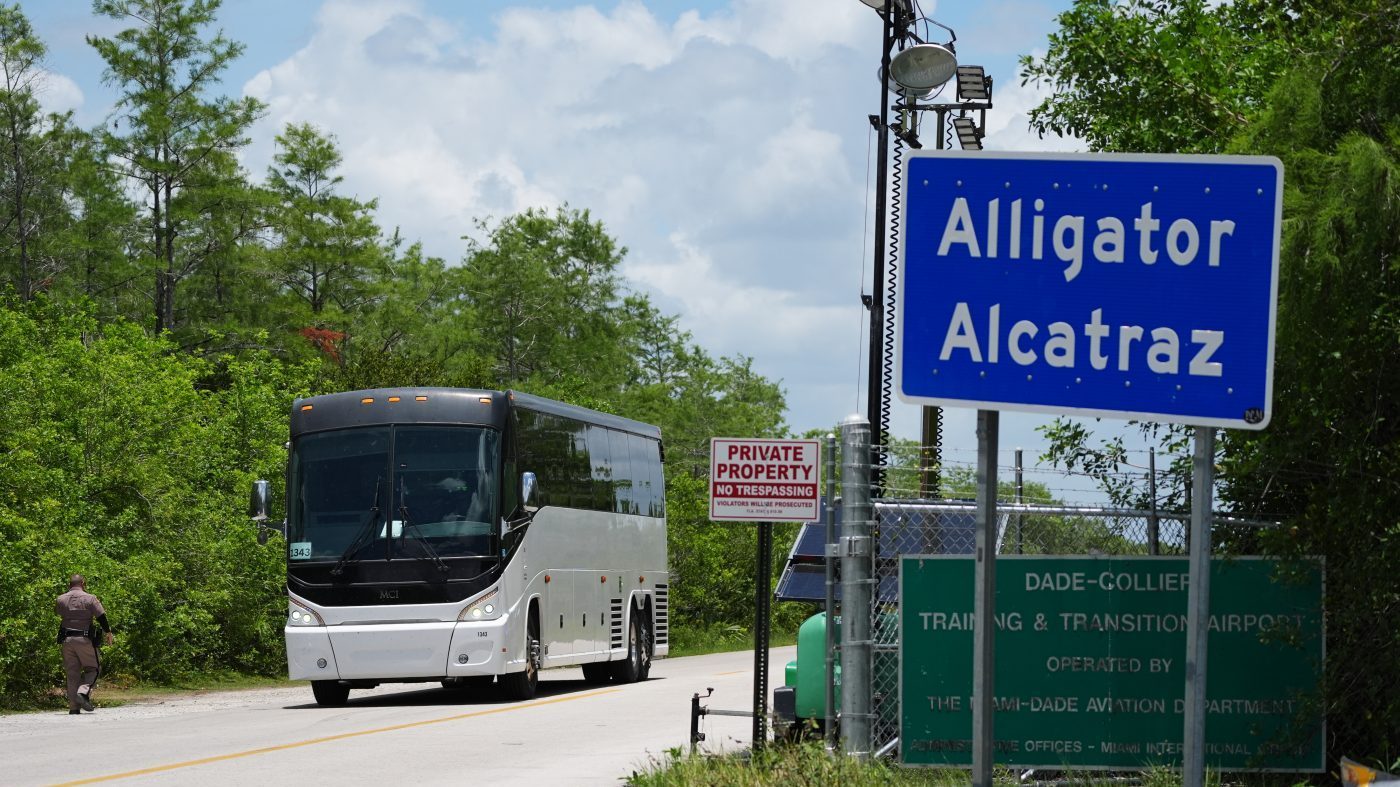
A new report reviewing the conditions at the now-closed “Alligator Alcatraz” center in Florida slammed U.S. Immigration and Customs Enforcement (ICE) for failing to meet a variety of federal standards, describing “unprecedented” treatment of migrants, including containing them in cages about the size of a phone booth.
The Monday report from the Department of Homeland Security’s (DHS) Office of Inspector General (OIG) is the first such federal review of the facility, which is referred to in the report as the Florida Soft-Sided Facility (FSSF).
The report describes alarming conditions, including unhygienic practices for food and water as well as limited opportunities for migrants to bathe themselves.
OIG said Alligator Alcatraz provided half the living space for migrants required under federal law — just 28 square feet when the facility was at max capacity, far from the 75-square-foot mandate.
ICE officials also used cages that were roughly 4 feet by 4 feet as “‘calming areas’ for detainees to deescalate and have time alone.”
“FSSF confined 79 detainees in small metal enclosures — each offering about 18 square feet of floor space — for periods ranging from several minutes to nearly 2 hours, a practice unlike any OIG team has observed in ICE facilities. The use of such restrictive spaces is highly unconventional and does not align with standards for humane treatment,” OIG wrote.
OIG found that in at least one documented case, a migrant was put in the small cages as a punishment.
The report generated swift blowback from immigration advocates who targeted ICE’s explanation for the small cages.
“There is no euphemism that can sanitize caging human beings. Calling a metal box a ‘calming area’ is an affront to the English language and to human dignity alike,” Krish O’Mara Vignarajah, president and CEO of refugee settlement agency Global Refuge, said in a statement.
“The stark reality is that human beings, many of whom came to this country seeking protection, were crammed into spaces unfit to accommodate them, denied adequate medical care, food, and basic hygiene — and in at least one case locked in a cage as punishment. That is not immigration enforcement. It is cruelty, carried out in our name and on our dime, to the tune of more than a million dollars a day.”
OIG said they were unable to “independently confirm or refute ICE officials’ assertions regarding their use of the enclosures” as well as other allegations, such as deprivation of food or water issues described in a prior Amnesty International report, as none of the detainees interviewed while OIG was there reported those conditions.
“Use of these small metal enclosures for any reason is unprecedented among ICE facilities inspected by OIG. Confining individuals in small metal enclosures for any reason presents significant risks to detainee health and well-being,” the watchdog wrote.
Both ICE and DHS did not immediately respond to request for comment.
In the report, however, the agency and department placed much of the responsibility for the facility on Florida, despite it being constructed with federal funds and managed by ICE agents.
“While FEMA [Federal Emergency Management Agency] provided funding for the Florida Soft-Sided Facility (FSSF) under the Shelter and Services Program, DHS did not have a contract with Florida to manage the detention space within the facility. The State of Florida authorized the repurposing of the center from the Dade-Collier Training and Transition Airport into a state detention center,” DHS officials wrote in a letter in response to the report.
Other aspects also generated significant attention from inspectors.
Several detainees told OIG investigators they did not have access to clean water, saying that self-serve water stations were dirty. Migrants were also given a cup but said they had no way to wash it.
Some were also only scheduled to shower three days a week, and the report includes photos of the showers covered in bugs.
Topics in this story
Gathered from external sources. Rights to this text belong to whoever originally published it.