Tim Cook hands over reins of Apple, but remains Trump whisperer
Apple’s Tim Cook handed over the reins as CEO to John Ternus on Tuesday, but the technology giant won’t be losing his political clout and connections to Washington. In his new role as executive chair of Apple’s board, Cook will focus on policy, leveraging the political muscle he’s built over the past 15 years to…
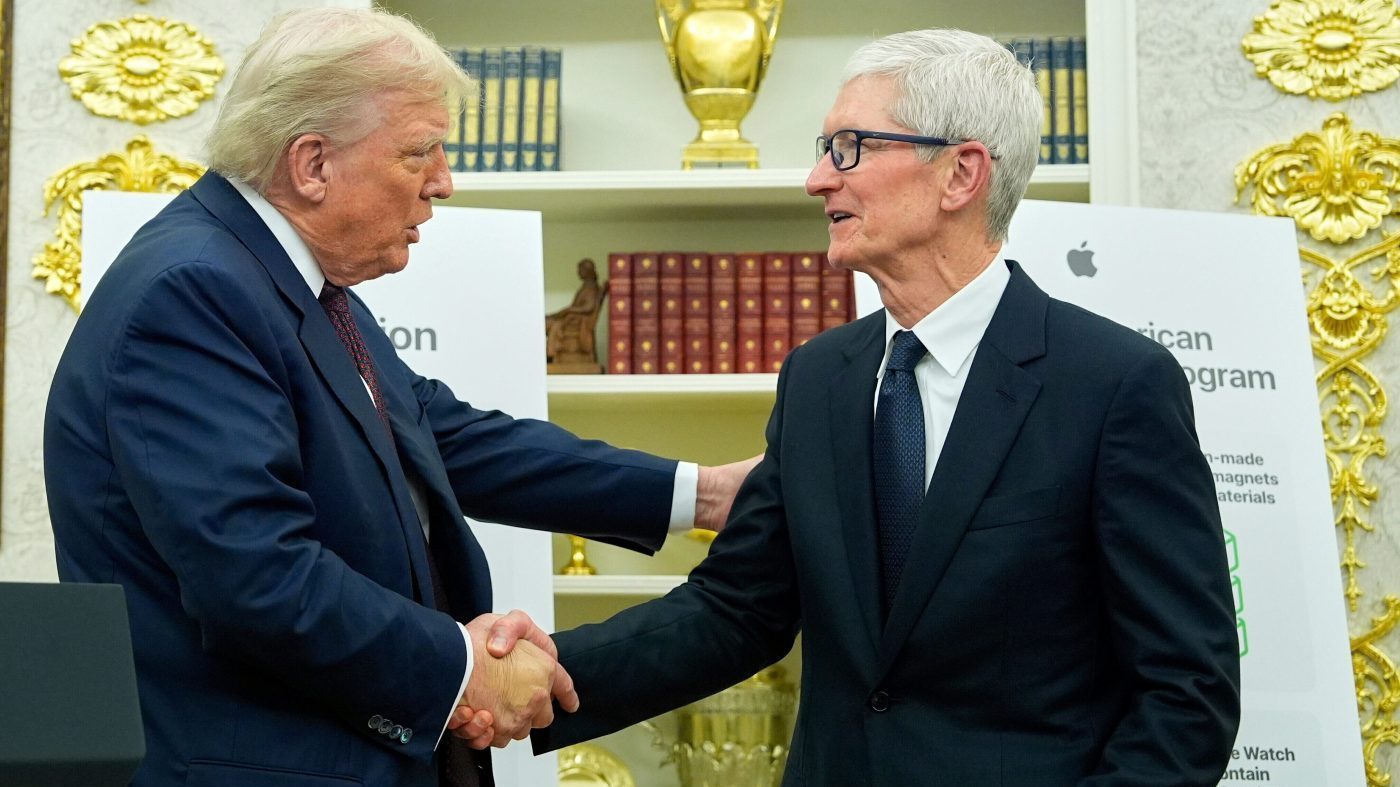
Apple’s Tim Cook handed over the reins as CEO to John Ternus on Tuesday, but the technology giant won’t be losing his political clout and connections to Washington.
In his new role as executive chair of Apple’s board, Cook will focus on policy, leveraging the political muscle he’s built over the past 15 years to navigate the White House’s shifting trade policy and fierce competition with China.
Cook is a “major asset to Apple” regardless of his position, Dan Ives, partner and senior managing director at Yorkville Ives, told The Hill on Monday.
“It’s not just for Apple, but [Cook] plays a key role for the tech industry going into this landscape with AI, political debates in the U.S. around data centers, the U.S.-China battle for tech supremacy,” Ives said.
Announcing his decision to step down as CEO in April, Apple said Cook will “assist with certain aspects of the company” as executive chair, including “engaging with policymakers around the world.” Specifically, Cook told Ternus he will manage Apple’s relationships with President Trump and the Chinese government, Bloomberg reported .
Cook, who served as Apple’s CEO since 2011, is among a handful of technology leaders who built a friendly rapport with Trump, despite occasional tensions in the president’s first and second terms.
Shortly after Cook announced he would step down as CEO, Trump said he has “ always been a big fan ” of the executive, calling him “an amazing manager and leader.”
Technology analysts predict Cook’s relationship with Trump will be key to ensuring Apple’s success as Ternus — a product designer with little political experience — steps into the role.
“Ternus really is a product guy … it makes sense for Cook to say, ‘Look, John, you run the product show right now, and I’ll handle these policy and relationship issues while you get your feet on the ground,’” said David Pogue, a veteran technology journalist and CBS News “Sunday Morning” correspondent who recently published the book “Apple: The First 50 Years.”
While Cook previously served as Apple’s chief operating officer, tackling sales, operations and supply chain logistics, Ternus’s 25 years at Apple were spent on hardware and product design.
The new CEO played a major role in the release of new products like the iPad and AirPods, most recently serving as the company’s senior vice president of hardware engineering.
Ternus is walking into the role under pressure to tackle the company’s lagging development of artificial intelligence and the rollout of Apple’s newest products at the company’s annual event next week.
Unlike many CEO transitions, Ternus will be able to focus on this with assistance from Cook and his 15 years of working with governments around the world.
The former CEO’s political maneuvering has been on full display during Trump’s first and second terms, including during the height of Trump’s tariff war last year, when Trump announced massive “reciprocal” tariffs on other nations, including China.
The tariffs exposed Apple to potential losses since the majority of its products are made in China and other parts of Asia.
But two days after Trump’s announcement in April 2025, Trump exempted electronics like phones, computers, routers and semiconductor chips, saying he “helped” Cook and “that whole business” by doing so. Apple regained its $3 trillion market cap following the exemption.
Reports later circulated that Cook spoke with Commerce Secretary Howard Lutnick about the potential impact of the tariffs on iPhone prices, but he did not publicly criticize the president or his trade decisions.
The move drew scrutiny from Democrats, who pointed to Cook’s $1 million donation to Trump’s inauguration fund and attendance at the ceremony. Other technology CEOs — like Meta’s Mark Zuckerberg, OpenAI’s Sam Altman and Amazon’s Jeff Bezos — also donated large sums to the fund and stood behind the president during his swearing-in.
“If the tariffs went into effect, it would have been disastrous for Apple and its shareholders and its customers. It would have perhaps doubled the price of an iPhone. It doesn’t take a detective to realize that if Cook could get Trump’s ear on this tariff decision, then it would benefit Apple and its constituents,” Pogue said.
In the following month, Trump announced a deal to lower tariffs on Chinese imports to 30 percent from 145 percent, adding he spoke to Cook that morning, during which the then-CEO vowed to open more plants in the U.S.
But at the same time, Cook faced public pressure from Trump to reshore Apple manufacturing from India to the U.S.
About two months later, Cook joined Trump in the Oval Office to announce an additional $100 billion investment into U.S. manufacturing, bringing the company’s total investment to $600 billion. During the event, Cook gifted Trump a glass dish with a 24-karat gold base designed by a former Marine who works at Apple.
“This is all either sickeningly subservient or shrewdly strategic, depending on your politics,” Pogue added.
While donating funds or gifts to governments is nothing new for business, Trump’s emphasis on personal relationships with leaders, combined with his fluctuating temperament, makes getting along with the president more important than ever now, experts said.
“We have a president who takes perceived slights much more seriously than various others, and so the business people of the world, whose primary job is to do well in business, of course, see that as an opportunity and a necessity to please the president,” Pogue said.
Damaged relationships between companies and the Trump administration have proved costly before. Ives pointed to this year’s spat between the Pentagon and AI firm Anthropic, which lost a contract after CEO Dario Amodei demanded certain safety guardrails for the use of AI on the battlefield.
The disagreement quickly became a culture turf war between Anthropic and the Trump administration, and it showcased how businesses could suffer as a result of disagreement with the government.
“I don’t think other tech companies want to be in that role,” Ives said.
Cook’s expertise on global affairs — especially China — is also likely to benefit Apple’s interests, as the former CEO balanced the line between maintaining relations with the Chinese government and appeasing Trump’s demands for domestic manufacturing.
“Trump’s always viewed Cook, despite some of the speed bumps, as someone that’s very plugged into not just the tech world, but also when it comes to China, and his importance is going to remain,” Ives said.
Over the next few weeks, all eyes are on Ternus and the direction Apple takes on AI as a product builder himself.
Cook, in a Monday memo to staff, wrote that “few people understand what it takes to build products that change the world the way John does.”
“It’s pretty clear that Apple has lagged when it comes to AI, so I think they are smart to put a product person as CEO because I think they really need to push more aggressively into AI hardware, AI-era hardware,” Sarah Kreps, director of the Tech Policy Institute in the Cornell Brooks School of Public Policy, told The Hill.
Topics in this story
Gathered from external sources. Rights to this text belong to whoever originally published it.