Bessent predicts Strait of Hormuz will be ‘worthless’ in 2 years
Treasury Secretary Scott Bessent said Tuesday that the Strait of Hormuz will be “worthless” to the oil industry in two years. Speaking to Fox Business’s Larry Kudlow on the sidelines of the Group of 20 finance ministers’ summit in North Carolina, Bessent argued the key waterway is “not a choke point” for the U.S. In…
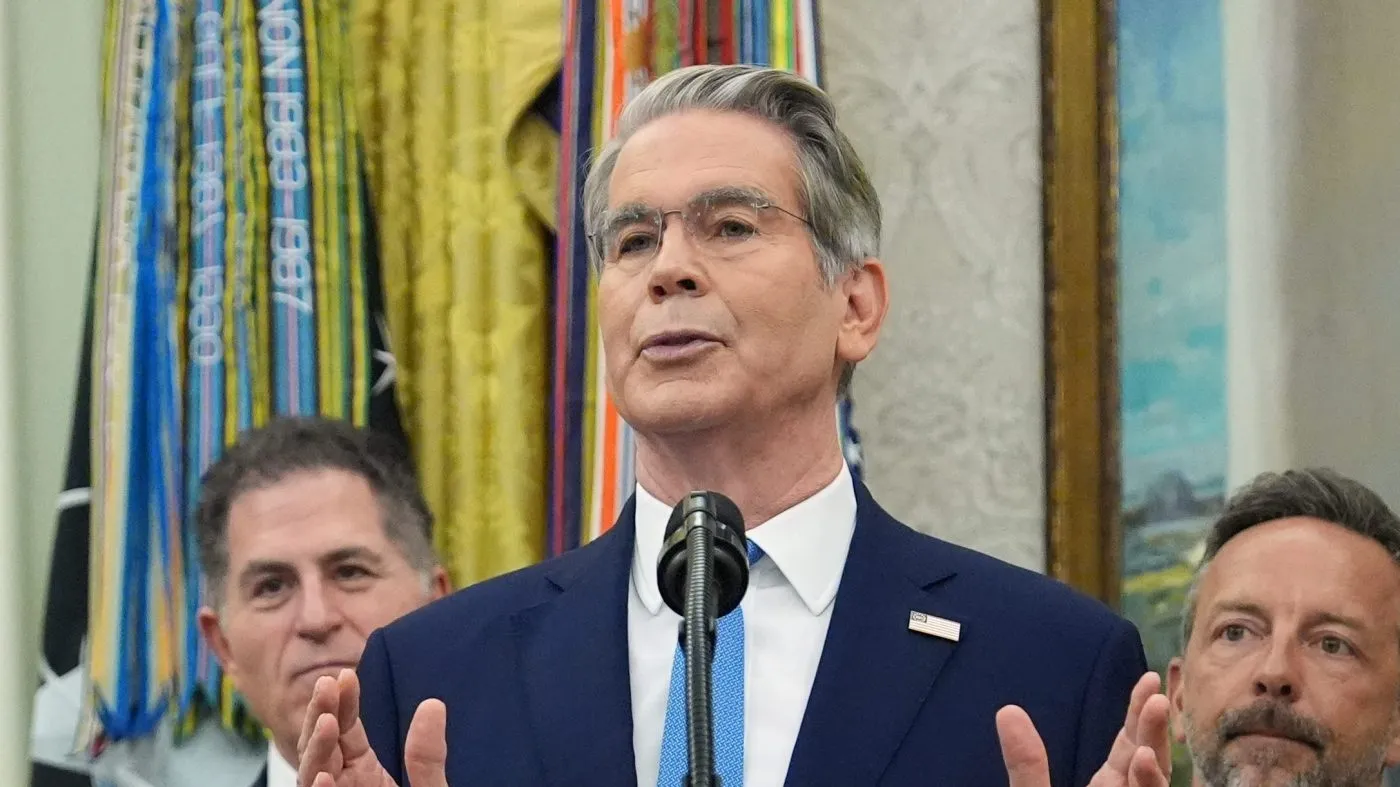
Treasury Secretary Scott Bessent said Tuesday that the Strait of Hormuz will be “worthless” to the oil industry in two years.
Speaking to Fox Business’s Larry Kudlow on the sidelines of the Group of 20 finance ministers’ summit in North Carolina, Bessent argued the key waterway is “not a choke point” for the U.S.
In 2024, the country imported roughly half a million barrels of crude oil per day from Persian Gulf countries through the strait, accounting for 7 percent of total U.S. crude oil, according to the Energy Information Administration (EIA).
The analysis from the EIA noted that U.S. crude oil imports from Persian Gulf nations hit their lowest level in nearly 40 years, as “domestic production and imports from Canada have increased.”
Bessent noted the strait is a choke point for “many, many other countries.” Nearly 34 percent of the world’s crude oil passed through the waterway in 2025, per the International Energy Agency (IEA) — which noted “most” of those exports went to Asian countries.
But the Treasury secretary said the strait’s role in the oil trade “will be bypassed” in two years.
“In two years, the Strait of Hormuz will be… a worthless piece of water,” he told Kudlow, adding oil “will be going on pipelines across land.”
The Iranian military’s restrictions on shipping in the strait over six-plus months of war have slowed traffic, resulting in an increase in oil prices.
Brent crude oil, the international benchmark, is trading at more than $95 per barrel as of 3:30 p.m. EDT Wednesday, after closing at $72.48 the day before the U.S. and Israel launched the war in late February.
Gas prices in the U.S. have also spiked, with the national average cost of a gallon of regular gas sitting at $4.09 on Tuesday, according to AAA . Two days before the conflict began, gas in the U.S. cost $2.98 per gallon, AAA reported .
Saudi Arabia and the United Arab Emirates (UAE) have operational pipelines to bypass the Strait of Hormuz, the IEA notes.
Multiple Middle Eastern governments, including Saudi Arabia, the UAE, Iraq and Turkey, have reached agreements with each other to construct oil pipelines . But those pipelines could take multiple years to build, indicating the Strait of Hormuz will remain a key part of the oil trade.
The U.S. military has sought to establish a foothold over the waterway in recent months, guiding tankers through a southern channel of the strait along the coast of Oman and enforcing a monthslong blockade of Iranian ports.
Those moves are part of the Trump administration’s attempts to inflict financial pain on the Islamic Republic, as the Treasury Department ramped up its economic campaign against the regime last week.
The Treasury’s actions included the sanctioning of nearly 60 entities, individuals and vessels that “enable” the Iranian government, with Bessent warning countries to cut financial ties with Iran or risk being cut off from the U.S. dollar system.
On Tuesday, Bessent said the administration has “seen great support” from foreign countries regarding its economic warfare campaign.
“We have zero tolerance,” he told Kudlow. “We are going to economically asphyxiate this regime.”
Topics in this story
Gathered from external sources. Rights to this text belong to whoever originally published it.