Volunteers recovered 255,000 weather records from 19th-century British naval logs; the data could extend climate records back more than 160 years
More than 255,000 historical weather records have been recovered from British Royal Navy ship logbooks dating back to the 19th century.
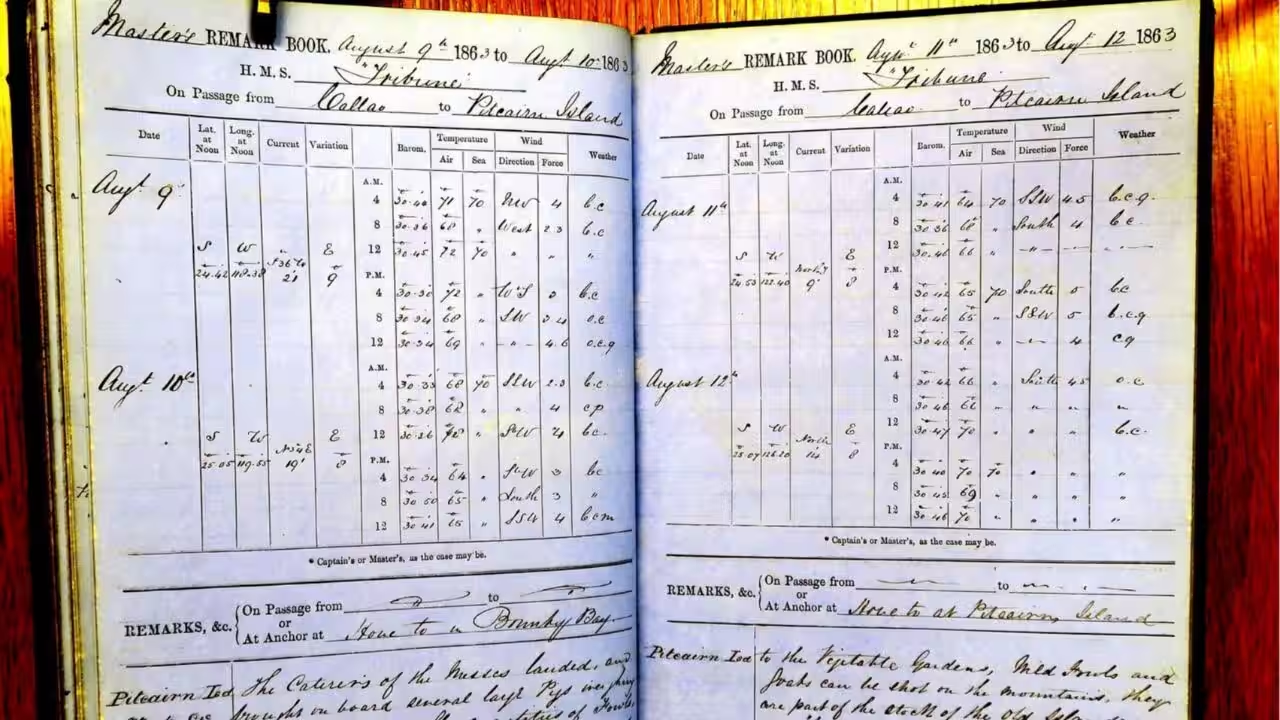
More than 255,000 historical weather records have been recovered from British Royal Navy ship logbooks dating back to the 19th century. Thousands of volunteers transcribed the observations from scanned handwritten pages as part of the Weather Rescue at Sea project, bringing together information recorded across several ocean basins. The resulting dataset covers weather conditions documented between 1861 and 1865, adding valuable records from a period when modern climate observations were still limited. The findings were published in the Geoscience Data Journal.Recovering 255,000 weather records from British naval logsThe records came from Royal Navy logbooks covering voyages made during the 1860s. According to the study titled ‘Weather Rescue at Sea: Recovering Historical Weather Observations From 19th Century British Naval Ships,’ the collection contains more than 255,000 observations with information on position, date and time, air pressure, air temperature, sea surface temperature, wind direction and wind speed. The dataset stretches from April 1861 to March 1865 and includes observations from almost all ocean basins.The logbooks were not simply diaries of life aboard naval ships. They were working records used for navigation and the day-to-day operation of vessels. Weather observations formed an important part of them, creating a detailed record of conditions encountered during long journeys.Many of the handwritten logs recorded observations at 4-hour intervals. A typical page could contain four days of entries, with information arranged in columns covering different weather measurements. The ship's position was generally recorded at noon, while weather observations could be made as many as 6 times each day.Importance of old records for climate historyThe value of these records comes partly from where the ships travelled. The study explains that historical weather observations are often sparse across large parts of the world's oceans, particularly in areas away from major trade routes. The recovered naval observations add information from places where existing climate datasets have fewer records.The dataset includes observations from the North and South Atlantic, Indian Ocean and parts of the Pacific. It also reaches less frequently represented areas, including waters around Hawaii, the west coast of South America and the Southern Ocean. Some observations came from the Sea of Japan and South China Sea, where the researchers note that earlier datasets had relatively few records.This matters because scientists need long records to understand how weather and climate have varied over time. The study says that adding these observations to larger historical datasets can help fill gaps in both time and geographical coverage and contribute to reconstructions of pre-industrial and early-industrial climate.Methodology used by volunteers to recover weather data from old naval logsThe recovery effort depended on people being able to make sense of handwriting produced more than 150 years ago. Weather Rescue at Sea was launched on the Zooniverse platform in October 2021, asking volunteers to transcribe observations from scanned Royal Navy logbook pages.The project created separate workflows for navigation, air pressure, air temperature, sea surface temperature, wind direction and wind speed. Volunteers were given tutorials, a field guide and access to a community forum. The system was designed so that people without previous experience in climate science or historical transcription could take part.The study reports that 4,500 volunteers transcribed 190 logbooks over 18 months. Each image was normally transcribed by 4 volunteers, while wind observations required 6. Having several people independently enter the same information made it possible to compare their results and identify likely transcription mistakes.How the researchers approached the recovered informationRecovering the numbers was only one part of the work. Historical records can contain mistakes originating from the original observations, the handwriting or the modern transcription process.The researchers therefore compared multiple volunteer entries for the same record. When all entries agreed, the value was accepted. Where there was a majority, that value was used, while entries without a clear agreement could be marked as inconsistent. Each observation also received a confidence flag showing how consistently volunteers had recorded it.The project also faced difficulties with old place names. Ships sometimes recorded their locations using the names of ports or landmarks instead of latitude and longitude. Volunteers helped create a geolocation table matching these historical names with positions, while gaps between recorded ship positions were filled using simple interpolation where the movement was considered physically plausible.The naval observations can strengthen longer climate recordsThe study does not present the recovered records as a finished replacement for existing climate datasets. Instead, it describes them as a new source that can be incorporated into larger collections.One comparison in the study found that the rescued dataset contained around 11,000 monthly marine air-temperature observations for the 1860s, compared with about 9,000 in the International Comprehensive Ocean–Atmosphere Data Set for the same decade. However, the new observations were concentrated in fewer ocean areas, so their value lies particularly in the locations and period they help document.The difference was even more noticeable for air-pressure observations, where the new dataset contained almost twice as many observations as the comparable records in the existing dataset for the same period. The researchers say such additions can improve long-term climate reconstructions and provide more information for systems that recreate past atmospheric conditions.The study notes that at least hundreds of thousands of ship logbooks still need to be transcribed, while the true number could be much larger when undiscovered and non-English records are considered.
Topics in this story
Gathered from external sources. Rights to this text belong to whoever originally published it.