A spacecraft flew through a strange S-shaped twist in space; scientists traced it back to the Sun
The Solar Orbiter spacecraft has unveiled the origins of mysterious S-shaped twists in the Sun's magnetic field, revealing key insights that connect solar phenomena to the solar wind and the Sun's atmosphere.
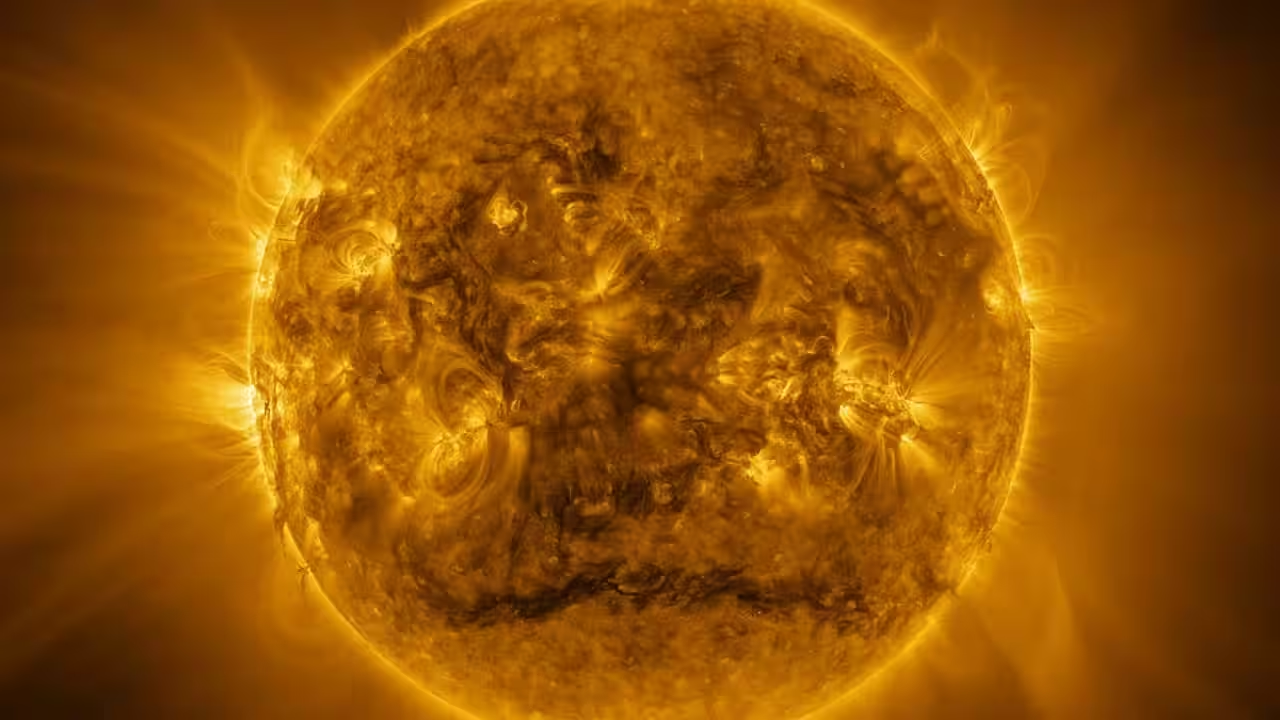
Somewhere between Earth and the Sun, a spacecraft drifted through an S-shaped bend in the solar magnetic field. The European Space Agency’s (ESA) report on the findings, published on 8th October 2026, said the clues pointed to the Sun’s lowest atmosphere. According to the ESA report on the Nature Astronomy study, Solar Orbiter was roughly halfway between Earth and the Sun when it crossed the switchback and its Solar Wind Analyser picked up a mix of charged oxygen and carbon particles that could only have formed in hot magnetic loops. Those fingerprints pointed to interchange reconnection in the Sun’s atmosphere, while the plasma’s later motion still showed the hallmarks of the waves and turbulence.Solar Orbiter’s flight through a very large switchbackThis magnetic field is mobile. It is carried away from the Sun by a constant flow of hot charged particles known as the solar wind. These field lines are not always straight; they can break, twist or even fold back. When this occurs sharply, it is referred to as a switchback. The new work comes from the study On the Coronal Origin of Magnetic Switchbacks in the Solar Wind, published in Nature Astronomy and led by Jesse Coburn of CNRS/LPP in France. According to Coburn, this is where the Solar Orbiter sampled rare particles within this massive switchback structure. The paper reports measurements from Solar Orbiter at 0.55AU, using heavy-ion data to trace the structure’s source. Elevated oxygen and carbon charge-state ratios, together with a relative helium depletion, indicate the plasma came from hot closed coronal loops and the author says a semi-empirical coronal model links it to either a coronal-hole boundary or loops within the hole.Oxygen and carbon ions that point to hot magnetic loopsThere were charged oxygen and carbon ions in the plasma. The mix of ions meant the plasma was created in hot magnetic loops in the Sun’s lower atmosphere. Coburn referred to the mix of ions as the “smoking gun” for the process of interchange reconnection. In some parts of the solar atmosphere, the field lines are open and they extend into space. However, in other regions, there are closed loops which bend back toward the Sun. When an open region is close to a closed one, the field lines may come together and break and reconnect, allowing the plasma from the loop to escape.Waves and turbulence appear to shape the journeyThe alternative theory focuses on waves and turbulence. As for the above-mentioned study, it shows that this phenomenon has been observed but probably only after the switchback has travelled out of the solar atmosphere. According to Stephanienn Yardley, co-author of the study from Northumbria University in the UK, waves and turbulence govern the structure’s dynamics once it has travelled away from the Sun.Thus, the two theories may describe different phases of a single switchback’s evolution. To determine its origin, scientists had to examine images of the Sun’s disc and develop models for its magnetic fields, both solar and interplanetary.A switchback first spotted in the corona in 2022This was not the first time a Solar Orbiter had caught one. The Observation of a Magnetic Switchback in the Solar Corona study, published in Astrophysical Journal Letters in 2022 and led by Daniele Telloni, reported images from the spacecraft’s Metis coronagraph. Researchers observed a single, large, propagating S-shaped vortex, which they interpreted as possible evidence of a magnetic switchback in the solar corona. It originated from an active region, in which a set of loops existed between the open field regions on its eastern and western edges. The researchers led by Telloni also highlighted that Parker Solar Probe had already found the switchbacks extensively in interplanetary space, but the nature of the process and origins still remain unanswered. Their observations, simulations and theories provide substantial evidence about the interchange reconnection process. The ESA also noted that the 2022 discovery confirmed the S-shaped structure that scientists had proposed earlier.What the findings mean for solar stormsThe finding offers insight into how the Sun heats its atmosphere and drives charged particles away from the star. In addition, this finding indicates that the Sun’s atmosphere is imprinted onto the particles of the solar wind, potentially allowing for reconstruction of the history of the solar plasma at a great distance from the Sun. Daniel Müller, ESA Project Scientist for Solar Orbiter, stated that the solar wind connects Earth and the Sun and that studying it will help prepare for solar storms.
Topics in this story
Gathered from external sources. Rights to this text belong to whoever originally published it.