In 1941, North Carolina engineers laid a 3,000-foot runway from perforated steel mats in 11 days; by World War II, similar runways could be ready within 72 hours
Explore how North Carolina engineers innovated runway technology during World War II, drastically reducing runway preparation times from 11 days to 72 hours with the Marston Mat. Discover the evolution of prefabricated aviation surfaces and their impact on military operations.
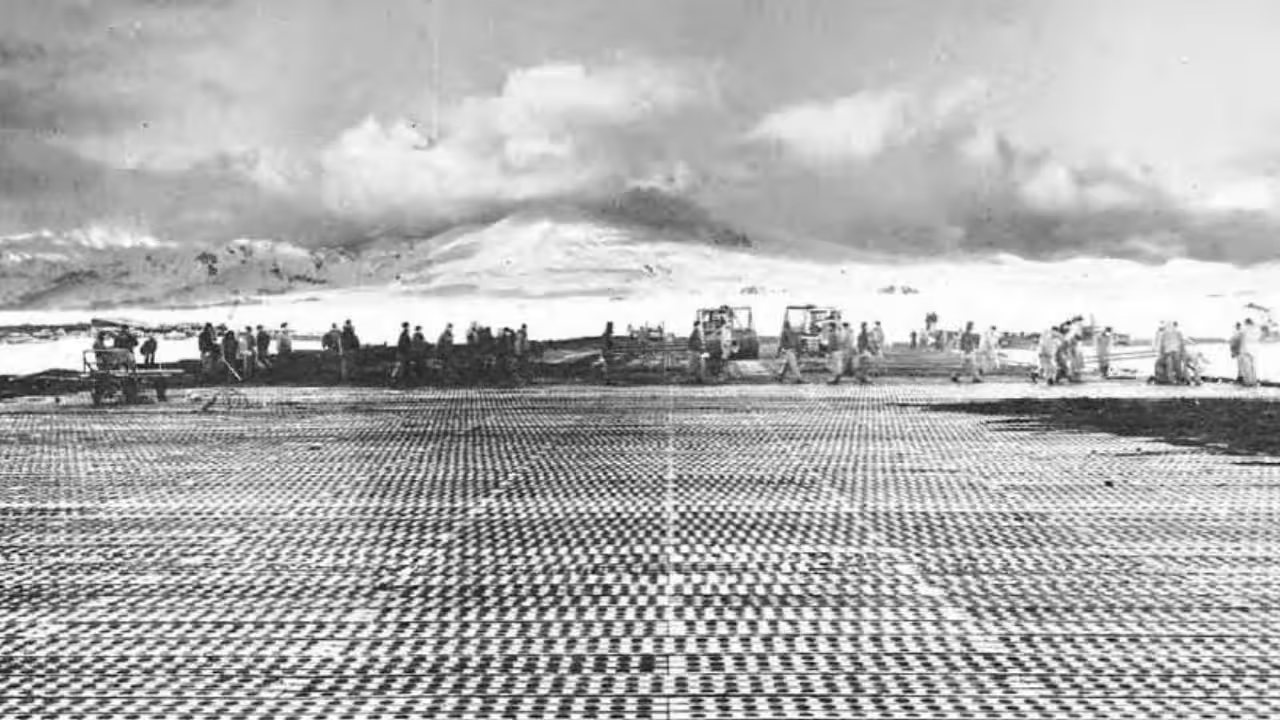
An aeroplane is only as useful as the ground it lands on. Soft soil swallows wheels, and a turf field can become badly rutted after sustained rain and heavy aircraft use. For an army that expects to move its aircraft close to the fighting, the time needed to prepare a landing strip matters nearly as much as the aircraft themselves. Conventional paving provides a solution to the problem but requires time, machinery, and plenty of material, which is not something that a forward unit can always have available. This is why engineers developed a prefabricated steel mat. Air Force Magazine notes that it packed tightly for ocean shipment, that one man could handle a section with a sledge, usually the only tool needed to lay it, and that two men with pry bars could remove a single mat.Marston mat development from December 1939 to the pierced design of winter 1940 to 1941The Wisconsin Aviation Hall of Fame traces the development of the Marston mat to December 1939. Early versions tested in the summer of 1940 were solid ribbed steel, and changes over the following winter produced the production design with punched holes. The Hall of Fame lists the panels as 10 feet long, 15 inches wide and 0.140 inches thick, each weighing 66 pounds. The Hall of Fame describes 87 punched holes, arranged in three rows of 29 along the length of each panel, and a slot-and-tab interlock along the edges that held adjacent panels together. Air Force Magazine, in its April 1989 articleMarston Mat, attributes the design to Gerald G. Greulich of the Carnegie Illinois Steel Company, with many contributions from the Army Corps of Engineers. The article adds that the Air Force specified a material of no more than 7 pounds per square foot, while the mat weighed 5.3 pounds per square foot.The Marston strip of November 1941: a 3,000-by-150-foot runway built in 11 days, including site preparationAccording to the Hall of Fame, the 3,000-foot-long, 150-foot-wide runway was built at Camp Mackall near Marston, North Carolina, during Army maneuvers in November 1941. The runway was built in 11 days, a figure given by both the Hall of Fame and Air Force Magazine. Hap Arnold, then Chief of the Army Air Corps, described the event as “the year’s greatest achievement in aviation warfare,” the Hall of Fame notes. This runway did not last. According to Air Force Magazine, it remained in use for only a few weeks before being disassembled and transported in 18 gondola cars to Langley Field, Virginia.What the 11 days covered: grading and moving 50,000 cubic yards of earthThe 11 days were not spent only on laying steel. Air Force Magazine reports that the period included clearing and grading an area of 350 by 3,800 feet and moving about 50,000 cubic yards of earth. Transportation and installation presented logistical challenges. The Hall of Fame adds that in the Pacific, the Navy’s Seabees could build a 5,000-foot-long, 200-foot-wide runway in two days, laying the matting over a rolled surface of crushed coral. Supply soon increased, and Air Force Magazine reports that by December 1941 two factories had manufactured about four million square feet of mat, and that a year later 29 factories were producing it.ANOAA Ocean Exploration feature by Matthew Hanks of the National Park Service describes a National Park Service and NOAA dive project off Guam, where divers found five sections of pierced steel planking off Agat Beach. The feature states that by the end of the war, Seabee crews could clear, grade, plank and complete a 3,000-foot runway in less than 72 hours, and that the planking also let them stabilise sandy beaches quickly so that supplies could move ashore. The two-day, 72-hour and 11-day figures describe different projects and conditions, so they are not directly comparable and should not be read as a steady progression.Replacement in the late 1950s and the matting research that followedThe Hall of Fame notes that as aluminium became more available for non-aircraft uses, an aluminium version of the planking appeared, and that pierced planking was replaced in the late 1950s as aircraft grew heavier and turned to jet power. It adds that during the Vietnam War a solid, corrugated steel mat, the M8A1, was developed to limit foreign object damage (FOD), and that AM2 aluminium matting later replaced it and is still in use today. The same concern with FOD runs through Recent Advances in Matting Technology for Military Runways, a paper that opens with a historical overview of military mats.
Topics in this story
Gathered from external sources. Rights to this text belong to whoever originally published it.