In Sweden, builders used pulp-mill boiler ash to stabilize sandy forest roads instead of conventional material; field monitoring found it effective and potentially cost-competitive
In Sweden, a groundbreaking study reveals that pulp-mill boiler ash can effectively stabilize sandy roads, offering a cost-competitive alternative to traditional materials. Field trials demonstrate improved bearing capacity and environmental safety, making this an exciting development for the forestry sector.
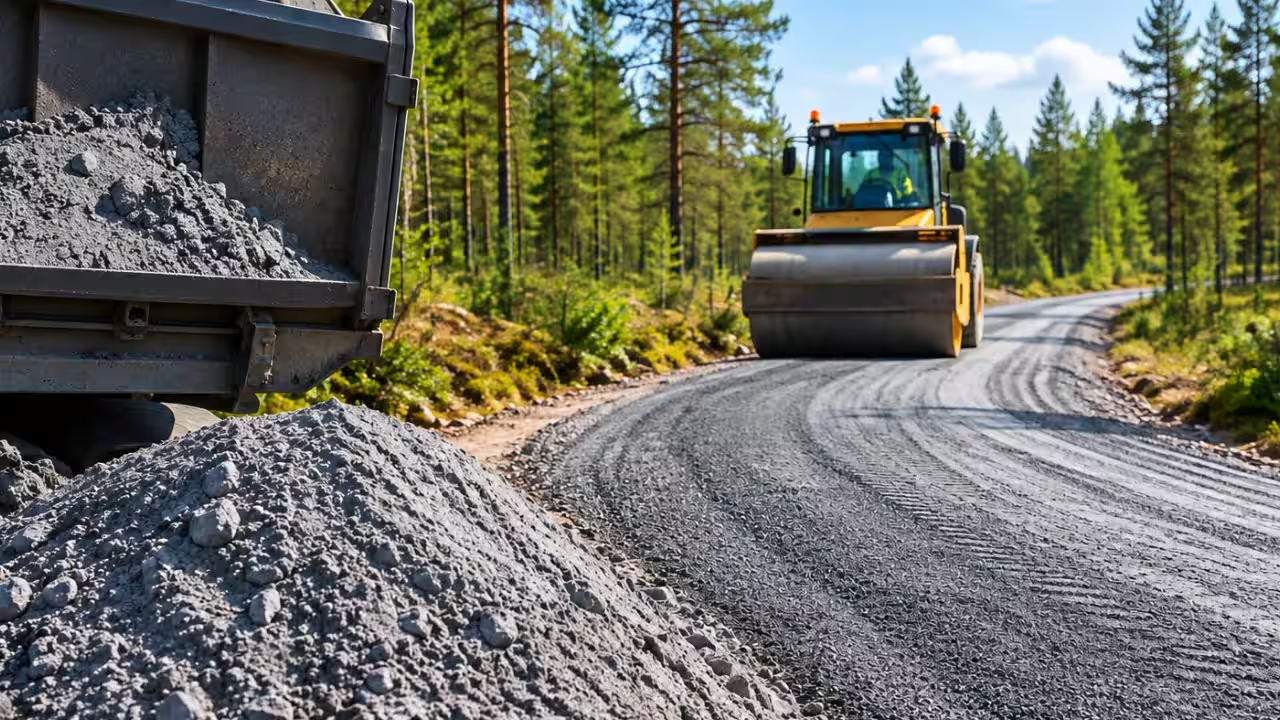
Forestry depends on roads that can reliably carry heavy timber transport. In Sweden, gravel roads can lose bearing capacity during the spring thaw, when meltwater is trapped in the road and the surface softens. Road owners may need to restrict traffic until the road recovers, so upgrading these roads matters to foresters and to the people who maintain them. Pulp and paper mills face a different problem. Many burn bark and other wood residues to produce energy, and combustion leaves ash that has to be disposed of. One option is landfill disposal, but studies have also examined using the ash in road construction. The trials carried out in Sweden for this research explore the feasibility of adding strength to roads through forest industry residue and at what cost.Sörkrånge road in Timrå: 30% Ortviken fly ash in the base layer, June 2009The best known Swedish example is a gravel road at Sörkrånge in Timrå municipality, upgraded in June 2009, as described in a 2021 Energiforsk report on the road’s first decade. The Swedish Forest Agency, the Swedish Geotechnical Institute and Luleå University of Technology ran the project on a road owned by SCA Skog AB. The report states that the fly ash came from the Ortviken paper mill in Sundsvall, where bark and sludge are burned in a fluidized-bed incinerator. Crews milled the ash into the existing road material to form a base layer of 30% ash and 70% road material, with no other binder. The report adds that the ash consists mainly of calcium and silicate oxides, which give it hardening properties.Two years of monitoring by Maria Arm and colleagues, published in 2014The first monitoring results came from Maria Arm and colleagues, whose study, Pulp mill fly ash for stabilization of low-volume unpaved forest roads: field performance, appeared in the Canadian Journal of Civil Engineering in 2014. The researchers used pulp mill fly ash without additives on a low-volume gravel road and monitored it for two years, measuring the achieved ash content, density, water infiltration capacity and load-bearing capacity. Their abstract reports that the ash-stabilised sections performed better than the conventionally upgraded sections and gained bearing capacity over time.Eleven years of follow-up by Désirée Nordmark and colleagues, published in 2022A road that holds up for two years can still fail later, so the same road was studied again. Long-term evaluation of geotechnical and environmental properties of ash-stabilised road, by Désirée Nordmark, Jenny Vestin, Linnea Hansson and Jurate Kumpiene, appeared in theJournal of Environmental Management. The team monitored the road two, six and eleven years after the 2009 stabilisation and found higher stiffness in the ash section than in the reference sections after eleven years. The Energiforsk report explains that stiffness was measured with a falling weight deflectometer in autumn 2019 and spring 2020. On those dates, test section 2 was 24% and 29% stiffer than reference section 1, while test section 1 performed similarly to it.Soil, pore water and vegetation near the road after 11 yearsIn the above-mentioned study, chemical analyses were conducted on samples of road material, soil, pore water and plants. Leaching of potassium, sodium, chloride, and sulfate from the road samples decreased with time. The Energiforsk report puts the average soil pH at 7.9 half a meter from the ash section, against 5.0 to 5.5 at every other sampling point, which it describes as normal for Swedish forest land. The report also found chromium, lead and copper at levels as high as, or higher than along the reference section than along the ash section. The vegetation on the ash section differed chemically from that on the reference section; however, the Energiforsk report states that no trace element reached a concentration that would cause poisoning symptoms in plants. The authors of the study consider the impact on nearby soil and vegetation low and acceptable.Barium is the one trace element that complicates the picture. The Energiforsk report states that it exceeded the Swedish guideline value of 200 mg/kg for sensitive land use at every sampling point, with 573 mg/kg at 0.5 meters from the ash section against 482 and 497 mg/kg at 1 and 2 meters. The concentration was slightly higher closest to the road, which may indicate spread from the ash, but the high values two meters away suggest elevated background levels.Construction costs: 39% to 67% above gravel in Energiforsk’s 2020 mixing trialsThe above-mentioned study notes that construction costs are higher for ash upgrading than for conventional upgrading. A 2020 Energiforsk report by Linnea Hansson and colleagues quantified this on two other test roads west of Timrå, where 20% to 25% Ortviken fly ash was mixed with crushed rock. It found that a base course cost 39% more than ordinary gravel when mixed with a road grader, 58% more with a mixing bucket and 67% more when mixed in a crusher.What one test road can and cannot showOnly the thicker ash layer on test section 2 stayed clearly stiffer than the reference sections, and costs remain higher. Both Energiforsk reports stress that results depend on the ash, the road material and the soil beneath, so more long-term trials on roads built under different conditions are needed before wider use.
Topics in this story
Gathered from external sources. Rights to this text belong to whoever originally published it.