Noah’s Ark mystery deepens as archaeologists drill into Turkey’s Mount Ararat site for first time, collect soil samples from depths of up to 60 feet to search for evidence of ancient wood
The long-running Noah’s Ark mystery has taken a new turn after researchers drilled into the Durupinar formation, a boat-shaped geological site near Mount
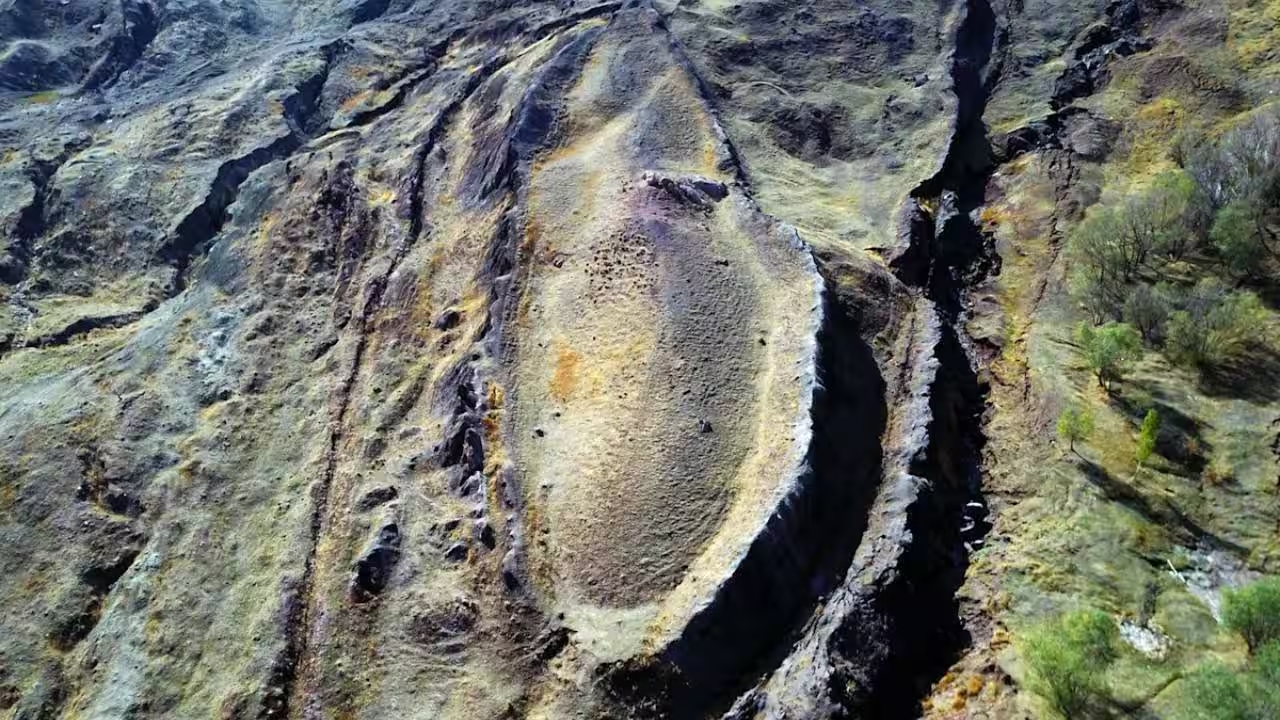
The long-running Noah’s Ark mystery has taken a new turn after researchers drilled into the Durupinar formation, a boat-shaped geological site near Mount Ararat in eastern Turkey.The formation has attracted researchers and Noah’s Ark enthusiasts since its identification in 1959. The latest fieldwork involved around 20 researchers from five countries, who collected hundreds of soil samples from both inside and outside the formation.Some of the samples were taken from depths of approximately 60 feet as researchers attempted to determine whether the site contains evidence of human activity or decaying wood.Andrew Jones, vice president of the Noah's Ark Research Project, said the team did not encounter a solid mass of limestone or other rock while drilling."We were hitting mainly soil," Jones said, according to Fox News. He added that the findings could challenge claims that the entire formation is simply a natural rock structure.Researchers find higher organic matter inside formationOne of the most intriguing findings from the Mount Ararat Noah’s Ark search involves carbon levels in the soil.Researchers said samples collected from within the Durupinar formation contained carbon levels roughly 40% higher than samples taken outside it. According to the team, the difference could potentially be associated with a higher concentration of organic material, including wood.However, the researchers have not established that the organic material comes from an ancient wooden vessel.The samples collected during the 2026 field season are now expected to undergo further laboratory analysis over the winter. Researchers say those results will be crucial in determining whether the site contains evidence that could explain its unusual structure.Pottery fragments found near Noah’s Ark siteThe international research team also discovered pottery fragments in the broader area surrounding the formation.The pottery could date to a period potentially relevant to the traditional Noah’s Ark timeline, although researchers stressed that none of the pottery fragments were found inside the Durupinar formation itself.Jones suggested that the discoveries could be connected to ancient settlements that once existed near the site."You can connect the dots," Jones said. "If this is Noah's Ark, we have people living right beside it."The pottery therefore provides an additional archaeological question but does not, by itself, establish a connection between the formation and the Biblical ark.What does the Bible say about Noah’s Ark?According to the Biblical account in Genesis, Noah’s Ark was built by Noah to protect his family and pairs of animals from a catastrophic flood.The Biblical story says the floodwaters covered the Earth before eventually receding. The possibility that the ark came to rest somewhere in the region of Mount Ararat has inspired centuries of speculation and exploration.The Durupinar formation has consequently become one of the most closely watched potential Noah’s Ark sites, despite continuing scientific debate over its origin.Earlier study called Durupinar a natural formationThe latest investigation comes amid decades of skepticism surrounding the site.A 1996 study published in the Journal of Geoscience Education examined the formation and concluded that it was naturally occurring.That conclusion remains important context for the current Noah’s Ark research. The new drilling project has not established that the Durupinar formation is Noah's Ark, and the researchers themselves say the investigation is not complete."What excites me most is that questions debated for decades can now be investigated using physical samples from documented locations and depths," Jones told Newsweek. "We have taken a substantial step forward in our ability to test the site, not completed the investigation."Noah’s Ark evidence remains unconfirmedDespite the renewed attention surrounding the Mount Ararat Noah’s Ark discovery, researchers have not confirmed that the Durupinar formation is the Biblical ark.The elevated organic matter, soil composition and nearby pottery fragments are clues that require additional analysis rather than definitive proof.Jones also acknowledged the skepticism surrounding the project, joking that some people view the search as being as unlikely as looking for "Santa's house."For now, the Noah’s Ark mystery remains unresolved. The laboratory analysis of the 2026 soil samples could provide researchers with more information about the history of the Durupinar formation, but whether those results establish a connection to Noah’s Ark remains an open question.
Topics in this story
Gathered from external sources. Rights to this text belong to whoever originally published it.