The Tesla Roadster flew, drove upside down, and hit 60mph in under a second
The next-gen Roadster has been in development for nearly a decade. But perhaps it was worth the wait.
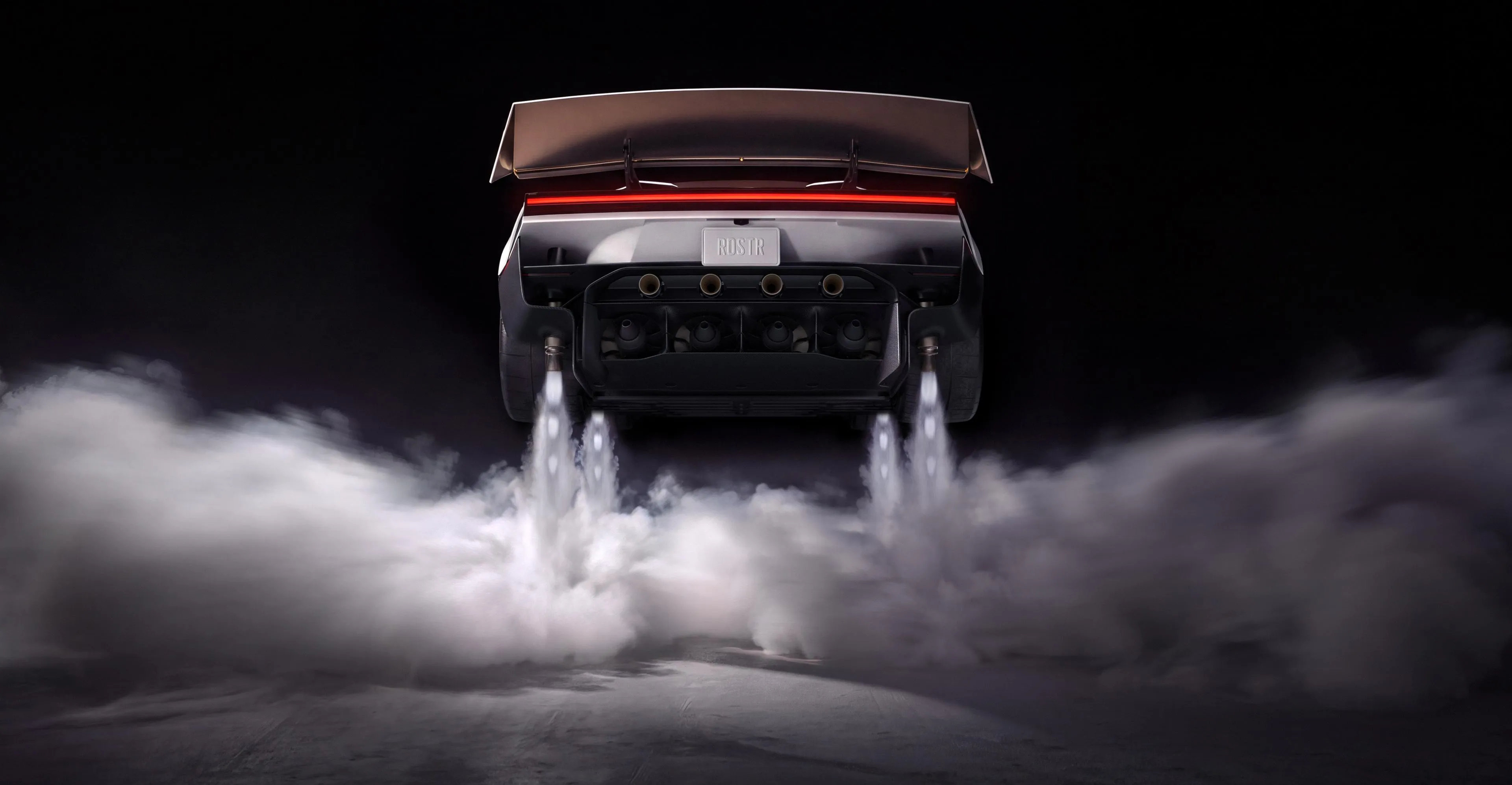
Elon Musk promised a flying car. And the Tesla Roadster did exactly that. Tesla demonstrated its next-generation Roadster at an event in Waco, Texas, where the electric supercar drove upside down, briefly flew, and accelerated to 60mph in under a second. It was an impressive demonstration of a car that likely will come with some heavy caveats and restrictions if it ever goes into production. The event was less than 30 minutes and felt more like a stunt show than a product reveal. Indeed, there was no mention of price, release date, or other such mundane details. Musk promised the hypercar would go into production in 2028, but after nearly nine years who’s counting. The people were here to see a car fly, and that’s what Tesla gave them. [Image: [Image: [Image: [Image: [Image: First, the Roadster drove up a very tall, multi-story ramp, using its incredible downforce to cling to the vertical roadway. When it reached the top of the ramp, it flipped around using its cold-gas thrusters to bring it gently back down to earth. The car uses a fan-based suction system, supplied by SpaceX and mounted underneath the vehicle, which is capable of generating up to two Gs of suction force. Next, the Roadster flew over the rest of Tesla’s lineup, including the Model 3, Model Y, Cybertruck, Semi, and Cybercab — doing what Tesla VP for Engineering Lars Moravy called “a kick flip” in the process. Musk explained that it features attitude-control thrusters as well as main thrusters at the rear, giving the Roadster rocket-like capabilities. “So it can basically fly like a rocket,” Musk said. “And it could do rolls. It could do, like, crazy gymnastics. Whatever you want, really. Now, I should say that this is not necessarily a safety-optimized car. But it takes the fun meter to 11 out of 10.” The Roadster two ultra-high pressure air tanks with a combined volume of 600 liters, containing approximately 250 kilograms of air, and uses 10 nozzles to execute its maneuvers. The Roadster can even recharge its own tank, without requiring a specialized chemical propellant. The stored compressed air supplies the thrust needed to lift the car and perform the demonstrated maneuvers. [Media: Musk claimed “This will be an actual car that’s on the roads” — though later the company admitted it would not be road legal. This seems obvious, of course. Imagine having to satisfy strict regulatory requirements from the Federal Aviation Administration and the National Highway Traffic Safety Administration. The Roadster could go into production in 2028, as Musk promised — or it could be another decade of missed deadlines and broken promises. Again, who cares? Car flew. As for the Roadster itself, Musk called it “the last best driver’s car.” Moravy said that Tesla drew inspiration from aerospace designs such as the SR-71 reconnaissance aircraft. It’s a two-seater, with seats molded directly into the chassis. Its steering and driving controls use steer-by-wire technology, including a steer-by-wire yoke, brakes, and throttle. The rear of the car features the thrusters and fans housed around the diffuser area. And it has a retractable rear wing for added downforce. [Image: [Image: [Image: [Image: [Image: [Image: [Image: Tesla has also said that the Roadster can accelerate from 0-60mph in less than a second. And during the event, the company claimed it did so in 0.81 seconds. Musk explained that increasing the applied force while reducing the vehicle’s mass help boost acceleration. In fact, Musk says the production Roadster should improve on the demonstrated result, although he acknowledged the extreme forces involved and the need to avoid subjecting occupants to extreme acceleration. “You’ve got to crack halfway to the speed of sound, I think,” Musk teased. “Mach 0.5. Maybe a little higher.” After the event, Tesla updated its website with details about the three distinct performance tiers for the next-generation Roadster, outlining how its controversial cold-gas thruster systems scale across the lineup: * Performance (Road Ready): The entry-level variant seats two passengers and relies on an active aerodynamics package paired with a multi-mode suction system to maximize downforce on and off the track. It claims a 0–60 mph time under 1.6 seconds and a target range exceeding 300 miles. * Thrust (Race Ready): Also a two-seater, this mid-tier version pairs the multi-mode suction system with rear-mounted cold-gas thrusters. The additional propulsion cuts the vehicle’s 0–60 mph acceleration to under 0.9 seconds. Tesla says this configuration will be in “limited release.” * Rocket (Air Ready): The single-seat flagship model expands the hardware to a full perimeter-mounted array of cold-gas thrusters. In addition to driving forward and upward acceleration, the thrusters enable lateral and rotational movement in midair — enabling the short, low-altitude stunts showcased at the event. This top-spec version reaches a top speed over 230 mph and pushes 0–60 mph acceleration to under 0.59 seconds. Tesla says this version will be “invite only,” but also “not approved for public road use.” The next-gen Roadster certainly took the scenic route in getting here. A prototype version was announced as a “one more thing” style surprise during the 2017 Tesla Semi event. The specs sounded ludicrous even back then: 0-60 mph in 1.9 seconds, a top speed over 250 mph, a 200 kWh battery delivering up to 620 miles of range, and a $200,000 starting price tag. Musk said deliveries would start in 2020, which sounded perfectly doable at the time. Early adopters quickly threw down $50,000 deposits (or $250,000 for the limited Founders Series), effectively interest-free loans to help fund Tesla’s scaling ambitions. But then Tesla seemed to forget about the Roadster, as cementing its status as the ultimate vaporware. Production deadlines slipped as Tesla prioritized mass-market vehicles like the Model Y, while also wrestling with the overly complicated Cybertruck. Occasionally, when Musk would remember that the Roadster existed, he would up the ante about its capabilities. This culminated in the “SpaceX package” that would equip the supercar with cold-gas thrusters, bestowing hover powers and a 0-60 time under one second. Musk has also sought to downplay the Roadster’s significance, calling it a “small potato situation” that will not “move the needle in a major way financially.” He’s framed the supercar more as a joint engineering collaboration between Tesla and SpaceX, even questioning whether it’s “even a car anymore” given its experimental nature. Some analysts theorize that the decision to re-release the Roadster is an attempt to set the stage for a rumored Tesla-SpaceX merger. Tesla’s failure to bring the Roadster to market allowed other automakers to slip past the company with their own hyper-powered EVs. Rimac has smashed performance records with the Nevera, Porsche has refined electric performance with the Taycan, and Chinese giants like BYD are producing track-ready supercars at a fraction of the cost. The Roadster is no longer shocking the world as an impossible prototype; it’s playing catch-up to an industry that spent nine years building what Tesla merely rendered. But then again, none of those cars flew.
Topics in this story
Gathered from external sources. Rights to this text belong to whoever originally published it.