Scientists play reef sounds through underwater speaker in Hawai‘i; cameras record 4 to 14 times more baby fish at treated site
A team of scientists has found that playing the sounds of a healthy coral reef underwater can attract substantially more young fish to a reef site.
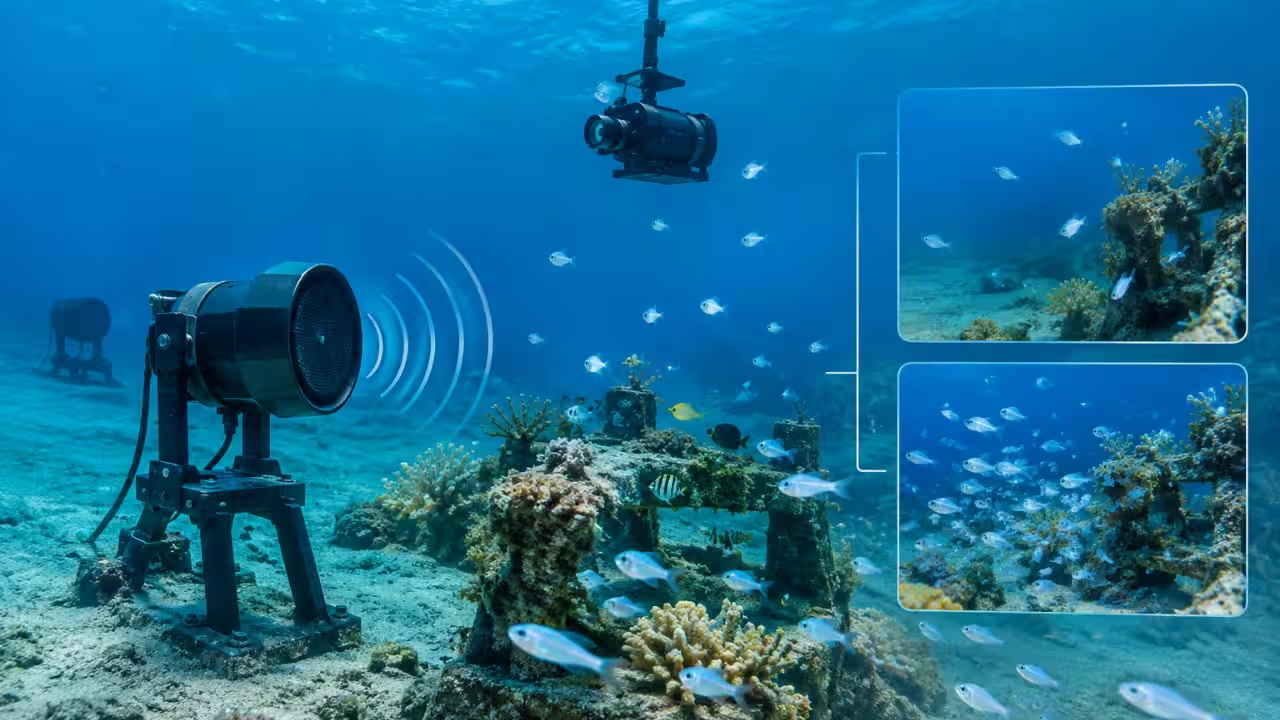
A team of scientists has found that playing the sounds of a healthy coral reef underwater can attract substantially more young fish to a reef site. In a study published in Scientific Reports, researchers used an underwater speaker in Kāne‘ohe Bay, O‘ahu, to broadcast recordings made at a healthy reef. Cameras then monitored the treated and control sites. The researchers found that larval fish numbers increased around the new moon at both locations, but the site receiving the reef recordings attracted four to 14 times more larvae. The findings suggest that recreating natural reef sounds could potentially become another tool for supporting reef restoration.Why reef sounds matterCoral reefs are naturally noisy environments. Fish, snapping shrimp and other marine organisms create a complex underwater soundscape that can vary according to the activity and condition of a reef. For young fish larvae drifting through the ocean, these sounds can provide clues about where suitable habitat may be located. As larvae approach the end of their early life stage, they need to find places where they can settle and grow.Scientists have previously suggested that degraded reefs may produce different or weaker acoustic signals than healthy reefs. This has raised the possibility of using recordings from healthy reefs to make damaged or artificial habitats more attractive to young fish. The approach is known as acoustic enrichment, in which sounds recorded from a healthy reef are played back at another location.The experiment in Hawai‘iThe researchers conducted the experiment in Kāne‘ohe Bay on O‘ahu, Hawai‘i. They established treatment and control sites on a sandy seabed about four to five metres deep. The sites were separated by roughly 42 to 65 metres and were located close to natural reef outcrops.Both locations had similar artificial structures and monitoring equipment. The main difference was that an underwater speaker at one site played recordings from a healthy reef, while an identical speaker at the control site remained silent. The researchers also switched the treatment and control locations during different deployments. This helped them determine whether differences in fish numbers were associated with the recordings rather than simply with the location. The healthy reef recordings were made nearby and captured sounds produced by organisms including reef fish and snapping shrimp.Cameras monitored the fishInstead of relying only on divers, the scientists used autonomous cameras to observe the experimental sites. The cameras were deployed during several spawning periods in 2023 and 2024. They recorded fish activity alongside hydrophones and artificial habitat structures. The researchers then analysed the footage to determine how many fish larvae and mature fish were present at the two sites. Using cameras allowed the team to monitor the locations for longer periods while reducing the disturbance that could occur if divers repeatedly entered the area.Four to 14 times more baby fishThe strongest difference appeared among larval fish. The researchers found that larval numbers at both sites tended to rise around the new moon, indicating that the lunar cycle influenced when larvae appeared. However, the location playing the healthy reef recordings attracted four to 14 times more larvae than the control location.The response was different among mature fish. The researchers found similar numbers of mature fish at the two sites. One possible explanation is that mature fish can travel over much greater distances than newly settled larvae. Because the experimental sites were relatively close together, adult fish could move between them.The attraction was temporaryThe researchers also found that the effect did not continue indefinitely. Although more larvae gathered at the location playing healthy reef recordings, they dispersed from the site in less than 48 hours. This suggests that attracting young fish is only one part of successful reef restoration. The habitat must also provide suitable conditions that allow those fish to remain and grow. The researchers therefore suggest that playing natural reef sounds could be more useful when combined with physical habitat restoration rather than being used by itself.What this could mean for reef restorationFish are an important part of coral reef ecosystems. Some species help control algae, while others contribute to food webs and other ecological processes. If healthy reef recordings can encourage more young fish to reach degraded areas, the approach could potentially help restore fish communities where natural recruitment has declined.However, the study does not demonstrate that playing reef sounds alone can restore damaged coral ecosystems. It shows that underwater sounds from healthy reefs can influence the behaviour of young fish and encourage them towards a particular location. The researchers also noted that their underwater speaker produced sound from a single point. Future restoration projects could potentially use several speakers to create a larger soundscape, although this would require additional testing and power.More research is neededThe research presented in this study emphasizes the significant advantages offered by autonomous camera systems for observing and documenting the intricate behaviour of fish without requiring a constant human presence or interference. However, it is important to acknowledge certain limitations encountered during the study, such as the challenges associated with the accurate identification of every larval fish down to the species level and the occurrence of some technical failures in the camera systems. Looking ahead, future research endeavors could benefit from integrating sound playback with alternative monitoring techniques to achieve a more comprehensive understanding of which specific fish species show a response and whether the larvae that are attracted to these sounds successfully survive after they have settled.At this point in time, the experimental findings from Hawai‘i provide compelling evidence that the auditory cues produced by a thriving and healthy reef ecosystem can play a pivotal role in influencing the gathering patterns of young fish. Consequently, the underwater sound environment may serve a function that extends beyond mere background noise; it could actually represent one of the essential signals that guide juvenile fish toward suitable habitats where they can thrive.
Topics in this story
Gathered from external sources. Rights to this text belong to whoever originally published it.