Missouri's Eli Drinkwitz tried to embarrass Kansas with late score, bemoans Jayhawks making rivalry about Civil War
Drinkwitz doesn't see the point of the historic series continuing if Kansas, in his eyes, keeps turning it deeper than it needs to be on the gridiron.
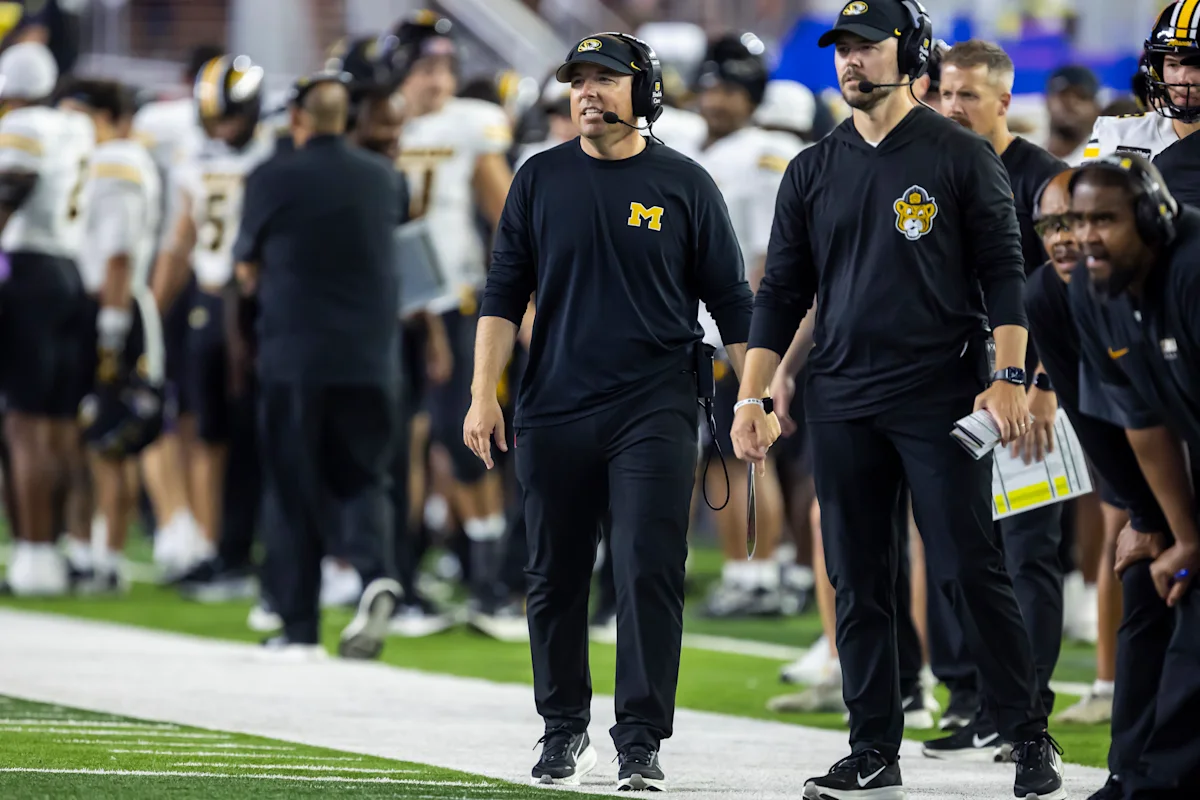
Eli Drinkwitz doesn't usually mince words. While mostly affable, the Missouri head coach doesn't always subscribe to tact. He's not to afraid to say how he feels.
He certainly didn't pull any punches after his No. 23 Tigers squad humbled Kansas on the road Friday night in the latest iteration of the schools' "Border Showdown." Missouri (2-0) handed the Jayhawks (1-1) a 38-21 defeat that could have looked even more lopsided had a head-turning shot to the end zone not fallen incomplete in the game's waning moments at David Booth Kansas Memorial Stadium in Lawrence.
That potential death knell resulted from Drinkwitz's frustration toward Kansas and the way the Jayhawks brazenly approached the programs' longstanding yet complicated rivalry in the lead-up to the matchup .
Kansas leaned into the Civil War history between the two states, posting a pregame hype video framed as "heroes vs. villains" with the social media caption, "It is that deep." Drinkwitz wasn't amused and fundamentally disagreed.
"I get there's a past to it, but why are we stirring that bull crap up? It's 9/11," Drinkwitz said postgame on Friday, the 25th anniversary of the Sept. 11 attacks.
"This country needs unity now more than ever. And I was embarrassed for 'em, to be honest."
Drinkwitz added, in reference to Missouri's pass that could have ran up the score with less than 30 seconds left: "And that's why I tried to embarrass them at the end."
Now in his seventh season at the helm of the Tigers, Drinkwitz expressed disappointment in "the turn" the fabled series between the neighboring programs took.
"I thought that was uncalled for," he said. "And this is about two teams playing football, and especially on 9/11 when we need more unity now than ever before — to be putting some stuff on your screen, celebrating ... I mean, everybody's got complicated pasts. "To make that an icon was bizarre to me. So I'm just glad that this whole right-versus-wrong bull crap that was started just got settled on a football field because it's a football game. It's a football game. It's an American football game that people love to come watch and cheer for their teams. "It's not any deeper than that."
"I thought that was uncalled for," he said. "And this is about two teams playing football, and especially on 9/11 when we need more unity now than ever before — to be putting some stuff on your screen, celebrating ... I mean, everybody's got complicated pasts.
"To make that an icon was bizarre to me. So I'm just glad that this whole right-versus-wrong bull crap that was started just got settled on a football field because it's a football game. It's a football game. It's an American football game that people love to come watch and cheer for their teams.
Kansas' aforementioned video, which was narrated by Jayhawks alum and former NFL defensive lineman Gilbert Brown , describes the "Border Showdown" like this:
"It's fueled by hatred passed down through generations," Brown said of the rivalry. "Our roots reach back to the Civil War when blood was spilled over what you believed in and which side you stood on. There are heroes and villains. Only allegiance decides their legacy. There's right and wrong. There's Kansas and Missouri."
Only the 1918 Spanish flu pandemic got in the way of Kansas and Missouri facing off on the gridiron between 1891 to 2011. For more than a century, their head-to-head was a staple in the college football landscape. But in 2012, Missouri left the Big 12 for the SEC, and the rivalry went dormant. Its 14-year hiatus ended last season, with the Tigers outlasting the Jayhawks in Columbia, Missouri .
Missouri leads the all-time series 59-54-9, according to Winsipedia , although the all-time record is a debate subject as well .
As Drinkwitz briefly conceded, "there's a past to" the series. The teams' nicknames come from the Civil War era. And the regional dispute can be traced back to the Kansas-Nebraska Act of 1854, which allowed the two then-territories to vote on their status as free or slave states when they joined the Union. Conflict ensued on the border of Kansas and Missouri — a slave state at the time — as pro-slavery and anti-slavery forces clashed.
That period of violent guerrilla warfare is known as "Bleeding Kansas." It served as a precursor to the Civil War.
"I don't really care if it continues or not," Drinkwitz said, when asked about the football rivalry, which isn't scheduled to pick back up again until 2031.
"I mean, if they're going to be weird about it, then what's the point?" he said. "If they want to have a football game and play a football game and have a great rivalry on the border, then awesome, let's do it. But if we want to make it deeper than that, man, we left Kansas bleeding again, so call it good."
Missouri broke open Friday's game in the second half, converting a pair of Robert Woodyard Jr. takeaways into touchdowns.
The game was the series' first in Kansas since 2005. It nearly ended with one more Tigers touchdown.
"I mean, I didn't want to score too bad, or I'd have called timeouts and tried," Drinkwitz said postgame after being asked how badly he wanted to score late.
"But I just wanted to — I mean, we didn't think we were going to throw that in the end zone, but I just wanted to let them know, like, 'Dude, what are y'all doing?' This is a football game. It shouldn't be bigger than that."
Topics in this story
Gathered from external sources. Rights to this text belong to whoever originally published it.