WVU vs Oklahoma St. Position Grades
Mountaineer fans, it’s time for the report card. We opened Big 12 play Saturday night against Oklahoma State with a lot of momentum. The Mountaineers entered...
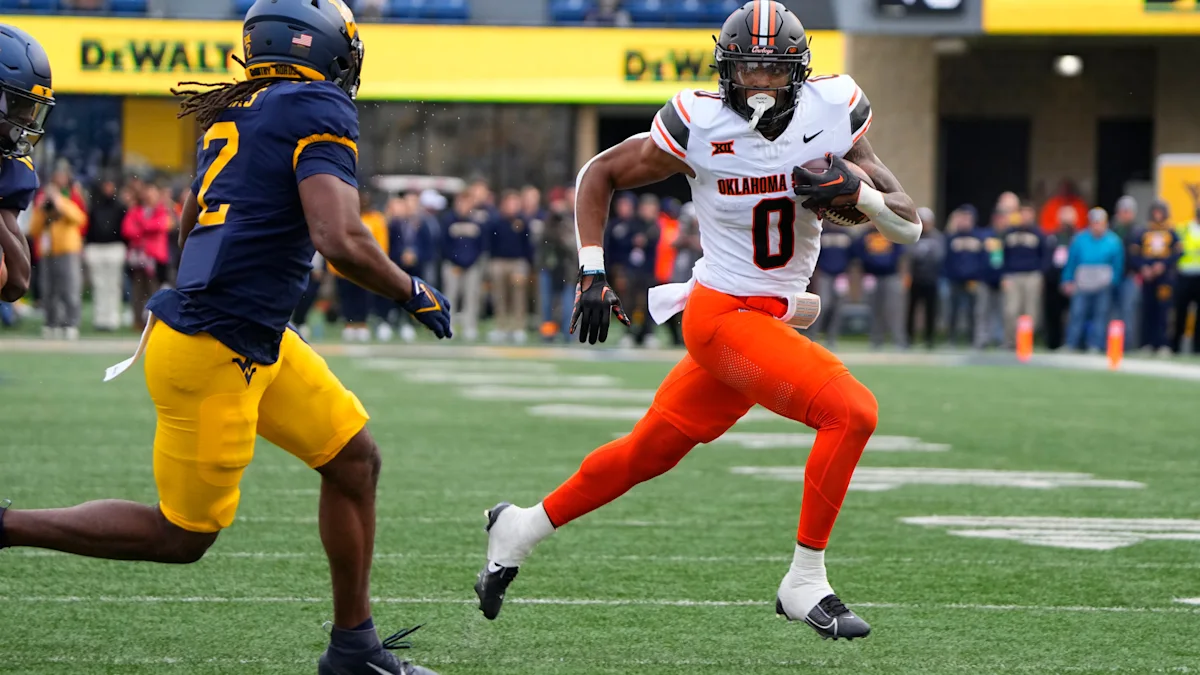
Mountaineer fans, it's time for the report card.
We opened Big 12 play Saturday night against Oklahoma State with a lot of momentum. The Mountaineers entered the game 3-0, playing at home, with an offense that had been one of the most productive rushing attacks in the conference. For a while, it looked like we were going to make it four straight.
Then the tipped pass turned interception happened. I think everybody feels the same way I do, when I say that changed the momentum. We were about to go up 21 to 6, instead they went down and scored and made it 13 to 14. Even though we went down and scored and made the game 21 to 13, they still had momentum because they were able to score a touchdown on their previous possession, that was all they needed.
Oklahoma State defeated West Virginia 41-24, turning a 14-13 halftime deficit into a 17-point victory. The Cowboys scored 28 second-half points and finished with 609 total yards.
So let's grade every position group. Not just based on the final score. Let's talk football.
Michael Hawkins Jr. gave us two very different performances Saturday night. With his legs, he was electric. Through the air, this was easily his most difficult game of the season. He finished with 132 passing yards, completing 10 of 22 attempts with an interception. He was also sacked four times. You cannot finish with less than a 50% completion percentage and get higher than a B with me.
But he rushed for 102 yards and three touchdowns. That's the dilemma with Hawkins. You can see the playmaking ability. You can see why we can be dangerous with him at quarterback.
Big 12 defenses are eventually going to force him to win football games with his arm. Oklahoma State did a good job disrupting his rhythm, and West Virginia became increasingly dependent on the running game.
According to PFF's postgame grades, Hawkins received a 72.2 overall grade, which was actually one of the better offensive grades for WVU.
This position group doesn't need much explanation.
29 carries. 193 yards. 6.7 yards per carry.
That's a legitimate running-back performance. And it wasn't just Cook. We finished with 334 rushing yards as a team, with Hawkins adding another 102. We averaged roughly 6.3 yards per carry. The running game gave West Virginia a chance to win this football game.
In fact, I'm comfortable saying this, the running backs were not the reason West Virginia lost. PFF gave Cam Cook a 75.8 grade and Amari Latimer a 76.3.
This is where things get difficult. We had only 132 passing yards. DJ Epps led the Mountaineers with 39 receiving yards. That's not enough production from the receiver room.
Now, we have to be fair. The passing game wasn't simply a case of receivers failing to get open. Oklahoma State's defensive pressure and West Virginia's offensive approach both played a role.
But when the running game is producing 334 yards, somebody eventually has to make a defense pay for loading the box. That didn't happen consistently. And that's going to become a problem if opposing defenses decide they can force West Virginia to throw.
The tight ends weren't a major factor in the passing game. We needed another reliable way to attack the middle of the field, particularly when Oklahoma State began focusing on the run.
The position group didn't provide enough production to change the complexion of the game. This wasn't necessarily a catastrophic performance. It was simply too quiet.
This is probably the most complicated position group to grade. On one hand, West Virginia rushed for 334 yards. That's phenomenal. On the other hand, Michael Hawkins was sacked four times.
Oklahoma State also generated significant pressure.
PFF's individual grades tell an interesting story. Right tackle Carsten Casady received a 64.8 overall grade but was credited with seven pressures allowed. True freshman Kevin Brown received a 59.1 grade and allowed four pressures, including two sacks.
So I'm not going to give the offensive line an A simply because the rushing numbers were excellent. The run blocking was good. The pass protection wasn't good enough.
The defensive line had a difficult night. Oklahoma State ran for 220 yards and threw for 389. That means the front wasn't consistently controlling either phase. There were moments when the defensive line created disruption, but not nearly enough of it.
And perhaps most importantly, Oklahoma State quarterback Drew Mestemaker wasn't sacked. That's a major problem when you're facing a quarterback who ultimately throws for 389 yards and three touchdowns. Now, I know we're talking a lot about the passing game, but every time Oklahoma State ran the ball to their left, it was for 6+ yards at least, we couldn't even stop them in the running game.
PFF's highest defensive-line grades were Corey McIntyre Jr. at 67.7 and Zeke Durham-Campbell at 67.1.
The edge rushers didn't generate enough pressure.
That's particularly concerning because West Virginia needed to make Mestemaker uncomfortable. Instead, he was allowed to settle into the game.
Rich Rodriguez himself pointed to the lack of pressure afterward, saying West Virginia didn't get enough pressure on Mestemaker and that the quarterback was able to get comfortable. Against a quarterback who ultimately completed 20 of 27 passes for 389 yards, that is a recipe for trouble.
There were some individual positives, but collectively this group needed to be better. Isaiah Patterson posted the highest PFF grade among WVU linebackers at 70.7. But the group struggled to consistently affect the game, particularly as Oklahoma State began generating explosive plays. SECONDARY — F
This was the position group that ultimately broke the game open.
Oklahoma State threw for 389 yards. Wyatt Young caught eight passes for 192 yards. before this game, we was given up big pass place because we couldn't keep containment, and the quarterback was scrambling, causing the secondary to collapse. This game, the quarterback had a clean pocket and didn't need to scramble, and we still gave up the yardage. Our defense has a major problem.
The Cowboys repeatedly found opportunities downfield, and seven of their 12 plays of 20 yards or more came in the second half. Four of those second-half explosive plays were passes of at least 40 yards. That's unacceptable defensive production. And this wasn't simply one player having a bad night.
PFF's postgame grades show problems throughout the secondary. Nick Taylor allowed four catches on four targets for 69 yards, while Andrew Powdrell surrendered three catches on three targets for 116 yards.
Special teams wasn't the reason West Virginia lost this game. There wasn't a major special-teams collapse that explains the 41-24 final score. This group did its job reasonably well.
This one deserves some nuance. I don't think West Virginia walked into this game unprepared. The Mountaineers led 14-13 at halftime and 24-21 in the third quarter. The game plan clearly understood where WVU had an advantage: the ground game.
The problem was what happened after Oklahoma State adjusted. The Cowboys scored 28 second-half points. West Virginia couldn't find an answer. That's where the coaching grade comes down. You don't have to abandon the running game. But you have to find ways to make the defense respect the passing game. And defensively, you have to find a way to stop the explosive plays.
Here's my biggest takeaway from this game: West Virginia wasn't incapable of beating Oklahoma State. That's what makes this loss frustrating. The Mountaineers had a running game capable of controlling the game.
We had a quarterback who could make plays with his legs. We had a lead. We had the home crowd. We had opportunities. But Oklahoma State made the explosive plays that West Virginia couldn't prevent.
That's how you lose a football game even when your own offense rushes for 334 yards.
The good news? I don't think the identity of this team is broken. The running game is legitimate. Cam Cook is legitimate. Hawkins has legitimate playmaking ability, but we have to become more balanced offensively and significantly better defensively. Because the Big 12 isn't going to get easier. The Mountaineers are now 3-1 overall and 0-1 in conference play.
And that's where the conversation changes. We're not grading preseason expectations anymore. We're grading what is actually happening on the field. An after Oklahoma State, here's my report card:
QB — C+ RB — A WR — D+ TE — C- OL — C DL — C- EDGE — D LB — C- DB — F Special Teams — B Coaching — C
The Mountaineers can run the football. Now they have to prove they can stop somebody. Because 334 rushing yards should be enough to win a football game. When it isn't, you know exactly where you need to start looking.
Topics in this story
Gathered from external sources. Rights to this text belong to whoever originally published it.