What could Rangers' 2012 case tell us about Man City's uncertain future?
From sanctions and stripped titles to starting from scratch, BBC Scotland explains how potential consequences for Manchester City compare with the financial collapse of Rangers in 2012.
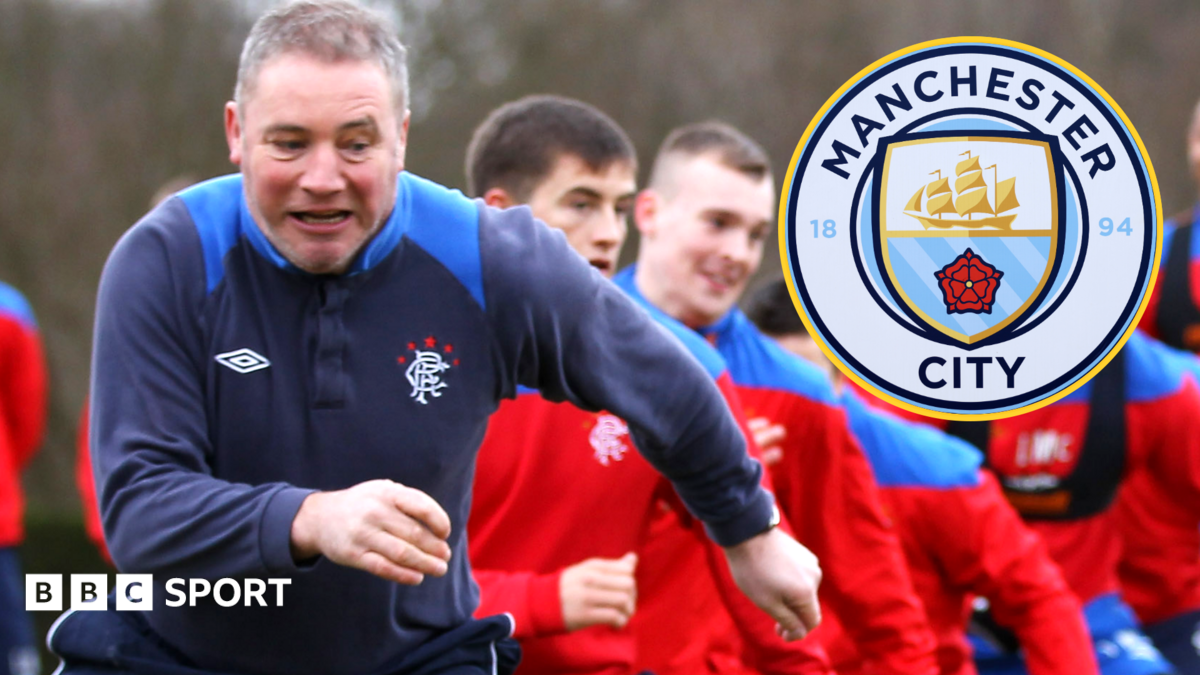
In the wake of Manchester City 's unprecedented guilty verdict, the scramble to source similar situations to help shed light on what could come next continues.
But finding a direct comparison has been a struggle because of that very word: unprecedented.
Some have attempted to draw parallels with the demise of Rangers in 2012 as an ominous, dark cloud of uncertainty hangs over the Premier League leaders.
From sanctions and stripped titles to starting from scratch, BBC Scotland explains how potential consequences for City compare with the financial collapse of the Ibrox club and which led to a giant of the British game being dumped at the bottom of the Scottish football ladder.
Clubs fear political interference in Man City appeal
Rangers boss McInnes 'not a fan' of extended break
What Guardiola said about Man City charges
It's a long story that, at this stage, doesn't really compare a whole lot to City's.
Rangers' case ultimately became an insolvency event after the club racked up huge tax liabilities. The Employee Benefit Trust (EBT) scheme was a major part of that.
Under former owner Sir David Murray, Rangers paid money into EBTs for employees - including players, managers and directors - for about a decade at the turn of the millennium.
In total, more than £47m came out of the trusts to more than 80 individuals. HM Revenue and Customs (HMRC) argued the payments should have been taxed as earnings and therefore that Rangers owed substantial sums.
After lengthy court and tribunal proceedings, the Supreme Court definitively ruled in favour of HMRC in its fight with Rangers over the use of EBTs. That came five years after the old company's liquidation.
City, meanwhile, have been found to have arranged "sham contracts" with a number of commercial partners as part of a scheme to disguise more than £830m of funding, according to the Premier League.
The Manchester club have been found guilty of all charges related to serious breaches of the league's financial rules between the 2009-10 and 2017-18 seasons. City have appealed against the verdict and deny any wrongdoing.
Sanctions, stripped titles and re-entering league system
With the threat of serious sanctions hanging over City, we wait to find out what comes next.
In Rangers' case, entering administration in February of the 2011-12 season meant a 10-point deduction was triggered. They finished the campaign in second, 20 points behind champions Celtic.
No further penalties were applied, with liquidation ensuing in June 2012.
Rangers were also never stripped of any honours they won during the years they used EBTs, which were ruled to have not gained them "any unfair competitive advantage".
Where things get a bit fiddly, confusing and the source of debate among fans, is the distinction between Rangers the club and Rangers the company.
Following the liquidation, the football assets - including Ibrox, the training ground, name and brand - were acquired by a new company led by Charles Green.
Despite the team continuing to play at Ibrox with the same colours and badge, jibes about Rangers not being the same club are heard from opposing fans at every match.
After Green bought the assets, a vote took place to decide whether Rangers could remain in the top tier. Ten of the 12 top-flight clubs voted against the application, with Kilmarnock abstaining and Rangers voting in favour.
Rangers then had to apply to play in the lower leagues, which at the time were governed by the Scottish Football League, a body separate from the top flight, then called the Scottish Premier League.
This shares similarities with the current set-up in England, with the Premier League separate from the English Football League, which governs the Championship, League One and League Two.
Premier League expulsion has been hypothetically discussed as a potential sanction for City. That could mean they then have to apply to be accepted into the EFL, just as Rangers did with the old SFL.
The Scottish FA recommended Rangers enter the second tier, but that was rejected by the majority of SFL clubs, with 25 of the 30 voting for Rangers to enter the fourth tier instead.
TV deals, 'heartbreaking' ordeals and a ball on a hedge
There were fears that without Rangers in the top flight, TV deals would be under threat without Old Firm derbies, putting clubs at financial risk.
Neil Doncaster, the league's chief executive, initially described the reduction in broadcast income as "slight" but acknowledged "there will be money coming out the game as a result of Rangers not being in the top flight".
So what would the loss of Manchester derbies do to the Premier League's?
Then manager Ally McCoist continued in his post following Rangers' demotion and led the team through the fourth and third tiers with relative ease.
The Ibrox icon recently described the 2012 ordeal as an "absolutely horrendous" situation because of the job losses that occurred.
"You're not talking about your centre-forward or centre-back," he said on Talksport. "I had one of the older lads in tears, not a player, just someone who had a wee job, because he was losing his job. It was heartbreaking."
On the pitch, however, McCoist recalled a bizarre but "unbelievable" journey through the lower leagues, hailing the commitment of the fanbase.
"I'll never forget one of the opening games," he added. "We played Brechin and the game got delayed because the ball got stuck on the top of a hedge."
The former striker also said he was dragged off the team bus by the Peterhead chairman to speak to fans in a marquee and did the half-time draw in a social club before his side faced Annan Athletic.
'The players won't stay - you're starting from scratch'
McCoist left midway through Rangers' first Championship season, which ended with them being denied a third straight promotion when they were beaten 6-1 on aggregate by Motherwell in the play-off final.
Mark Warburton arrived in the summer of 2015 and was the man to guide Rangers back to the Premiership.
Just one league title, delivered under Steven Gerrard in 2020-21, has come in the following decade.
Attempting to translate how that would look for City is a challenge given the difference in financial disparity between England and Scotland.
Even in the fourth tier, the budget Rangers were operating with still allowed them to attract some of the Premiership's top talent. That continued throughout their rise through the divisions.
It would be difficult to picture City enticing Premier League players to join them in the event of a severe demotion. And that is before you consider their squad being ripped apart.
Due to the nature of Rangers' plight, they lost a host of integral players without being able to recoup a penny.
The likes of Steven Davis, Steven Naismith and Allan McGregor were among those to lodge objections to a transfer to the 'newco'.
For City, they would at least be able to bring in cash for departing stars, permitting any potential contract clauses.
City fan Matt Mellor joked he "can't wait to see Erling Haaland bag a hat-trick against Grimsby" in League Two next season. McCoist isn't convinced.
"When you go down there, you're effectively starting from scratch, because the players won't stay," the Rangers great said.
"If you're talking about Manchester City , you're starting again. You're officially starting again."
Topics in this story
Gathered from external sources. Rights to this text belong to whoever originally published it.