OFFSIDE: Is the 'Special One' Jose Mourinho still the 'Real' deal?
Football News: Explore the highs and lows of Jose Mourinho's illustrious career and his recent comeback to Real Madrid. Can he regain his status as the 'Special One'?
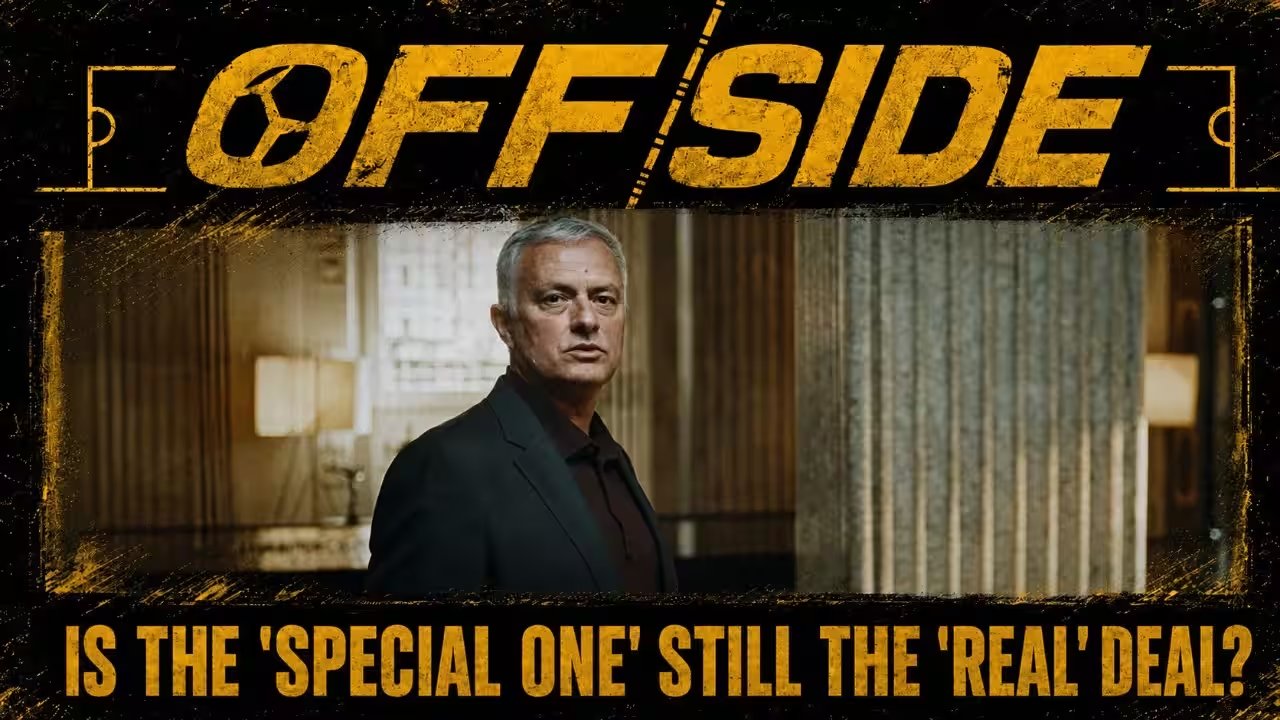
Hello and welcome to your weekly dose of football in OFFSIDE.There is a man who loves the sound of his own voice. It is hard to hold that against him because he has a supernatural gift of the gab that could floor Mark Antony and a sense of humour that would put Ricky Gervais on notice. The cameras and the press adore him. He thinks the sun shines out of every orifice and carries a perennial chip on his shoulder because, despite his accomplishments, the establishment continues to consider him an outsider.That proverbial chip, and his lifelong obsession with refusing to be defined by it, upended the established order as he reached the pinnacle of his profession before his Icarus-like hubris saw him cast out of his own kingdom. Yet he managed something even Napoleon could not: returning from exile for a sequel.The lede might sound as though it is about Donald Trump, but it is another Special One: José Mourinho, who on a bad day oddly resembles an IRGC general, which perhaps says something about the complicated history of the Iberian Peninsula.Much like Trump returned to the White House after being cast out, Mourinho is now back as manager of Real Madrid, a club he left 13 years ago following what we have come to recognise as a third-season supernova. His first spell featured an epochal conflict in which he played the fallen angel Lucifer Morningstar to Pep Guardiola’s archangel in Johan Cruyff’s kingdom of Barcelona.Netflix recently dropped a three-part documentary on Mourinho that, depending on who is speaking, is either a hagiography of his years at Porto, Chelsea and Inter Milan or a reality show about Real Madrid and everything that followed.In his prime, Mourinho was the Muhammad Ali of football management, walking into every room ready to announce that he was the greatest.The documentary highlights this arrogance as he surveys his own greatness and declares: “You don’t do a documentary with a guy that wins nothing.”The series covers his upbringing in Portugal, the influence of his goalkeeper-turned-manager father Félix and the pain of watching him get sacked on Christmas Day.The one rare moment when Mourinho appears vulnerable beyond the circus-master mockery is when he discusses his father’s death.He highlights his obvious lifelong irritation at being called Bobby Robson’s interpreter: an unfortunate label that reduces years of observation and coaching education to linguistic chicanery. Yet Mourinho admits that he stood on the shoulders of giants and that his apprenticeship under Robson and later Louis van Gaal gave him access to football’s greatest tactical laboratory: one where Total Football was mastered and which also gave rise to the Fallen Angel who would become its greatest opponent.Porto was where the experiment produced its first miracle. Mourinho won the UEFA Cup in 2003 and the Champions League a year later, memorably sliding down the touchline after defeating Alex Ferguson’s Manchester United. A year later, he arrived at Chelsea, bolstered by Roman Abramovich’s millions, declaring that he wasn’t arrogant but a “special one”.Of the bunch, those early Chelsea players were the ones who forever worshipped at his altar, willing to put their bodies on the line for their manager. His greatest gift was convincing players that he understood them better than they understood themselves. “I look, you look, I see more than you,” he says. Former players still discuss him with the devotion of soldiers remembering a commanding officer. They knew he could criticise and provoke them, but they also believed he would fight the world on their behalf.That power reached its purest form at Inter Milan. Mourinho turned experienced players into a private army and delivered the 2010 Treble. The defining battle came against Guardiola’s Barcelona in the Champions League semi-final, when Inter won 3-1 at home before surviving the return leg with 10 men. It was Samuel Eto’o, who played much of the match on the left in front of a defender, resisting war.Mourinho celebrated at Camp Nou with a raised finger as Barcelona’s sprinklers came on around him, an image so perfectly Mourinho that it might have been designed by a Renaissance painter with a taste for trolling.Inter beat Bayern Munich in the final, and Mourinho departed at the summit, crying in Marco Materazzi’s arms before joining Real Madrid. It was perhaps the last time he left before the third-season supernova.Madrid was a different proposition. Guardiola’s Barcelona were a footballing ideology, a collection of academy graduates led by Lionel Messi and the reigning cultural authority in European football. When going toe-to-toe didn’t work, Mourinho changed tactics and became the full heathen we would come to appreciate. Every Clásico was a war, with Mourinho telling his Spanish players that they could go and kiss their Barcelona teammates during international duty.Captain Iker Casillas was dropped, and Mourinho did break Barcelona’s domestic hold, yet the tools of war left his kingdom too fractured. He departed in 2013 with three trophies and one badly divided kingdom.The documentary’s biggest revelation also showed that Mourinho had been hand-picked to be Sir Alex Ferguson’s successor, a role that he agreed to take before deciding that he would head back to Chelsea instead.Mourinho admits that losing the chance to succeed Ferguson was “dramatic”, but says he needed to return somewhere he felt loved. He invokes Nietzsche to defend the decision: “When you do something for love, you are never doing anything wrong.” It is an unusually romantic explanation from a manager who has spent his career treating emotion as another tactical vulnerability.Chelsea would give him one more Premier League title, and he finally arrived at United three years later, winning the League Cup and Europa League and finishing second. But by then, something during his Madrid era had left him too bruised.Then came the journeyman years of Tottenham, Roma, Fenerbahçe and Benfica, during which the man who had once treated Europe as his personal empire became a wandering general, collecting a Conference League here, reaching a Europa League final there and accumulating enough sackings to keep the third-season jokes alive.And now, 13 years after leaving Madrid as its fallen angel, Mourinho has returned older, greyer and carrying the scars of every kingdom that rejected him. The beginning has been almost suspiciously perfect: a tense 2-1 victory over Espanyol, a 4-1 demolition of Real Sociedad and a 4-0 evisceration of Málaga. Three matches, three victories, 10 goals scored and only two conceded.He now has global superstars like Kylian Mbappé, Vinícius Jr and Jude Bellingham, who are even more fragile than those whom he managed earlier, and yet there’s something strangely nostalgic about his return. Football has brought Mourinho back to the stadium where he was at his most powerful and most broken, offering him the rarest gift it gives an ageing conqueror: the chance to rewrite the ending. Netflix reminds us why José Mourinho was once unquestionably the Special One. The Bernabéu will decide whether the Special One can become the man again or be haunted forever by the thought of what he once used to be.Bruno the MagnificentIn political reporting, there’s a maxim that all great reporters follow: never make a prediction because reality is cruel. Hindsight is always 20/20, and OFFSIDE learnt it the hard way after complaining about United’s Ship of Theseus hitting a Hull problem before being blown away by Bruno Fernandes’ magnificent hat-trick as he helped United beat Ipswich Town 5-2.United aficionado Andy Mitten has been writing a running series in The Athletic on the club’s greatest 25 players, and the only man to make the cut from the post-Fergie years is Bruno Fernandes, who comes in at number 25. Perhaps that’s a tad harsh, given that there’s absolutely no doubt that amid the vacillating vagaries of United grappling with uncertainty in the post-Fergie era, there has been only one player who has stepped up time and again.The United captain, who picked up every individual best-player gong last season, was at his supreme best, reminding the world of his vintage with a performance for the ages as he scored three goals and set up one for Bryan Mbeumo. The Portuguese created 136 chances last season, while number two in Europe’s big leagues was Raphinha, who created 98. Despite the fact that he spent half the season playing in the defensive midfield role in Rúben Amorim’s 3-4-3, which should be considered a crime against humanity, he ended up with 21 assists, and that number would have been far higher if he had had better marksmen in front of him.United’s second goal also required an explanation after the ball appeared to strike Harry Maguire’s hand before his shot was deflected into the net by Jacob Greaves. Under the handball law, accidental contact is automatically penalised when the player who handled the ball immediately scores. Since the goal was credited to Greaves as an own goal, that provision did not apply. Had Maguire’s shot gone directly into the net, it would have been disallowed. Football’s handball law remains perfectly clear, provided you possess a law degree and several hours to spare.In many ways, Bruno evokes Bryan Robson, another magnificent United captain who carried an imperfect team through the barren years. Robson eventually received the ending he deserved, finally lifting the league title after 12 years at Old Trafford. Bruno deserves a similar ending.Messi’s GoodbyeThe last six weeks have been terrible for the world’s greatest footballer. After losing to Spain in the World Cup final, where his entire team decided to cosplay as pub-side hacks instead of footballers, Messi lost his father, a man who had been with him every step of the way in his footballing journey. He has since announced his retirement from international football, bringing down the curtain on an Argentina career that finally delivered the World Cup that had once seemed destined to elude him.There were even questions about whether he would come back to play after the grief of losing his guide, but a four-goal demolition of CF Montreal to end Inter Miami’s winless run shows why there will never be another like him. Miami’s interim coach Guillermo Hoyos admitted that “words simply fall short”, which is unfortunate for anyone employed to describe a footballer who has spent two decades exhausting the available vocabulary.A date with giantsThere used to be an old joke about Indian communists. They are hardcore nationalists, just not Indian nationalists. Some of them are Russian nationalists, some Chinese and some Cuban. A similar joke could be made about Indian football fans, who have had to cheer for every nation recognised by FIFA and the UN because of Team India’s perennial absence from football’s biggest stage.Every four years, Bengalis divide themselves into ancestral Brazilians and Argentinians, Europeans discover a grandparent from whichever country is winning and the rest of India briefly develops strong opinions about German gegenpressing and Spanish tiki-taka.This time, the giants are coming to us.India will play five-time world champions Brazil at Kolkata’s Salt Lake Stadium on October 3, before facing two-time champions Uruguay at the same venue three days later. The Blue Tigers will warm up for that examination by playing Panama in Bengaluru on September 26.Sunil Chhetri admitted that he was “a little jealous”, having carried Indian football for more than two decades without receiving an opportunity of this magnitude. His successors will now face three World Cup teams within 11 days.The scorelines could be sobering, particularly against Brazil and Uruguay, but there is only so much one can learn from playing teams at a similar level. India’s players will experience the speed, movement and technical quality demanded at the summit of international football. For one week in October, Indian football fans will not need to borrow another country’s flag. They can wave their own, even if they occasionally need it to cover their eyes.PS:Lionel Messi announced his retirement from international football while this piece was being published. Argentina have lost their No. 10, but Inter Miami, and the rest of us, still get a little more time.Get the latest Sports News and Live updates. Download the TOI app.
Topics in this story
Gathered from external sources. Rights to this text belong to whoever originally published it.