Biggest Risers and Fallers in 2027 NFL Draft Entering Week 8 of CFB Season
Every collegiate football program has reached the halfway point of its 2026 regular season. As expected, plenty of surprises have emerged along the way—both with the on-field product and continued development, or lack thereof, among future NFL prospects.
Every collegiate football program has reached the halfway point of its 2026 regular season. As expected, plenty of surprises have emerged along the way—both with the on-field product and continued development, or lack thereof, among future NFL prospects.
Next year's draft class has been particularly intriguing based on the potential of what it could be. However, early returns have not been as promising as expected, particularly at the game's most important position.
Those same expectations don't need to be lessened, though. They should be readjusted thanks to different names running with their opportunities. Meanwhile, some of the projections for highly regarded individuals should be revisited.
As a result, Bleacher Reports takes stock at the halfway point to see which prospects have impressed or disappointed the most.
Riser: QB Drew Mestemaker, Oklahoma State
A wait-and-see approach was necessary with Drew Mestemaker after transferring to Oklahoma State. He's answered the bell against Big 12 competition and emerged as the Bleacher Report Scouting Department's QB1.
Mestemaker became a known entity during the 2025 campaign when he led the nation with 4,379 passing yards. However, competition at North Texas is different than playing at Power Four program. Many wanted to see if the quarterback could thrive when facing tougher defenses on a regular basis.
To be fair, Mestemaker didn't need to learn a new offense since he followed North Texas head coach Eric Morris to Oklahoma State. However, 92 new players entered the Cowboys program this year, which means the quarterback had plenty of work to do in building a rapport with his offensive teammates.
Initially, Mestemaker struggled, specifically in Week 1 against the Tulsa Golden Hurricane. The Okie State quarterback didn't look comfortable at all and couldn't help the Cowboys stave off the state rival. A week later, Mestemaker and Co. beat the Oregon Ducks.
During the subsequent four contests, the 20-year-old prospect completed 73 percent of his pass attempts. Mestemaker posted a 13-to-two touchdown-to-interception ratio during that stretch. He's also produced five straight games with 300 or more passing yards. Three of those contests came against conference rivals.
From an evaluation standpoint, Mestemaker displays top-notch arm talent, with the arm strength to drive the ball vertically and enough touch to layer passes. The 6'3", 215-pound gunslinger stands tall in the pocket and shows a willingness to stare down the gun barrel of an oncoming rusher. Plus, Mestemaker is a good athlete to help create chunk plays when forced outside of structure.
The redshirt sophomore can be arrogant with some throws, leading to turnovers. Also, he is only in his second season as a starting quarterback. So, his decision-making and how he sees the field still have room for improvement. But all of the physical traits are present to become the first quarterback off the board once April's draft begins.
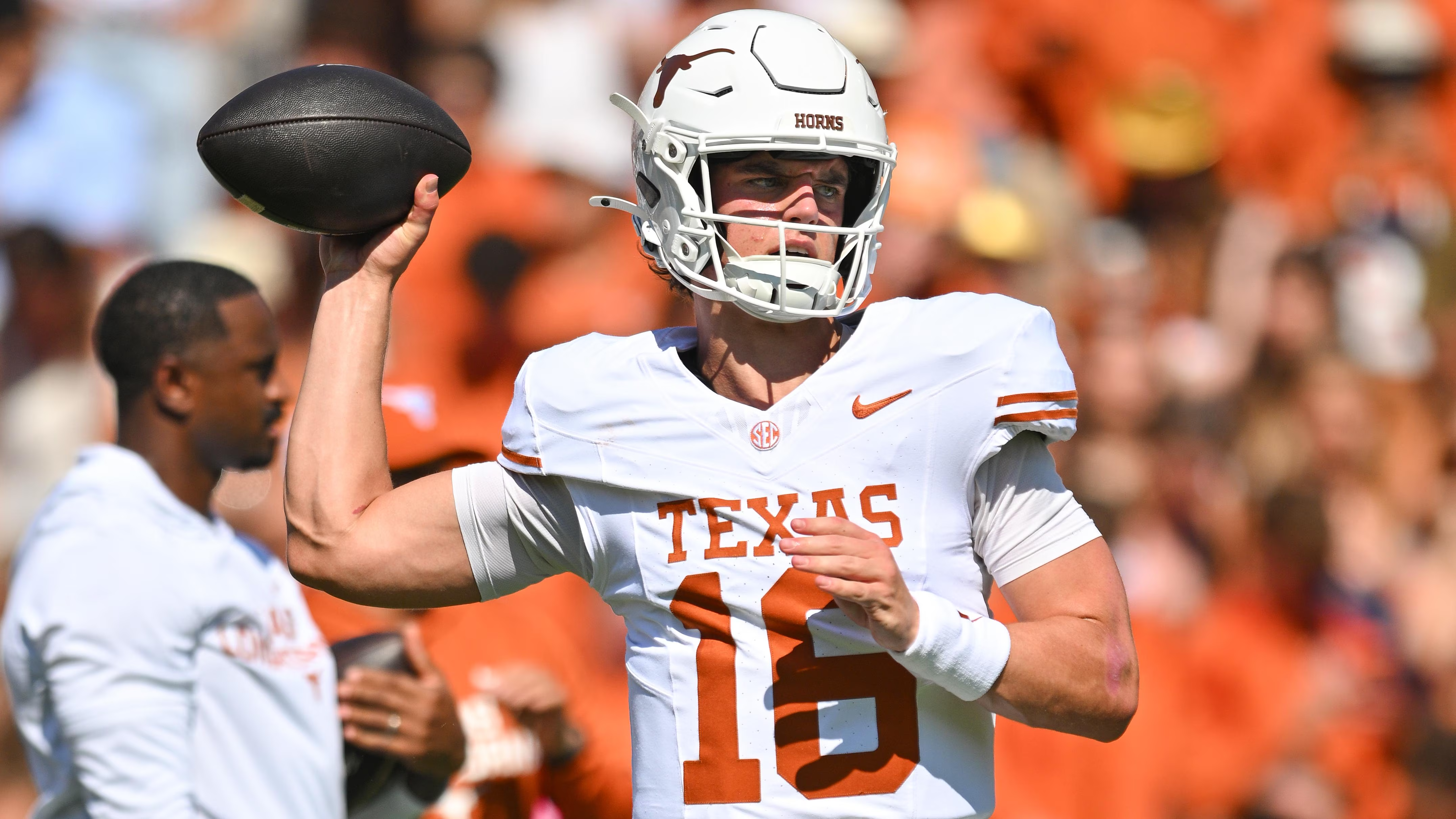
Arch Manning has lived under tremendous scrutiny since being anointed as a 5-star high school recruit .
Entering this season, he was often projected as a future No. 1 overall NFL draft pick. Based on what he's shown so far this fall, the Texas Longhorns quarterback isn't currently worthy of first-round consideration and could use another year in college to refine the whole package.
There is a chaotic element to Manning's game, which makes his skill set much closer to his grandfather, Archie, than either of his Super Bowl-winning uncles.
Archie Manning was the second overall selection in the 1971 draft class, but he struggled greatly with the neophyte New Orleans Saints. Arch Manning has similar playmaking skills as an athlete working outside of structure and a lack of refinement to his overall game.
The latter is the major sticking point when evaluating Manning as a prospect for today's NFL, where teams are more willing than ever to develop quarterbacks with outstanding physical tools and tailor their offenses around them.
In the Texas quarterback's case, that same approach could be difficult for an NFL coaching staff, because his footwork and throwing mechanics are highly inconsistent, resulting in far too many poorly placed passes.
More importantly, Manning struggles to quickly work through his post-snap reads. He often predetermines where he wants to go with the ball, leading to dangerous throws, or takes too long getting through his options.
Peyton and Eli Manning both left college after their senior seasons. Arch Manning may need to follow the same path.
Notre Dame's Anthonie Knapp wasn't on the radar as a first-round talent entering the 2026 campaign, at least as an offensive tackle prospect.
His transition to guard has gone swimmingly, placing him among the 2027 class' top-12 prospects regardless of position and in competition with LSU's Jordan Seaton to become next year's highest-rated offensive line prospect.
Knapp took over Notre Dame's blind side as a true freshman. He spent his first two seasons as the Fighting Irish's left tackle. Typically, a collegiate blocker capable of manning the offensive line's most valuable position as a freshman doesn't move from that spot.
In Knapp's case, Notre Dame had another talented option in Will Black, who's a little longer and more naturally suited to the position.
Knapp told reporters this past spring that he had no qualms about transitioning to guard:
"I don't care. I'm a football player. I love football. I'm here to play football. I was a fourth-string center when I first got here, so it's whatever [offensive line coach Joe Rudolph] needs. He knows best. Whatever the team needs, whatever Coach needs. If they think I can be pretty good at guard, then I trust them. I'll do whatever it takes to be the best I can be and do what the coach says."
Along the interior, the 6'5", 305-pound lineman is a force physically. He plays with a certain level of violence at the point of attack that's not often seen from offensive tackle converts. Knapp fires out of his stance, generates movement and strains to finish blocks.
Now that everyone has seen what Knapp can do at guard, he's a Day 1 talent all day long, with no other interior option coming close to his level of performance so far this season.
Texas' Trevor Goosby entered the current draft cycle as the class' OT1 almost by default.
A year ago, the junior prospect showed impressive growth during his first season as a Longhorns starter. He was expected to continue along the same trajectory this fall. Instead, he's been surpassed by others, specifically LSU's Jordan Seaton.
Goosby's selling points are obvious. He has the requisite size (6'7", 325 lbs) and wingspan to be a starting NFL left tackle. The underclassman also displays the natural power and grip strength to displace and control defenders in the run game.
However, an offensive tackle's value is built upon a foundation of what the individual can do as a pass protector. Stiffness in Goosby's lower body has become evident. The first-team All-SEC honoree tends to play high, struggles to redirect and may not be able to handle NFL speed off the edge.
Despite those concerns, Goosby still has long-term starting potential. His subpar athletic profile simply caps his ceiling. As a result, Seaton quickly and easily surpassed Goosby as OT1 due to the LSU product's natural and smooth movement skills.
Now, Texas' left tackle looks far more like a Day 2 option alongside other prospects, like USC's Elijah Paige and Kentucky's Lance Heard, who have surged throughout this process. Overall, the offensive tackle class looks much stronger than it did prior to the start of the campaign, which further diminishes Goosby's standing.
A safety, Caleb Downs, carried the highest grade among the 2026 draft class. Texas' Jelani McDonald isn't in the same tier as Downs, but the previous example shows how valued a complete safety prospect can be.
Ultimately, Downs fell to the 11th overall pick during this past April's draft primarily due to positional value. Right now, McDonald has earned his status as B/R's No. 1 safety and a legitimate first-round talent.
"McDonald is exactly the kind of player the NFL needs today," B/R scout Daniel Harms tweeted . "He's a physical, 'A+' run defender, high-level communicator and has the instincts to take away routes over the middle of the field."
The senior prospect understands his angles, both when he's defending the run or playing in space. To Harms' point, McDonald posted the third-lowest missed tackle rate among qualifying safeties last season, according to CFB Film Room . He's been as good or better this fall. The defensive back is currently on pace to surpass last season's total of 80 tackles. McDonald's on-ball plays have decreased, but he still tends to be in the right spot to make life difficult on receivers.
While other Longhorns made this list after disappointing starts, McDonald deserves recognition for the complete player he is. His performance allowed him to surpass Notre Dame's Brauntae Johnson (injured) and Georgia's KJ Bolden as the incoming crop's top safety.
The Miami Hurricanes' defensive line was nearly unblockable a season ago. Defensive tackle Ahmad Moten was a big part of the unit's success, especially down the stretch, when he emerged as college football's best interior pass-rusher. He hasn't been quite the same this fall.
To be fair, Moten was slowed at the start of the season by an arm injury. He returned against the Clemson Tigers and looked like the explosive upfield defender everyone hoped to see this season. At times, some inconsistency can be found regarding his get-off and how he handles blocks at the point of attack.
An argument can be made that Moten is somewhat of a feast-or-famine defensive tackle prospect. He can certainly generate outstanding plays in the backfield, but he'll also get washed out of others due to playing with a high pad level and suspect anchor.
As this season progresses, more consistency, while staying healthy, will be key, because Moten was viewed as a potential first-round draft pick entering this season. With Miami at 6-0 and now ranked as the nation's No. 1 team, the spotlight will certainly shine brightly upon the Hurricanes' best players.
A second-half surge similar to last year's should propel Moten back toward his original projection. As of now, he stands as B/R's DL6 and sits outside of the scouting department's top 75 prospects.
Topics in this story
Gathered from external sources. Rights to this text belong to whoever originally published it.