B/R's Week 1 PPR Fantasy Football 2026 Player Rankings
The wait is over: The 2026 NFL season has arrived.
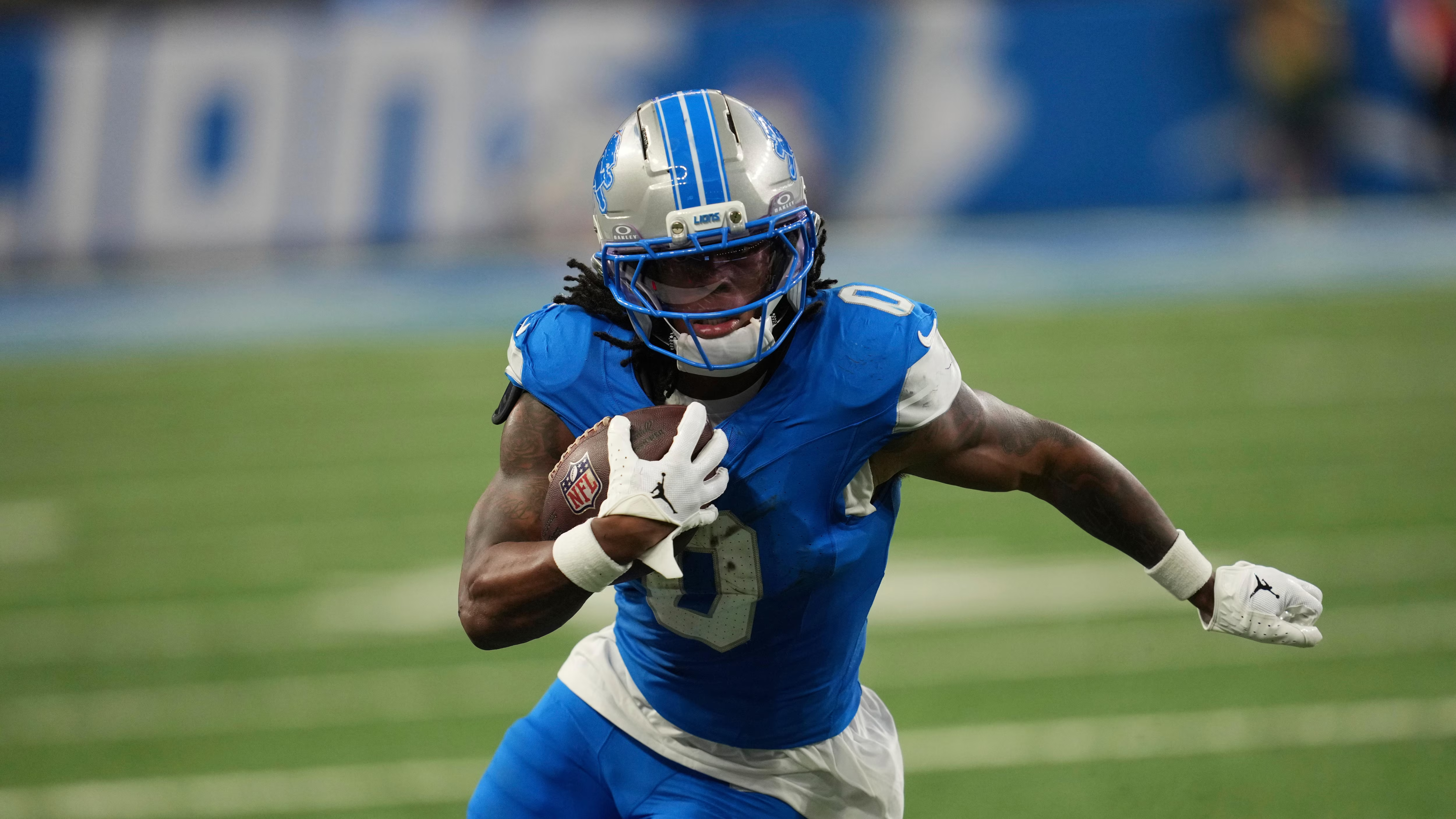
The wait is over: The 2026 NFL season has arrived.
The Seahawks host the Patriots on Wednesday night, launching both the new NFL season and another year of fantasy football.
After a summer of drafting fantasy rosters, it is time to focus on the Week 1 lineup. Put the players you selected in the best position to deliver an opening win and start the path toward the fantasy playoffs on the right foot.
Each week, Bleacher Report will provide tiered PPR rankings, a top-149 overall list and player analysis to help fantasy managers set their lineups.
The presence of two quarterbacks coming off injury-marred seasons in the top three underscores the uncertainty of Week 1 rankings.
We enter Week 1 with plenty of expectations, but fantasy football has a way of challenging them quickly. Stay flexible as the season begins to provide clearer answers.
Don't overthink your Week 1 lineup. If you drafted a clear starter under center, roll him out even if he's ranked a little lower here than you expected.
Also, don't be stunned if some big names start slow. Many of the high-end quarterbacks played sparingly or not at all in the preseason. It could take a little time to shake the rust off.
The cream of the crop occupies the first tier. Lamar Jackson draws a dream matchup against a Colts team that allowed more passing yards per game a year ago than any team in the AFC.
Josh Allen isn't so fortunate, travelling to Houston to face one of the NFL's best defenses. Joe Burrow faces a Tampa Bay Buccaneers team that allowed the third-most fantasy points per game to quarterbacks in 2025.
Most of the Tier 2 quarterbacks draw favorable matchups to open the season, highlighted by Jalen Hurts against a Washington Commanders defense that surrendered the second-most fantasy points per game to signal-callers a year ago.
Trevor Lawrence's home tilt against the Cleveland Browns isn't as good on paper. If you saw the Browns in the preseason, though, you will know that depth in their secondary is a major issue.
Fantasy managers aren't going to see Drake Maye ranked this low very often this year, but the last time we saw him against Seattle wasn't his best effort of last season.
Jayden Daniels is a major unknown early in the season, but so is an Eagles defense with issues on the edge.
Good luck figuring out what's going to happen with Stafford and the Rams in Australia. The strange circumstances of that game make him something of a crapshoot this week.
The fourth tier of quarterbacks this week are fringe starters with question marks.
What will Kyler Murray look like in his first start for the Minnesota Vikings. How healthy is Patrick Mahomes ahead of Monday's AFC West showdown with the Broncos? Can Baker Mayfield capitalize on a favorable Week 1 matchup with a Vikings defense that allowed the fifth-most fantasy points per game to QBs last season?
This tier consists primarily of matchup-dependent options.
Malik Willis has a favorable Week 1 matchup against the Raiders, although Miami's offensive outlook remains uncertain. Baltimore struggled against the pass last season, but Daniel Jones may have difficulty capitalizing given Indianapolis' unsettled receiving corps.
One or two quarterbacks in this tier could finish among the top 12 at the position, but they carry considerable risk.
Entering Week 1, these quarterbacks are low-confidence options even in superflex and two-quarterback formats and should not be considered in standard one-quarterback leagues.
The running back position could be especially difficult to evaluate in the early weeks of the season because several backfields and workloads remain unsettled.
Two higher-end backs—Ashton Jeanty of the Raiders and Jeremiyah Love of the Cardinals—enter the season nursing ankle injuries. Several backfields also remain unsettled, including those in Carolina, Green Bay, Minnesota, Pittsburgh, Tampa Bay and Washington.
If you have clear lead backs, start them with confidence. Knowing a back is likely to receive 15-plus touches provides valuable lineup certainty, whether it is Week 1 or Week 11.
If you are considering a running back in an unsettled committee for a flex spot and have a similarly ranked wide receiver, the WR may be the safer Week 1 choice.
Fantasy managers paid a hefty price for these backs on draft day, and now it's time to start getting a return on that robust investment. Christian McCaffrey enters 2026 with understandable durability concerns, but he should continue to handle a substantial workload in Thursday's game in Australia.
Saquon Barkley could finish as the overall RB1 in Week 1 after the Commanders allowed the fifth-most PPR points per game to running backs last season.
The second tier of running backs are all solid Week 1 starts, just with a little less certainty and/or a slightly lower ceiling than the tier above them.
Omarion Hampton has a good chance to start hot against a Cardinals defense that led the NFC in PPR points per game given up to running backs a year ago. Javonte Williams faces a Giants team Sunday night that fielded the second-worst run defense in the league last year.
As we move into Tier 3, the questions start to add up, but these backs should all see solid workloads in Week 1 and a couple will likely end the week inside the top 12 at the position.
The Buffalo Bills fielded a bottom-five run defense, so David Montgomery's debut in Houston could be a big one.
Cam Skattebo has a favorable Week 1 matchup against a Dallas defense that may improve in 2026 but remains a potential vulnerability against the run.
Uncertainty increases in this tier, which includes few clear three-down backs.
The workloads for MarShawn Lloyd and Seahawks rookie Jadarian Price remain unsettled entering Week 1.
Quinshon Judkins projects as Cleveland's lead back, but he faces a Jacksonville defense that led the league by allowing only 85.6 rushing yards per game last season.
By Tier 5, committee backfields become a major concern.
Minnesota appears likely to deploy a true committee featuring Jordan Mason and Aaron Jones Sr.
Jonathon Brooks' Week 1 outlook became less secure when Chuba Hubbard returned to practice.
J.K. Dobbins projects as Denver's lead back, but the Broncos could manage his workload to preserve his availability.
Tier 6 options are best reserved for deep leagues or managers addressing lineup uncertainty.
Rachaad White could see increased receiving work if Washington plays from behind against Philadelphia, while Chris Rodriguez Jr. could limit Bhayshul Tuten's early-season workload.
These backs offer upside, but their roles and projections carry significant uncertainty.
These running backs are primarily players to monitor rather than recommended Week 1 starters.
George Holani and Chris Brooks could receive more work than expected, but most options in this tier need a clearer path to meaningful volume before becoming viable fantasy plays.
Wide receiver is a deeper and more stable position than running back. This isn't to say there aren't concerns, mostly due to injuries.
As a whole, though, the wideouts are less nerve-wracking than their counterparts in the backfield.
Once you get to WR4 territory, the waters start to muddy. But the odds are at least your top-three wideouts were drafted to be just that. So long as they are healthy, start the guys you drafted to start.
There will be ample time to panic soon enough.
This is the elite of the elite at wide receiver. These are players fantasy managers should start with a smile on their face on a weekly basis.
It's possible the game in Australia could get strange and affect Puka Nacua's stat line, but this quartet should feast on a weekly basis.
The second tier rounds out the fantasy WR1 for Week 1. It's a group that should have a relatively high floor as well as the potential for a smash week.
DeVonta Smith could deliver a big performance in his first game as Philadelphia's No. 1 receiver against a shaky Washington secondary.
CeeDee Lamb and George Pickens also have favorable upside in Dallas' Sunday night matchup against the Giants.
The Tier 3 wide receivers all have top-10 fantasy upside—it just comes with a little more uncertainty.
If Jaylen Waddle receives the target share I expect, this could be the lowest he is ranked all season.
At the other end of the spectrum, a healthy Rashee Rice has an elite ceiling. However, he draws a difficult Week 1 matchup against Patrick Surtain II and the Denver Broncos on Monday night.
There is considerable upside in this fourth tier, but each player also carries a notable question mark.
Jameson Williams has top-five potential, though his downfield role makes him a high-variance option. Parker Washington finished strongly for the Jaguars last season, but he is part of a crowded Jacksonville receiving corps.
Emeka Egbuka and Malik Nabers enter the season managing injuries, which adds uncertainty to their Week 1 outlooks.
Christian Watson has flashed in the past, but durability and week-to-week consistency remain concerns. Marvin Harrison Jr. could emerge as the focal point of Arizona's passing game, while Michael Wilson could continue to play a meaningful role with Jacoby Brissett at quarterback.
Cam Ward's development as a passer will also be a major factor in determining whether Carnell Tate can make an immediate fantasy impact as a rookie.
This tier includes several talented receivers, but each carries a lower floor or a more difficult Week 1 matchup.
Fantasy managers are hoping Brian Thomas Jr. rebounds in 2026, though he could face frequent coverage from Denzel Ward against Cleveland.
Stefon Diggs finished as a top-20 fantasy receiver in New England last season, but matching that production in Washington may be difficult.
De'Zhaun Stribling generated significant fantasy interest after an impressive preseason, but his role in San Francisco's offense remains uncertain.
Tre Tucker may enter Week 1 as Las Vegas' top wide receiver, though the value of that role will depend on how the Raiders' offense performs.
Tier 8 wide receivers are generally best reserved for deep leagues or emergency lineup situations in Week 1.
A player in this group could find the end zone and deliver a useful fantasy score, but the range of outcomes is wide and the floor is low.
Most managers should keep these receivers on the bench unless injuries, format requirements or unusually deep starting lineups leave few alternatives.
NFL head coaching legend has a Minecraft hobby just as impressive
In recent years, the tight end position has done its level best to become as infuriating as the running backs. Stars such as Brock Bowers of the Raiders falter, while players like Harold Fannin Jr. of the Browns come from nowhere to have a big year.
Odds are that 2026 will bring more of the same uncertainty. With only Week 1 ahead, managers have limited information to work with, so there is no need to panic yet.
Unless you are streaming the position, start the tight end you drafted as your primary option. Week 1 uncertainty is normal, but most managers should avoid making a lineup change based solely on a marginal difference in the rankings.
Bowers and McBride begin the season in a tier of their own. A Tier 2 tight end could eventually join them, but for now they are a clear step above the rest of the position.
These tight ends are weekly starters with the potential to lead the position in scoring in any given week, along with floors that provide a measure of stability.
Colston Loveland enters 2026 with high expectations after a strong finish to the 2025 season.
With Tua Tagovailoa under center in Atlanta, Kyle Pitts could see a significant target share against a Steelers defense that allowed the second-most PPR points per game to tight ends last season.
Tier 3 tight ends carry a wide range of outcomes: They could finish among the position's top five in Week 1 or outside the top 15.
Fannin impressed as a rookie last season, but Cleveland's offensive changes create uncertainty around his 2026 outlook.
Tucker Kraft was productive before sustaining an ACL injury in 2025, and his snap count could be limited against Minnesota.
This tier is best approached as a group of matchup-dependent streamers. Kincaid offers the most upside, though his Week 1 matchup with Houston limits his projection.
Tier 5 tight ends are generally low-priority streaming options.
Greg Dulcich has some appeal as one of Miami's more experienced pass-catchers, but the Dolphins' offense showed limited consistency during the preseason.
This group offers occasional touchdown-dependent upside but carries low floors and significant week-to-week volatility.
Tier 6 is made up of low-end, matchup-dependent tight ends.
If George Kittle is unavailable for Thursday's game against the Rams in Australia, Jake Tonges could become a viable short-term replacement.
Otherwise, managers should look for stronger options unless they are in a particularly deep league or facing a roster emergency.
Fantasy managers generally took one of two approaches at defense on draft day: They drafted an every-week starter or planned to stream based on matchups. That strategy remains unchanged entering Week 1.
Managers who drafted elite defenses such as the Houston Texans or Denver Broncos may not love their opening matchups.
However, those matchups were known when drafts took place, and the benefit of investing in a high-end defense is the ability to start it confidently regardless of opponent, trusting that its playmaking can still produce a strong fantasy total.
Managers who stream defenses based on matchups may have more favorable options in Week 1. That approach requires regularly reassessing the schedule and using the waiver wire to identify the best available defense each week.
You had a plan on defense. Now execute it.
The Tier 1 defenses are atop the position this week because of matchups.
Cleveland and Arizona ranked among the 10 most favorable opponents for fantasy defenses in points allowed per game last season, while Atlanta also enters Week 1 with an uncertain offensive outlook.
Tier 2 consists largely of high-end defenses facing less-than-ideal Week 1 matchups.
The Rams, Texans and Broncos were the first three defenses selected on average during draft season.
There will be some volatility, but all three should produce more strong fantasy performances than disappointing ones in 2026.
Tier 3 includes capable defenses and matchup-dependent streaming options.
The Seattle Seahawks fit the first category in Wednesday night's matchup with the Patriots.
The Tennessee Titans are a matchup-driven play against a New York Jets offense that allowed the sixth-most fantasy points per game to opposing defenses in 2025.
Tier 4 includes several volatile defenses with some matchup-driven upside.
The New York Jets are the most appealing option in this group, facing a Titans offense that allowed the fourth-most fantasy points per game to opposing defenses in 2025.
However, each defense in this tier carries a low floor and is best viewed as a high-risk streaming option.
The Raiders are a high-risk Week 1 streaming option.
Las Vegas is looking to improve after a poor defensive showing in 2025, and it opens against a Miami offense that allowed the 10th-most fantasy points per game to opposing defenses last season.
The matchup provides some upside, but the Raiders remain a volatile play until their defense shows meaningful progress.
There is little reason to overcomplicate the kicker position in Week 1. Start the kicker you drafted, ideally one attached to an efficient offense and a favorable matchup.
Reassess the position after the first two weeks, unless you have an elite option such as Brandon Aubrey or Cam Little.
This is a short list of kickers worth trusting early in the season. Little's exceptional range gives him one of the highest ceilings at the position.
Tier 2 blends established options such as Ka'imi Fairbairn with kickers like Evan McPherson and Jake Bates, who benefit from offenses expected to create frequent scoring opportunities.
This large tier offers a wide range of outcomes.
At least one kicker in this group could finish among the top five at the position in Week 1, but several could also fall outside the top 20.
Kicker scoring is highly volatile, making matchup and projected scoring environment especially important when choosing among these options.
Tier 4 kickers are best avoided outside of very deep leagues or emergency situations. Their projected scoring environments and individual outlooks make them low-confidence Week 1 options.
Before we get to the top 149 players overall (which can help with "flex" decisions) in Week 1, we have a couple of quick notes.
First, this list doesn't contain any quarterbacks. If you play in a "superflex" format and you can flex a quarterback, that's a good idea—unless that quarterback is Deshaun Watson.
Starting Watson is not a recommended option in fantasy this week.
Second, Week 1 brings plenty of excitement—and plenty of anxiety—for fantasy managers. No one wants to open the season 0-1, but that pressure can lead to overthinking and unnecessarily risky lineup decisions.
As we have said many times, relax. You drafted the players you did for a reason. Provided they are healthy in Week 1, there's no real reason to sit early-round picks outside the yips.
Don't start the season with your brain in pretzel-mode. It will get there soon enough regardless.
Gary Davenport is a two-time Fantasy Sports Writers Association Football Writer of the Year. Follow Gary on X at @IDPGodfather .
Topics in this story
Gathered from external sources. Rights to this text belong to whoever originally published it.