To kick or receive? NFL coaches still haven't figured out the overtime coin toss
The NFL changed overtime to guarantee both teams a possession, but that created a new strategic puzzle.
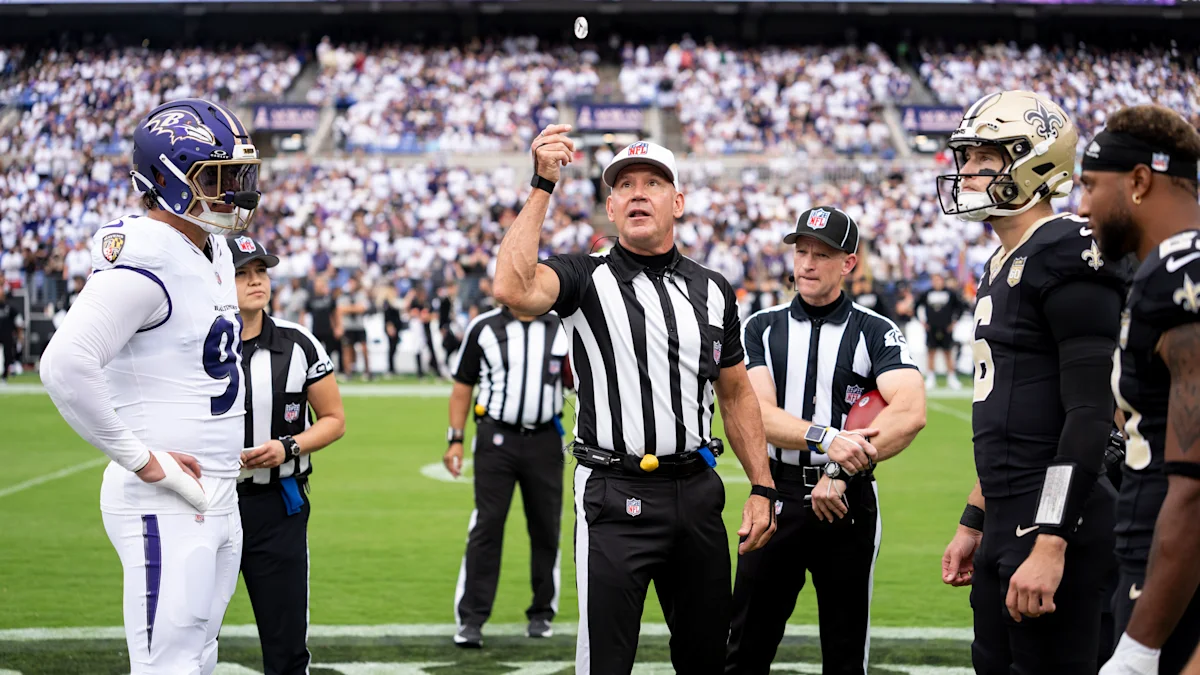
Prior to overtime last Sunday night, with his team in jeopardy of starting a pivotal season with two straight losses, Indianapolis Colts coach Shane Steichen contemplated one of the toughest choices in football.
He had to decide whether to kick or receive if the Colts won the coin toss.
Winning the overtime coin toss used to be cause for celebration under the NFL's previous rules. The receiving team gained the opportunity to secure victory without its opponent touching the ball if it scored a touchdown on its opening possession.
The optimal strategy is far murkier now that the NFL's overtime system guarantees both teams possession of the ball. Winning the coin toss now means choosing between taking the ball first to chase a potential possession advantage or playing defense first to know exactly how many points are required to win.
The presence of quarterback Patrick Mahomes in the opposing huddle influenced Steichen's decision to give the Kansas City Chiefs the ball to start Sunday's overtime. As Steichen told reporters after the game, "If we go first with it, Mahomes gets four downs going the other way, so we wanted to play defense there and know we had four downs."
Steichen's decision backfired on the Colts when both teams settled for field goals on their initial possessions of overtime and Mahomes took advantage of getting the ball a second time. Harrison Butker's game-clinching 40-yard field goal sent the Chiefs spilling onto the field in celebration and sparked renewed debate over how teams should approach winning the overtime coin toss.
It's difficult to draw meaningful conclusions from the results of recent overtime games because the sample size is too small. Twenty games have gone to overtime since the NFL adopted the new rules for the playoffs in March 2022 and then extended them to the regular season in 2025. The team that won the overtime coin toss has chosen to kick in 14 of those 20 games. And yet the team that received the ball first is 11-8-1 (57.5%).
A study published by a football-obsessed cardiologist in The Journal of Sports Analytics this past July offered some of the first mathematical insight into the optimal strategy for the NFL's kick-or-receive overtime coin toss dilemma. Using a Monte Carlo simulation to predict which strategy would prove advantageous over 100,000 NFL overtimes, author Dylan Goings found that electing to receive the ball first would produce a win rate of 53.14%.
"Coaches who choose to kick are trading a structural positioning advantage for informational clarity that, in our analysis, does not translate to improved outcomes," Goings concluded.
Goings told Yahoo Sports he took on the project in his spare time last January after he and some college buddies got into a spirited debate over whether the Chicago Bears were right to kick the ball to the Rams at the start of overtime in the divisional playoffs. The cardiologist could not let the argument go unresolved, especially not when his background in medical research, risk stratification and statistical analysis gave him the tools to find a definitive answer.
"It's just the type of person I am," Goings said with a laugh. "If you have an argument with a friend and you have a hunch that you're right, let's settle it.
"I had already written code to do a Monte Carlo analysis for something very similar. So with just a few tweaks I had something that's relevant to football fans."
The key limitation to a Monte Carlo simulation — an analysis that uses random guessing over and over to predict the possible outcomes of an event — is that the results are only as good as the assumptions and probabilities that the researcher feeds into the simulation. Goings combatted that before submitting his study for publication by posting the results of his Monte Carlo simulation to a handful of Reddit forums and incorporating feedback on how heavily to weigh variables like two-point conversion strategy or clock pressure.
"It was like a peer review process from strangers on the internet," Goings said.
To test whether the optimal strategy varied if one team had an elite defense or a turnover-prone quarterback or a shaky kicker, Goings conducted a sensitivity analysis using extreme or even unrealistic efficiencies. There was no combination of variables, he said, where he found it was more advantageous to kick than to receive.
The best way for the team that has the ball second in overtime to eat into its disadvantage, according to Goings, is to aggressively go for the win on its initial possession. Whether by going for it on 4th-and-short instead of kicking a tying field goal or attempting a two-point conversion instead of kicking a tying extra point, those options are superior to matching scores and giving the opposing team possession of the ball in the sudden death format.
One of the most qualified people to assess Goings' findings might be a former backgammon world champion with a passion for game theory. Frank Frigo has worked with risk-averse NFL and college coaches to help them optimize their in-game decision making, first as a co-founder of data analysis firm EdjSports and now as an independent consultant.
When asked which strategy he favored for the overtime coin toss winner, Frigo told Yahoo Sports that he believes the potential to have a greater number of possessions by taking the ball first slightly outweighed the informational advantage of getting the ball second. Frigo hasn't run a full data simulation like Goings, but he pointed to data showing that 22.1% of NFL overtimes end on the third possession and 6.4% on the fifth.
"It's hard for me to imagine that the informational advantage of having the ball second outweighs that," Frigo said.
As fans in Buffalo know all too well, the NFL implemented its new overtime system in response to the Kansas City Chiefs beating the star-crossed Bills in the divisional round of the NFL playoffs in January 2022. After a thrilling, back-and-forth 60 minutes of regulation, the overtime coin flip had an outsize influence on the outcome. The Chiefs won the toss, and Mahomes promptly led them to a touchdown on the opening drive of overtime, stranding Josh Allen on the sideline with no way to respond, no way to impact the result.
The lack of debate over whether the kicking or receiving team has the advantage in overtime now is proof that the NFL's new system is working. Since the start of the 2025 regular season, the overtime coin toss winner has a record of 6-12-1. To this day, teams don't seem to fully understand how to capitalize on the slight structural advantage of receiving the ball first or how to negate much of the disadvantage of taking the ball second by playing for the win.
After his team lost 20-17 in overtime to the Green Bay Packers last Sunday, New York Jets coach Aaron Glenn struggled to explain to reporters why he elected to receive the ball first in overtime. Glenn said the Jets were hoping to eat most of the 10-minute clock with their opening drive, score a touchdown and put pressure on the Packers to answer.
"It didn't happen for us the way that I planned," Glenn conceded.
Later that night, Steichen also faced a barrage of questions about why he chose to kick a game-tying field goal at the end of the Colts' lone overtime possession rather than going for it on 4th-and-8 deep in Kansas City territory. Steichen initially sent his offense onto the field, only to gesture to quarterback Daniel Jones not to snap the ball.
"Had a play called, [but] had to love the look to run it there," Steichen said. "And, if not, obviously we took the delay of game there and kicked the field goal to tie it."
To Goings, the most egregious overtime coin flip decision this season was his favorite team's. Having either not read Goings' study or not agreed with his conclusions, New Orleans Saints coach Kellen Moore — after winning the toss — chose to kick the ball to Detroit in a 31-30 week 1 overtime loss to the Lions.
"They did the exact opposite of the strategy I suggested," Goings lamented. "That was pretty frustrating to watch."
Topics in this story
Gathered from external sources. Rights to this text belong to whoever originally published it.