Colin Kaepernick won't support NFL, says league is 'actively blackballing me' and others who protested
Colin Kaepernick still watches football, just not the NFL.
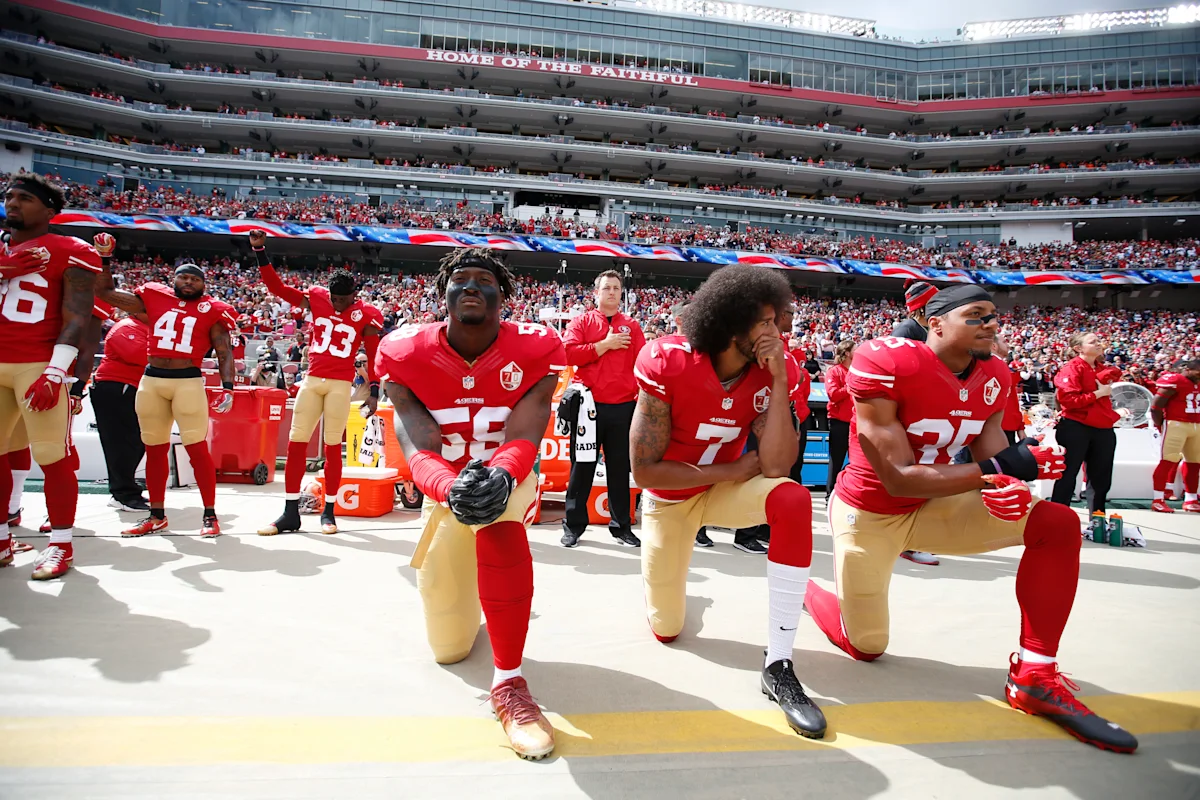
It's been 10 years since San Francisco 49ers quarterback Colin Kaepernick took a knee during the national anthem as a way to protest what he perceived as oppression against Black people and people of color in the United States.
"I am not going to stand up to show pride in a flag for a country that oppresses Black people and people of color," Kaepernick explained 10 years ago. "To me, this is bigger than football and it would be selfish on my part to look the other way. There are bodies in the street and people getting paid leave and getting away with murder."
Kaepernick, who has not played in the NFL since 2016 gave a rare interview with NBC News in which he discussed his protest and the effects of it.
In the interview, Kaepernick said he hasn't watched an NFL game since he was exiled from the league following the 2016 NFL season. He also made it clear that he believes the league is still " blackballing " him and targeting others who protested.
"I'm not gonna support an organization that one, is actively blackballing me, but two, has targeted my brothers who have been protesting as part of this as well," Kaepernick says. "I watch college football."
During the interview, Kaepernick discussed the origin of the kneeling and whether it had support from military veterans. Kaepernick said it was teammate Eric Reid — who took a knee with Kaepernick on Sept. 1, 2016 — who suggested the gesture as a form of protest.
At the time, it was suggested that a former Green Beret, Nate Boyer, came up with the idea for Kaepernick and Reid to take a knee, but that wasn't actually the case. Boyer did meet with both players, with Kaepernick asking how he could protest without angering those in the military. Boyer said people would be angry no matter what, adding that sitting on the bench — which Kaepernick was doing during the national anthem prior to Sept. 1 — was not an inspiring way to get their message across.
Boyer then told Kaepernick he believed sitting on the bench "wasn't the most inspiring" and that the protest could be more effective if he was next to his teammates, perhaps bowing his head while standing. "He said no immediately, and I respect that," Boyer says, and the conversation then logically turned to taking a knee. He doesn't dispute that the two players may have come to that conclusion before meeting him.
Boyer then told Kaepernick he believed sitting on the bench "wasn't the most inspiring" and that the protest could be more effective if he was next to his teammates, perhaps bowing his head while standing.
"He said no immediately, and I respect that," Boyer says, and the conversation then logically turned to taking a knee. He doesn't dispute that the two players may have come to that conclusion before meeting him.
After the game, Reid claimed Boyer was on board with the idea. Kaepernick said he didn't dispute that at the time because he didn't want the conversation to devolve into a "back-and-forth."
Kaepernick's decision to kneel caused a significant reaction both inside and outside the NFL. Within the game, a player group chat reportedly grew contentious, with then-Seattle Seahawks cornerback Richard Sherman reportedly telling Kaepernick he "shouldn't tell players how to protest," per NBC News.
Outside the game, Kaepernick became a popular political lightning rod. Then-Supreme Court Justice Ruth Bader Ginsburg said Kaepernick's protest was "dumb and disrespectful," though she later apologized for her remarks. Before his first presidential term, Donald Trump famously said he wished owners would say, " Get that son of a bitch off the field right now, out, he's fired. He's fired!" when players protested.
On top of that, angry fans burned Kaepernick's jersey.
Kaepernick said the criticism he faced for taking a knee was a way to distract from the actual message he was trying to send, per NBC News.
"The critique of the method is a way to distract from the actual message," Kaepernick says. "The conversation that was being had is taking a knee is more problematic than Black people being killed. Just simply put, 'Hey, we need to talk about taking a knee. This is urgent. We need to resolve this.' But another Black person gets killed, and it's like, 'Oh well, that's kind of normal.'"
Despite all of that, Kaepernick spent the 2016 NFL season with the 49ers. While he did not open the year as the team's starter — losing that role to Blaine Gabbert — Kaepernick eventually came off the bench to start 11 games down the stretch.
He finished the season with 16 passing touchdowns and four interceptions.
At the end of the season, the 49ers told Kaepernick he would be released. Despite leading the team to the Super Bowl in 2012 and reaching the AFC conference championship in 2013, Kaepernick met with just one team during the 2017 offseason — the Seahawks.
Kaepernick said other coaches — like then-Baltimore Ravens coach John Harbaugh — expressed interest in signing him, but were shut down by those above them.
In 2017, Kaepernick eventually filed a grievance against the league, alleging collusion to keep him out of the NFL. He settled with the league in 2019.
In the years since his decision to kneel, Kaepernick made it clear he wanted to return to the NFL. Despite repeatedly saying he was ready to come back, Kaepernick remained unsigned.
Throughout that entire saga, NFL commissioner Roger Goodell has denied collusion by the league, saying teams are free to make their own decisions when it comes to personnel.
In the years since his NFL exit, Kaepernick has continued his work as an activist, winning a number of awards for his ability to make an impact. He's also published a children's book and been the subject of a Netflix series.
Topics in this story
Gathered from external sources. Rights to this text belong to whoever originally published it.