Report Grades for Every NHL Team's Prospect Pool for the 2026-27 Season
It's the most stressful time of the semester for students—midterms. To celebrate, we're sending out report cards for your favorite (and least favorite) NHL team's prospect pool. Why should you be the only one getting a grade?
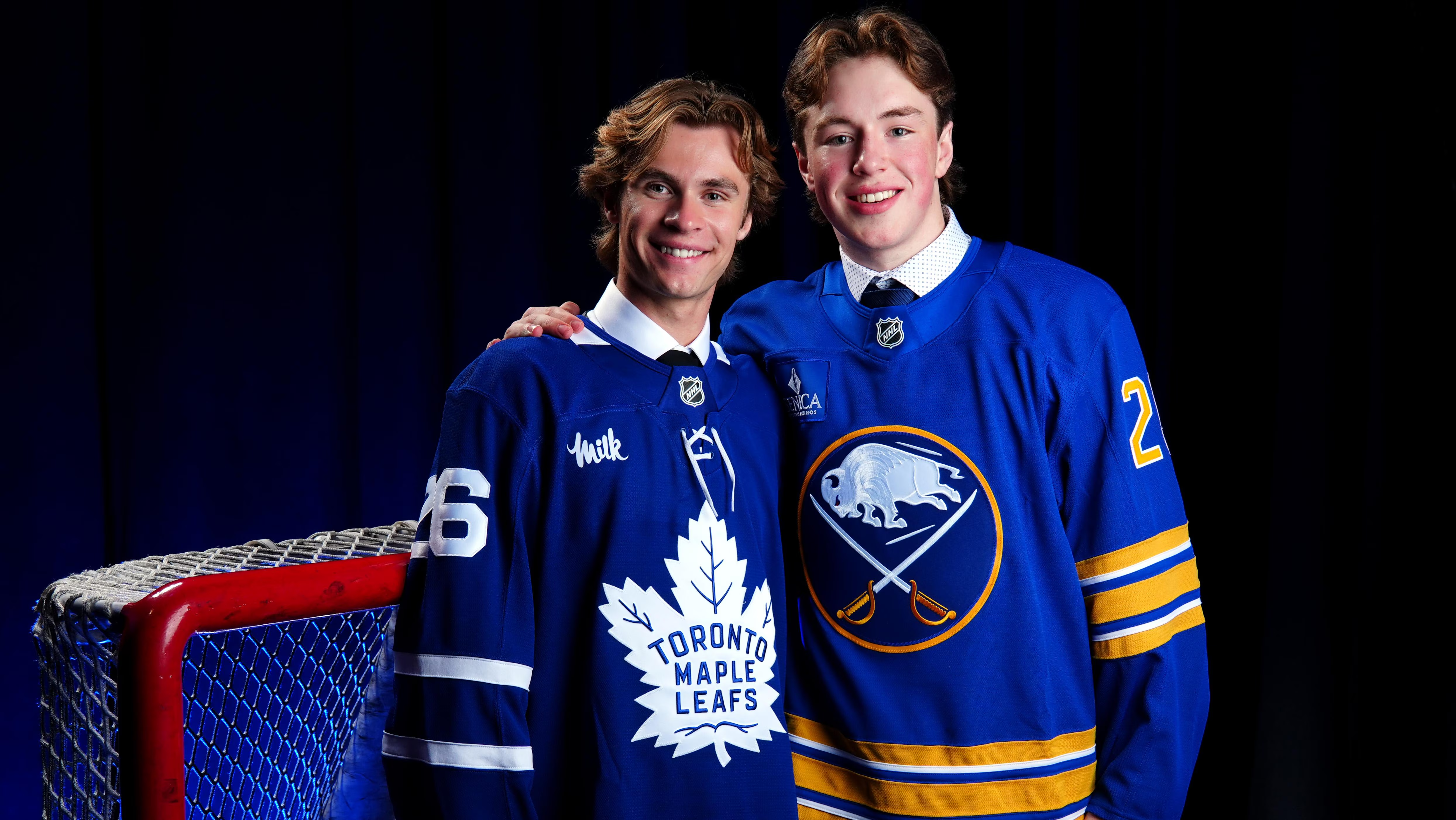
It's the most stressful time of the semester for students—midterms. To celebrate, we're sending out report cards for your favorite (and least favorite) NHL team's prospect pool. Why should you be the only one getting a grade?
Grades (and rankings) of prospect pools are always in flux. Such is the cyclical nature of professional hockey and player development. There's always someone graduating to playing pro full-time, and always someone new being drafted. Your favorite team could get an A-grade this year, graduate three or four of their top prospects to the NHL all at once, and drop down to the bottom of the league if they don't pick up any big names at the next NHL Entry Draft.
(Many such cases in these reports, in fact; we'll get to those in a bit.)
Looking at a prospect pool's makeup reveals a lot about both the drafting and development strategies of a team. We recently ranked them against each other; now it's time to judge them all on their own.
ANA | BOS | BUF | CAR | CBJ | CGY | CHI | COL | DAL | DET | EDM | FLA | LAK | MIN | MTL | NJD | NSH | NYI | NYR | OTT | PHI | PIT | SEA | SJS | STL | TBL | TOR | Utah Mammoth | VAN | VGK | WPG | WSH
The Anaheim Ducks made the top 10 in our recent prospect pool rankings, largely due to players like Roger McQueen, Nikita Klepov, and Stian Solberg. We also called out defenseman Tristan Luneau as a player we expected to see make the Ducks full-time sooner rather than later. Since then, McQueen and Klepov have made the Ducks' opening night roster, and Luneau has signed a six-year contract extension worth $43.2 million.
How many games McQueen and Klepov play this season remains to be seen (McQueen is currently with the San Diego Gulls—while he was named to the Ducks' opening night roster, he didn't actually play). Whether Luneau lives up to the high dollar amount he signed for is equally in question. But the fact that the Ducks have a prospect pool that allows them to make these kinds of moves bodes well for their future.
There's depth at every position, barring maybe goaltender; even the players there are unknown quantities rather than never-NHLers. They'll drop once the earlier-mentioned players graduate to the NHL full-time, but they won't go far.
If it weren't for James Hagens and Dean Letourneau, who single-handedly (double-handedly, since it's two of them?) dragged this grade up, the Boston Bruins would be looking at something in the D or D-minus range. The Bruins were near the bottom of our prospect pool rankings last year for a reason. There just isn't much to work with outside of a few top names because, quite frankly, they haven't been good at making use of their picks over the last decade.
Dig back through the Bruins draft history over the last ten or so years. How many names do you think the average fan would recognize? How many of these guys have become true NHL regulars—not tweener or journeyman types, but players who contribute on a really meaningful level? Since 2020, the only ones who are even contenders are Matthew Poitras and Mason Lohrei, and at present they're more utility guys than true play-drivers.
Hagens and Letourneau will; Will Zellers and Cooper Simpson could. But outside of that, the Bruins are going to have some real work to do moving forward.
There are not many teams in the league right now with a deeper or more well-rounded prospect pool than the Buffalo Sabres. And they broke their fourteen-year playoff drought at the end of last season. It's rare that a team is able to do both; whether they can keep it up is another matter entirely, as one of the functions of prospects is as bargaining chips for pieces of a Stanley Cup run. But at the moment there's a treasure trove of potential, and Sabres fans should enjoy it.
Names that drove the grade up include recently drafted defenseman Daxon Rudolph, who does nothing extraordinarily but everything very well (minus being a touch too nonchalant), and forward Konsta Helenius, who, despite being recently scratched for "not enough compete," is in a good position to become a full-time NHLer this season. Defenseman Radim Mrtka, too, is waiting in the wings to become a valuable part of the NHL lineup, though he'll likely require more seasoning in the AHL first.
Outside of these players, there's significant depth at nearly every position. Keep an eye on guys like Ilia Morozov and Adam Kleber.
One of the top prospect pools in the league for several years running belongs to the Calgary Flames. It is well-rounded, with depth at every position—they have impressive forwards with true offensive skill, defensemen who are elite processors and puck-movers, and even high-end goaltending—and they have made the most of multiple seasons of high draft picks. Names like Zayne Parekh, Carson Carels, and Matvei Gridin come to mind.
In addition to drafting well high, though, the Flames have also consistently found value with their depth picks. Ethan Wyttenbach, drafted in the fifth round in 2025, was the leading scorer in college hockey last season. Luke Misa, a 2024 fifth-round pick, is a fantastic transition player currently developing with Penn State's NCAA team.
The Flames' prospect pool is also just large . They made 9 picks in 2026, 8 in 2025, and 10 in 2024. Placing so many bets makes it that much more likely you'll have several that pan out into consistent contributors when they reach the NHL.
Falling solidly middle-of-the-league in our recent pool rankings, the Carolina Hurricanes earn a nicely above-average grade of B+ for their report card. Their prospect pool is deep and well-rounded, allowing them to make swings for players that helped them on the way to their recent Stanley Cup win, but there are also no true stars in their prospect pool right now.
That's honestly fine when you've got a lot of good players and a good track record when it comes to utilizing the next man up.
Felix Unger Sorum doesn't get enough respect as far as prospect discussion goes; he has the skill level necessary to contribute in the NHL right now, although his decision-making could still use a bit of refinement. He's with the Chicago Wolves of the AHL right now, but he and fellow forward Bradly Nadeau (also currently with the Wolves) are both possibilities for that next-man-up role this season. Where Unger-Sorum excels at passing, Nadeau's calling card is his incredible shot.
Beyond those two lies a whole host of players with quite high skill levels—but that skill is also raw. The Hurricanes, more than most other teams in the league, swing on potential, and you have to respect it; if you're able to refine it, acquiring that raw potential overlooked by other organizations gives your team a real competitive advantage.
Overwhelmingly, the rationale for the A that the Chicago Blackhawks received here is because of the sheer depth in the organization's prospect pool. There are some exceptional players at the top of the pool—Anton Frondell, for example, and Roman Kantserov, both of whom project to be long-term top-six forwards in the league. Neither is without their flaws—Frondell's skating could use some work, and Kantserov could stand to refine the defensive side of his game—but regardless, their overall upside is significant.
Behind them is a whole stable of good—though not elite— players, including Václav Nestrašil, Xavier Villeneueve, Ryan Roobroeck, Marek Vanacker—the list goes on for quite some time. There's depth at every position, each player with their own highlight areas. Oliver Moore and Nick Lardis have played too many games to technically be prospects, but they graduated from the pool extremely recently.
For a team like the Blackhawks, desperate to return to contender status, having such a large pool to deal from is crucial to building a playoff-worthy roster. If they continue on their current track, it won't be long before they break through that wall.
The Colorado Avalanche had a terrible prospect pool until very recently. With the recent drafting of QMJHL forward Egor Shilov, and the fact that they have goaltender Ilya Nabokov under contract, as well as a few other changes, it's now only at a "bad" level.
Obviously, any NHL team would take consistently being contenders over having a deep or particularly strong prospect pool; there's often an inverse relationship between how good your NHL team is and how good your prospects are due to the nature of the draft. Unlike the previously discussed Calgary Flames, the Avalanche have made relatively few picks in recent stretches—from 2021 to 2023, they only made 11 picks total, trading away almost exactly as many as they made.
But even thin prospect pools will often have one standout; one player who could possibly be a difference-maker. Even with as highly as I rate Egor Shilov, the Avalanche simply don't have that right now. Still, when your prospect pool is this bad, all it takes is one good pick to boost your overall grade—see the Boston Bruins and James Hagens, for example, or the Toronto Maple Leafs and Gavin McKenna.
Time will tell if the Avalanche finds their outlier.
Are the Columbus Blue Jackets prospects good, or do they look good on paper? That's the question we were left with during our August prospect pool rankings. There are several notable names in said pool, and guys that I myself rate pretty highly—defenseman Jackson Smith and forward Cayden Lindstrom are only two of those. But are they more than just their names and the potential that we see in them when we scout?
Too often, that potential is identified but never pans out. There are a variety of reasons for this: injury, a poor development environment, or lack of commitment by the player, just to name a few. But there's always a stretch where that outcome is unknown, and it's just taking a swing on potential.
That's where the bulk of the Blue Jackets' prospect pool lies right now. Will Lindstrom's back surgery and resulting path back to himself and his own potential hamper his development entirely? Is Oscar Hemming a legitimate NHLer, or are the flashes of (admittedly impressive) playmaking that we've seen just that—a flash in the pan? We'll likely know better this time next year whether these guys are the real deal, or if they're just—as my colleague Adam Herman so aptly put it in our August rankings —a "paper tiger".
There's talent in the Dallas Stars' prospect pool, but there's not much of it.
The Stars landed second-to-last in our recent rankings, and the reason for this was twofold—and both reasons apply to their disappointingly low grade. In the past six years, they've only selected in the first round three times—Wyatt Johnston, Lian Bichsel, and Emil Hemming. In those same six years, they've only graduated three players to the NHL—Wyatt Johnston, Lian Bichsel, and Logan Stankoven, who recently won the Stanley Cup with the Carolina Hurricanes.
It doesn't seem like those numbers are going to climb much higher, either. Of all the players selected in that same six-year span, there are only two players outside of Hemming who really come across as having NHL potential. The first is undersized but high-scoring winger Cameron Schmidt out of the WHL; opinions are mixed on his future potential, but it's likely that he finds a place somewhere. The second is defenseman Jakub Vaněček, who is impactful on the rush but desperately needs to reduce the chaos in his game if he's going to find an NHL home.
Things are weird with the Detroit Red Wings right now. No permanent general manager, a captain who wants out for reasons we won't speculate on, a high-end defenseman who wants out because of how contract negotiations have been handled—or not handled—and a plan for the future that right now feels like a bunch of question marks.
Fortunately for the Red Wings, something that is going right is their drafting. Their prospect pool is solidly above average, with pretty decent depth throughout. Like a lot of teams, there is no truly elite standout player in their pool, but when you have a bunch of good players, that's much less of a problem.
Trey Augustine should be a mainstay in goal for the Red Wings (I say should because, well, we can't predict much about them solidly right now) for a long time. Carter Bear needs some seasoning but has the kind of tenacity and hockey sense that you can't teach. Throw in names like Victor Plante, JP Hurlbert, Michael Brandsegg-Nygard, and reigning Hobey Baker winner Max Plante, and you've got true depth down the line.
Buckle in, Edmonton Oilers fans. I'm about to pour metaphorical peroxide on your splinter and pull it out. Happens to all of us at some point.
The cupboards are basically bare in Edmonton. There's not much to say besides that.
Their top prospect was Ike Howard, acquired in a trade from the Tampa Bay Lightning. I say was because Howard is almost certainly graduating to being a full-time NHLer this season and will no longer count as a prospect. And outside of him, well, it's pretty bleak. Tommy Lafreniere and Samuel Jonsson are two of only a few with even a whiff of an NHL future any time soon.
Rudolfs Berzkalns, drafted by the Oilers in June, has significant potential to be a strong bottom-six NHL center—particularly as he already plays an NHL-style game—but he's the kind of player who requires patient and supported development. The Oilers are bad at that in addition to being bad at drafting. And if you're going to be bad at drafting, you have to be good in the playoffs. They haven't figured out that part yet either.
The situation in Florida is nearly as bad as it is in Edmonton. The Panthers occupied the final spot in our August rankings for a reason, with the Oilers being dragged up by Howard.
Without him considered a prospect, the Panthers edge ever so slightly ahead, and it's entirely because of the potential—not the certainty, but the potential—of players like Simas Ignatavičius and Ryder Cali. Both forwards are good skaters, tenacious and physical, with Ignatavičius bringing flashes of playmaking and Cali showcasing really nice speed. Both of them project as pretty solid support players in the future.
But the Panthers have literally no one at the top of the funnel. If you don't draft and develop players at the top of the funnel, you have to acquire them via trade. The Panthers instead traded for Brady Tkachuk, Radko Gudas, and Brad Marchand. None of them are bad at hockey, and the Panthers clearly have a very strong player brand. But they have nothing going for them beyond the immediate future when it comes to play-drivers. And that wart isn't going anywhere for a while.
The Los Angeles Kings have a prospect pool that I would classify as "mid with promise". Their pool definitely isn't bad, but it's also not something we can truthfully classify as good. It has its standouts, though, and they're players that are easy to project to the NHL in the near future.
Henry Brzustewicz is a surprisingly skilled defenseman who suffered from the London Knights' curse of being hidden in a deep roster; if he'd been on a different team, it's possible he would've already been gone when the Kings drafted 31st overall in 2025. He's a strong, smooth skater who activates often and effectively. His puck-moving abilities have significantly improved over the last year. At worst, he's going to have a solid career as a bottom-pair defenseman, but he projects more as an effective second-pair type.
Hampton Sluksynsky is a poised, athletic goaltender with a lot of success under his belt and significant promise. Winger Elton Hermansson, drafted in June, has the potential to be truly special offensively, but there's uncertainty as yet as to whether he will put all the pieces together. There's a little bit of depth behind these top three guys, but not much.
If the Los Angeles Kings are on the higher end of average, the Minnesota Wild are aggressively on the lower end of average. They graded higher as recently as last year, but then they traded for this guy you might've heard of named Quinn Hughes and lost a couple of their high-end prospects in that and other transactions.
It's a deal most teams would make, and all teams could understand.
While the cupboard is a bit more sparse, there's still value in it. Charlie Stramel has the most certain professional future and could make the move to full-time NHL as soon as this season. He's currently with the Iowa Wild, but he's a really good call-up option should any injuries occur, particularly because of his size and agility.
Other players like Adam Benak, David Spacek, Hunter Haight, and Ryder Ritchie—among several others—all add to the depth of the cupboard in terms of numbers. How significant the potential is among this tier of players is what remains in question.
Solid A-grade prospect pool, 10/10, no notes.
Okay, well, some notes. Note number one: Michael Hage is going to be a longtime NHL player, and if anyone is worrying about the fact that he returned to college, don't. He had some unfinished business from last year's Frozen Four, and it wasn't a certainty that he'd play in Montreal the entire season. It just makes sense to go back and try and win a championship. He's quick, he's consistent, he's a terrific passer, and he's not afraid to be physical. It's going to be fun to see what kind of leap his offense takes this season.
Outside of center Hage, the Canadiens have fantastic depth in their cupboard. Winger Alexander Zharovsky, defenseman David Reinbacher, goaltender Jacob Fowler — there's high-end promise at every position. And there are guys behind these guys. Gleb Pugachyov has really fun potential on the wing. Timofei Runtso brings offensive skill and great attention to detail at defense.
The beauty of the Habs' prospect pool is that I could keep going from here. Between this and their NHL roster seeing success last season, it's a good time in Montreal.
Another A-grade pool on the list, the Nashville Predators have made a huge leap forward since last season. Drafting Brady Martin, Cameron Reid, and Ryker Lee in 2025 was a good step, but they took it further this year and selected forward Wyatt Cullen and defenseman Tommy Bleyl in the first round alone. That top tier of their pool is looking awfully shiny.
Their turnaround has happened for two reasons: they acquired more picks to give themselves more options, but they also simply seem to have gotten better at identifying talent. The Predators of even a few years ago wouldn't have selected players like Lee and Bleyl, and they definitely wouldn't have taken a swing on a forward like Cullen. They would've gone for someone of size and grit.
But the depth keeps going. Some of their more intriguing second-tier options include the tenacious center Teddy Stiga, goaltender Jack Ivankovic, and Russian center Yegor Surin, whose never-quit motor makes him absolutely fearless.
The New Jersey Devils are another prospect pool that is extremely mid at best. But they're also extremely mid at worst, and as we've seen, there's a long way down from there. Silver linings!
In terms of NHL projection, the only players who appear to have a strong likelihood of an NHL future are defenseman Anton Silayev—who could make his first NHL appearance as soon as this season, though he's currently playing with the Utica Comets—and center Alexander Command.
It's not a surprise that Command's pick, as well as that of defenseman Nikita Shcherbakov, came under the leadership of general manager Sunny Mehta. He didn't replace the scouting staff, and credit, as always, goes to the scouts who identified the value in these players, but new leadership often frees people to speak up more or differently. Previous years' picks felt particularly uninspiring; this year's were at least interesting. We'll see what sort of pattern begins to emerge at the 2027 NHL Entry Draft next spring.
The New York Islanders' pool might be a weird one, but it's good weird. It's all over the place, with prospects ranging from the relentless and intelligent winger Victor Eklund to the high-risk, high-reward shutdown defenseman Malte Gustafsson, and everyone in between.
Defenseman Matthew Schaefer, Calder Trophy winner, never really counted as a prospect. He was drafted on the basis of 17 games in his draft season, immediately transferred his ability to control the flow of play when he steps onto the ice to the NHL, and is wearing an A this season. He doesn't affect this draft ranking, but the philosophy used when selecting him first overall extends to the rest of the Islanders' prospect pool, and that's why they have the depth that they do.
They could stand to add a couple more top-of-funnel guys, particularly as they are likely to graduate several of their top prospects to the pros fairly soon, but they're well-rounded at present.
Some names you might recognize—and if you don't now, you will soon—from that depth include defenseman Kashawn Aitcheson, true boom-or-bust winger Cole Eiserman, and hard-hitting, net-driving winger Daniil Prokhorov.
Previously not well thought of, the New York Rangers' prospect pool got a much-needed boost over the last year through both drafting and trade. The good news is that the boost in question was legitimate and included players with very real NHL futures. The bad news—if you can call it that—is that the boost in question was extremely defense-heavy, at least in terms of draft selections.
It's not a bad problem to have, all things considered. Especially when you take into account the quality of those defensemen and the fact that the Rangers acquired both Liam Greentree and Cole Beaudoin via trade to address the forward side of the pool.
When you combine the two of them and this year's draft picks—particularly Alberts Smits, who made the opening-night roster, and Ben Macbeath—the Rangers' prospect landscape looks entirely different from what it did at the start of the calendar year. Smits is a fantastic skater, able to eat important minutes. Greentree is a fantastic stickhandler. Beaudoin is a tenacious middle-six center who has significantly improved his skating.
Here's to hoping they stay on this path. Things are definitely looking up.
The Ottawa Senators come in at ever-so-slightly above average. That designation is due to two primary factors: what I dubbed in our August rankings "a few highlights among the rubble", and some promising selections at the 2026 NHL Draft that may potentially indicate a new draft philosophy that will continue to drag them upward in the years to come.
As far as top-of-funnel guys go, defensemen Carter Yakemchuk and Logan Hensler are your chief players to watch here. If they don't pan out, that grade drops to a D+ instead of a C+. A C- at best. Yakemchuk has a really nice ability to manipulate opponents; at his best, Hensler is excellent at smothering them and shutting down their opportunities. They would honestly make a pretty solid pair if they weren't both right-handed guys.
How did Ottawa get two of the most coveted assets in the league, for that matter? A right-shot defenseman goes for an arm and a leg these days.
Regarding their 2026 selections: Jonas Lagerberg-Hoen and Jaxon Cover, while being pure swings on potential, were really smart, high-reward picks. Adam Nemec is another guy with a lot of promise. If they signal a new draft direction, we'll see Ottawa's pool rise further next year.
Let's all take a moment and acknowledge that there's no reason Porter Martone should've dropped to sixth overall in 2025. Anyone who read my draft work that season knows I considered him my nemesis because of the frustration inherent in watching him float around the perimeter, but even with that legitimate critique, his potential was clear and significant. He made great strides last season, and they were loudly on display as he made his debut with the Flyers at the end of the year. He's such a special player.
Between Martone, Denver Barkey, Jett Luchanko, and Oliver Bonk, the top end of the Flyers' prospect pool is quite impressive, even with the metaphorical warts surrounding the development of the latter two. Unfortunately, there's also a significant drop after those guys. Jack Nesbitt was not the guy to take at 12th overall in 2025, and Maxim Sokolovskii is hit or miss.
The Flyers will likely take a tumble in both ranking and grade next season when several of those top guys have graduated, so enjoy it right now.
You'll take your B+ grade and like it, Pittsburgh Penguins fans. It's not that long ago that this prospect pool could've received the kind of blistering indictment the Edmonton Oilers have earlier in this piece. General manager Kyle Dubas, and more specifically his scouting staff (utilizing the picks he has been deliberately stockpiling), have added quite a few important pieces over the last few years.
No longer do the post-Crosby-and-Malkin years look like a long drop off a sharp cliff. Now they just look like a gentle tumble down a very small hill; one that's easy enough to get up and dust yourself off from, even if you are a little bruised.
Some standouts include: goaltender of the future (and I suppose the present, now that the season has started) Sergei Murashov; forwards Bill Zonnon and Will Horcoff; and our new favorite narrative, who also happen to bring true skill to the ice in the process, twins Liam and Markus Ruck.
Defenseman Harrison Brunicke will be on the NHL roster before long, and forward Rutger McGroarty might've seen his development stall a little, but he's still got an NHL future ahead of him.
Amazing depth. Well-rounded as far as positions go. Consistently good choices made on draft day. Can there really be enough good things said about the San Jose Sharks' prospect pool?
These selections have, of course, come to the Sharks because the on-ice NHL product was admittedly very bad for a while. But with the advent of the Macklin Celebrini era (so dubbed because he is captain, and not to slight anyone else who has entered the NHL in the same timeframe), things are starting to look up.
Celebrini and linemate Will Smith don't count anymore, but the ethos that brought them to San Jose shows up in the rest of the pool as well. In June alone, the Sharks brought in Ivar Stenberg, Keaton Verhoeff, Ryan Lin, and Brady Knowling. That follows their 2025 selections of Michael Misa and Joshua Ravensbergen and their 2024 selections of Sam Dickinson (also now considered a full-time NHLer) and Igor Chernyshov.
Good things are coming, Sharks fans. The only question is timing.
The Seattle Kraken have finally gotten out of oops-all-centers drafting mode, and their prospect pool is beginning to look truly well-rounded. That being said, this would probably be more of a B-grade pool if it weren't for standout defenseman Chase Reid. He's the best example of a gamebreaker that the Kraken currently have in the cupboard. Reid is a truly special player, able to impose his will on the flow of play with his incredible skating, elite hockey IQ, and puck-handling skills.
Center Berkly Catton joined the NHL full-time last season, but there's another high-end center waiting in the wings for his moment. Jake O'Brien is currently on the injured non-roster list, so we won't see this any time soon, but he's another with real near-future full-time pro potential. He's so dynamic and creative, and he can easily identify opportunities other players don't even consider.
Second-rounders Casey Mutryn (2026) and Blake Fiddler (2025) bring up the next tier. Fiddler provides true defensive impact, while Mutryn is a tenacious playmaker who wins more battles than most and isn't afraid to throw his weight around.
The St. Louis Blues are your typical above-average prospect pool with no true stars but a whole slew of guys with a lot of promise. That's honestly not a bad place to be in as an organization trying to take that next step; it allows you to deal for high-end roster players without losing anyone you're deeply, truly attached to. You've just got to know which of those guys with promise you'd prefer to keep.
Take a look at the players that the Blues have in the cupboard and let us know which ones you'd keep and which ones you'd deal for that key addition.
The top guns in their pool right now are Tynan Lawrence, Justin Carbonneau, and Adam Jiricek. Lawrence is a powerful player with a strong shot and a lot of intent; Carbonneau is a true QMJHL enigma with extremely high offensive skill and a desperate need to improve his defensive details. Jiricek brings strength and intelligence on defense.
A personal favorite of mine is 2026 first-rounder Maddox Dagenais, who could've truly gone anywhere at or after about pick number 10 and been justifiable. He brings size and a whole lot of smarts, and just needs to put all the pieces together to be successful.
Yet another team falling on the aggressively low end of average, the Tampa Bay Lightning should feel lucky that they graded this high. A grade of D was briefly tossed around. At the end of the day, though, the skill brought to the table by Conor Geekie (counted as a prospect because he hasn't stuck in the NHL for a full season yet) and Sam O'Reilly won out and dragged them up to a C-.
You'll notice that neither of these players was drafted by the Tampa Bay Lightning. They made a habit of trading away their high picks for quite some time; the Lightning's last time drafting in the first round was in 2022, and Ike Howard is with the Oilers now. Their last time before selecting Howard was 2019. Nolan Foote never played a single game for the Lightning and is now part of the Philadelphia Flyers' organization.
The Lightning do much better utilizing players they acquire via trade, though 2025 second-round selection Benjamin Rautiainen is showing some promise.
Key thing to note before we start: the B+ grade is largely due to the drafting of Gavin McKenna. If we consider McKenna graduated, this is a C- prospect pool at best, more likely a D ranking. There's simply not much behind him as far as true NHL potential goes, especially now that players like Easton Cowan and Fraser Minten are considered pros now (Minten for the Boston Bruins, having been part of the Brandon Carlo trade in 2025).
Defenseman Ben Danford is strong and poised, but isn't projected to play a top-pair role. He'll probably see some penalty-killing time eventually. Ethan MacKenzie is a defenseman with an aggressive approach to the game, bringing tenacity and big hits.
There are some fun diamonds in the rough depth projects in the Leafs' late-round selections: guys like Brody Pepoy or Harry Nansi. But you have to look in the mirror and ask yourself: are the Leafs actually going to invest the time needed to sand the rough edges off those players to get to the potential beneath? Probably not.
McKenna is really the only true top-of-the-funnel guy in this pool. The Leafs had better either start acquiring strong prospects from other teams or find a way to win while he's young and fresh.
Tij Iginla and Ethan Belchetz alone would boost the Utah Mammoth's prospect pool to above-average status. Iginla's toolkit is elite in nearly every area, allowing him to take over a shift when he steps onto the ice. Belchetz is a bit of a question mark due to a broken collarbone during his draft season, but he shines when he is able to combine his power-forward style with his high-end playmaking abilities.
Thankfully, the Mammoth has a nice bit of depth behind them as well, and isn't solely relying on those two to push the future of the organization forward.
Their recent acquisition of goaltender Sebastian Cossa from the Detroit Red Wings was a particularly savvy piece of business, as Cossa is widely regarded as one of the best goaltending prospects out there. Add to that players like third-round 2026 selection Adam Valentini, a strong forechecking center, and intelligent playmaking center and fourth-overall 2025 selection Caleb Desnoyers, and you've got a prospect pool that has significantly improved in only the last couple of years.
Prior to the last year or two, the Vancouver Canucks' prospect pool was honestly pretty bad overall. They've really done a nice 180-degree turn with some really good choices in prospect acquisitions.
At the forward position. We're not going to talk about defense, because I refuse to bring down the vibe.
Center Caleb Malhotra was without question the best center available in the 2026 NHL Draft. If the Canucks couldn't get Gavin McKenna—due to the perceived cosmic wrong that was the Leafs winning the draft lottery rather than the true worst team—then Malhotra was pretty much the world's best consolation prize. He's going to become a Canucks mainstay sooner rather than later, and the fans are going to love his elite skill set so much that a few of them might even forget they lost that draft lottery.
Outside of Malhotra, the pool has tenacious forechecking center Braeden Cootes and an incredible passer of a winger in Adam Novotny. Add to that 2026 second-round selections Brooks Rogowski and Niklas Aaram-Olsen, and you've got the basis for a really nice turnaround.
When winger Trevor Connelly is the highlight of your prospect pool, things aren't going especially well.
This is not to say that Connelly doesn't have skill; he does. But he can't seem to get out of his own way—and lest anyone think otherwise, this is entirely about his on-ice decision-making. He takes bad penalties, he sticks to the perimeter too often, and he tries to make plays happen even when there's practically no chance of them succeeding. His skill hasn't disappeared, so if he can refine that decision-making, he's got a good NHL future ahead of him. But that's still a pretty big "if", and at times it feels like he's moving backward in that area.
Defenseman Juho Piiparinen is intelligent and physical, but he's the kind of defenseman who makes a very good support player rather than being an active play-driver himself. And that's fine! The league needs those kinds of players too. But it doesn't do much to boost the pool grade.
Goaltender Carl Lindbom likely has a solid NHL future ahead of him. Whether that is as a starter or a backup remains to be seen, but at present, a starter seems most likely.
Thorns and roses, Washington Capitals fans. The roses: there are so many really good prospects in this system. The thorns: all the ones at the top of the funnel are going to graduate very, very soon.
Ilya Protas, Cole Hutson, and Andrew Cristall are going to be full-time NHLers sooner rather than later. Cole Hutson won't win the Calder Trophy because he's up against Gavin McKenna, but he should at least get nominated. Cristall's playmaking and Protas's passing are both eye-catching skills, and ones that will thoroughly benefit the Capitals as they integrate into the NHL team full-time (whenever that may be for each). When they do graduate, depending on how the Capitals draft in 2027, that A- will probably drop to somewhere around a B, but that's still pretty solid.
Behind that trio are even more solid prospects and a team that invests heavily in their development. (The partnership between the Capitals and the Hershey Bears is one many NHL organizations could stand to learn from.) Wingers Lynden Lakovic and Terik Parascak and centers Milton Gastrin and Oliver Suvanto are the standouts of the next tier.
Like many other organizations, the Winnipeg Jets are saved from a failing grade by one shining standout player: one of my personal favorites from the 2026 Draft, Swedish center Viggo Bjorck. Don't be fooled by his slow start to the NHL season; he was always going to need an adjustment period. But his toolkit is elite in every way that matters. He's deeply intelligent, is an excellent and agile skater, and he processes the game exceedingly well.
Just trust me. He's going to be a longtime NHLer, and a really good one, especially if he can add a little more muscle. And don't listen to anyone who tells you he should be on the wing. He shines at center.
Outside of Bjorck, though, it's kind of a desert. Brayden Yager is an agile player with strong defensive intelligence but his offensive output has been disappointing of late, though he's off to a good start in the AHL this year. Defenseman Sascha Boumedienne could still pan out, but he's currently a question mark. He's at Ohio State University this season after spending two years at Boston University; we'll see if the change in environment is the boost he needs.
Gathered from external sources. Rights to this text belong to whoever originally published it.