After 15 years with ALS, Saints legend Steve Gleason reveals how his diagnosis changed his life and strengthened his connection with NFL players
New Orleans Saints legend Steve Gleason is marking 20 years since one of the most important plays in franchise history while reflecting on a very
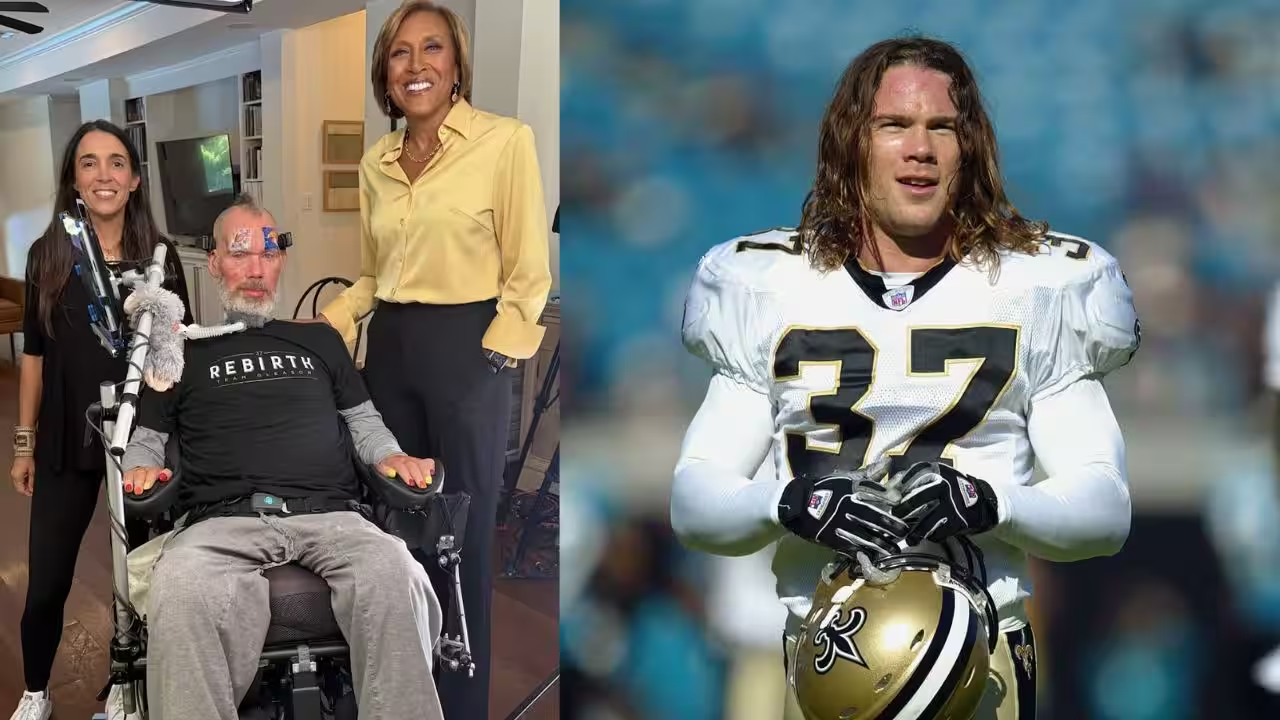
New Orleans Saints legend Steve Gleason is marking 20 years since one of the most important plays in franchise history while reflecting on a very different battle that began five years later. Gleason was diagnosed with ALS in 2011, but the blocked punt he made against the Atlanta Falcons in 2006 eventually became much more than a defining football moment. In an interview with ABC News’ Robin Roberts, Gleason explained how that play helped give him a public platform for Team Gleason and connected him with other NFL players facing ALS. Now, 15 years into his diagnosis, he says his life still holds plenty of meaning.How did Steve Gleason’s 2006 blocked punt shape his life?Gleason’s place in Saints history was secured during the team’s first home game at the Superdome after Hurricane Katrina. On Sept. 25, 2006, he blocked Michael Koenen’s punt in the first quarter against Atlanta. Curtis Deloatch recovered the ball in the end zone, giving New Orleans its first touchdown in a 23-3 victory.The play became one of the defining images of the city’s return. Gleason understood its importance that night, but he later realized the moment had also changed his own future.“If I do not block that punt, I am another former special teams player, a has-been football guy," Gleason said. "When the ALS came I probably fade away quietly and die anonymously."He believes the visibility from that play eventually helped Team Gleason, the nonprofit he founded in 2011 to support people living with ALS.“That play made me visible at the exact moment this city needed a symbol. Years later, that visibility became a lifeline.”What has life been like for Gleason after his ALS diagnosis?Gleason has now lived with ALS for 15 years. The disease has taken away his ability to move, speak and breathe independently, but he remains closely involved with his family, creative work and advocacy.“I cannot move, talk, or breathe on my own. Some days are brutal," Gleason said, speaking with Roberts. "And still, this is a miraculous, wonderful life. ... I wake up, I watch the sunrise, I am with [my wife] Michel, [kids] Rivers and Gray. I get to love this life and the people in it."He communicates with his eyes using a specialized tablet, with eye tape helping him keep his eyebrows positioned correctly.“I live on a ventilator," Gleason explained. "I live knowing this breath is given to me by a machine, and this sentence is built letter by letter, and this moment with those I love is the whole point."That perspective has also shaped the way he talks about survival.“Robin, I'm still here. That still surprises some people," Gleason told ABC News' Robin Roberts. "It does not surprise me as much as it used to."Why does Gleason call other NFL players with ALS his brothers?Gleason has found another source of strength through former NFL players who have also dealt with ALS. He calls them his NFL “brothers,” including Chris Johnson, Tim Shaw, O.J. Brigance, Eric Stevens and Steve Smith.“Chris Johnson is my NFL brother. Tim Shaw, O.J. Brigance, Eric Stevens, Steve Smith, others," Gleason said. "More importantly, they are my fellow humans. When ALS enters your life, it is a tsunami of emotions. I want everyone in their families to know they are not alone."His message reaches beyond former players. Gleason wants families dealing with ALS to understand that the disease does not have to become an isolated experience.That sense of community has become a major part of his work with Team Gleason, which has used his public profile to raise awareness and provide support for people living with ALS.What does Gleason’s return to the Superdome mean now?Gleason will return to the Superdome with his family as the Saints mark the 20th anniversary of their return following Katrina. He and Deloatch will be honored as “Legends of the Game,” while Team Gleason will benefit from the game's 50/50 raffle.“When I roll back into that stadium, I will not only be visiting a monument to 2006, I will be walking into a mirror, a place that learned how to rise," Gleason said. "I had to learn the same thing. Twenty years later, I can't wait to be in the room where that love still lives."His connection to New Orleans has also extended into music. Gleason recently released “Rebirth,” an album combining his poetry with work from New Orleans musicians."It's a love letter to the people and spirit of this wild place," Gleason said of the project. "Who better to bring that to life than the best musicians from right here in New Orleans? When we started reaching out around town, they kept saying yes. Their support has been one of the most meaningful parts of making this album for me."The NFL has also announced a $500,000 donation to Answer ALS’ Champion Insights program, which studies ALS among professional football players, other elite athletes and military first responders.For Gleason, the meaning of that old blocked punt has changed with time. What began as a football play became part of a much larger fight."The truth I have to live with is this: The same play that helped New Orleans breathe again is a big reason I'm still breathing now," he said.Stay updated with the latest Asian Games 2026 news, check the Asian Games medal tally and complete Asian Games schedule.Get the latest Sports News and Live updates. Download the TOI app.
Topics in this story
Gathered from external sources. Rights to this text belong to whoever originally published it.