Grade the trade: What does dealing center Cam Jurgens to Ravens mean for Eagles' Jalen Hurts in short and long run?
The gem of the trade is the 2028 second-rounder, giving the Eagles a surplus of picks. The A.J. Brown trade netted a 2028 first, so they'll be outfitted with...
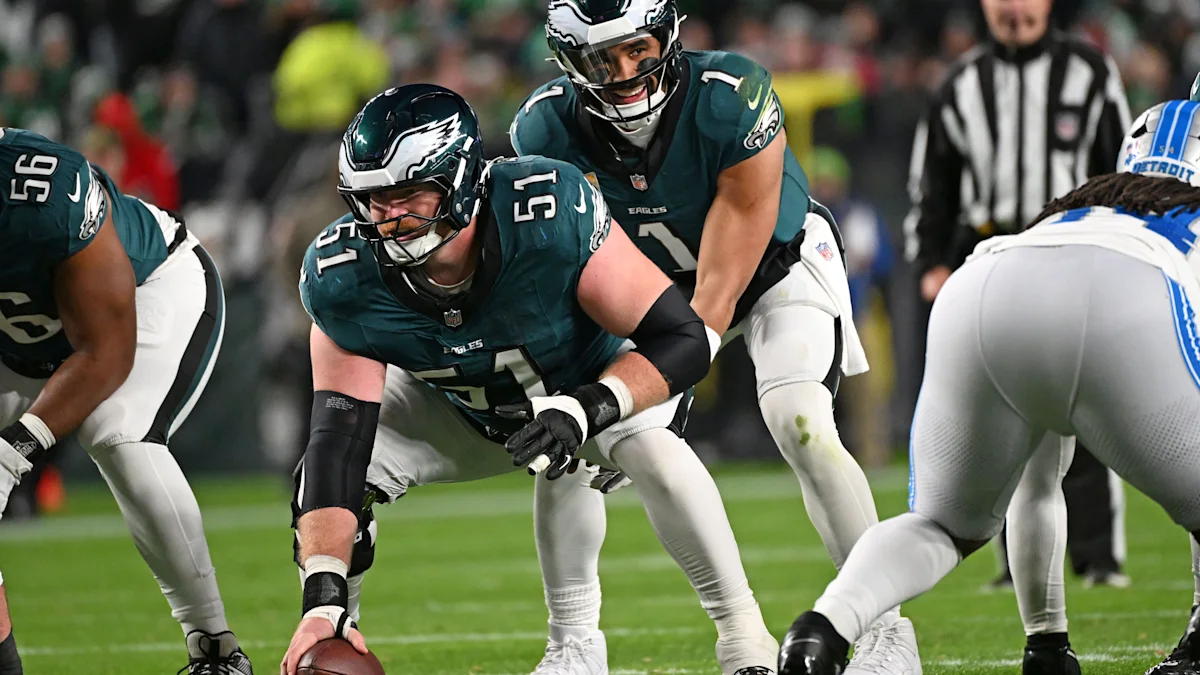
It has been a busy week for the offensive lines of the Eagles and Ravens. Wednesday's trade between the two teams shuffled things up even more .
The Eagles traded offensive lineman Cam Jurgens and a 2027 seventh-round pick to the Ravens in exchange for a 2027 fifth-round pick and a 2028 second-round pick.
The timing, one day after longtime Eagles right tackle Lane Johnson abruptly announced his retirement , is perhaps the most surprising element of the trade.
The Ravens, who have had a hard time replacing Tyler Linderbaum at center, recently watched as Danny Pinter, Jovaughn Gwyn and Ethan Pocic all suffered injuries, forcing 2026 first-rounder Vega Ioane over from guard to center.
Jurgens now figures to be Baltimore's center for multiple seasons, given the nature of his contract after he signed an extension last year.
So who won this fascinating trade? Let's dive into each team's perspective.
Eagles may have eyes on 2028, but short-term worries arise
The Eagles' offensive line was already in rough shape, and Johnson's retirement changed the picture dramatically. So why are the Eagles selling off OL assets?
On the surface, it's hard not to initially wonder if the Eagles are semi-punting on this season. Losing two OL starters in a two-day span, no matter how poorly the unit was playing, is a tough look. Johnson is a future first-ballot Hall of Fame candidate, and the Eagles thought highly enough about Jurgens to sign him to the major extension a little over a year ago.
Things really fell off when Landon Dickerson landed on injured reserve, which necessitated Jurgens moving from center — by far his best position — to guard, where he has struggled this season.
Now, with Johnson retired and Jurgens gone, the line will take on a wholly different look. Left tackle Jordan Mailata is now the one true fixture, although right guard Tyler Steen has appeared to do his job well. Our best guess is that Drew Kendall and Willie Lampkin are the new center and left guard, respectively, although they could also flip spots if needed, and rookie Markel Bell steps in at right tackle.
Dickerson is eligible to return from IR after Week 5, so he also could help solidify things inside. The undersized Lampkin could be the smallest offensive lineman in the NFL, and he has two regular-season offensive snaps — neither of them on the offensive line. Bell played in last season's national title game at Miami and is a massive blocker, but he looked overmatched against the Rams after replacing the injured Johnson.
It's hard not to wonder if the Eagles have worsened the group in the short term with the hope of a long-term return. Yet that payoff could be big.
The gem of the trade is the 2028 second-rounder, giving the Eagles a surplus of picks in what could be a crucial offseason for the franchise. The A.J. Brown trade netted a 2028 first, so they'll be outfitted with four picks in the top 64 that year. This is not some happy accident; this is by design.
That could be the offseason when the Eagles can first move on from Jalen Hurts if they want to, without completely nuking their salary-cap situation. And though it's early, 2028 also could be a banner QB class in the draft, depending on who declares early next spring and who doesn't. Two firsts and two seconds, even with where the Eagles typically pick in the draft, is the kind of ammunition a team must have to be in the running to select a quarterback up high.
Hurts now has this season and next to prove his worth to the team, but he'll arguably be doing it this season with a weakened group up front. That's what the Eagles are willing to live with in the short term, apparently, even with the NFC East still very much up for grabs.
The trade return, contract shedding and general manager Howie Roseman's long-term vision deserve some praise. But the cost now could be great. It's a tricky deal to grade from the Eagles' perspective, with a wide range of possibilities. Splitting the difference is probably the most fair way to judge it — a B+ for the long term and a D+ for this season.
Ravens filled a big need, but was it an overpay?
The Ravens had a clear, glaring need at center, and they solved it. The question is how well.
Jurgens is a two-time Pro Bowler who is theoretically in his prime at age 27. He's played well for the Eagles, but out of need the team moved him to left guard — and the results have been surprisingly bad this season. In addition to pass-blocking issues, Jurgens has had four penalties in four games; he's never had more than six in any of his full seasons prior to this year.
A move back to center figures to help Jurgens, and getting a healthy remainder of the season out of him figures to lift the entire Baltimore front. The rest of the unit had appeared relatively solid through the first four games, but the shaky play at center — and the multiple changes there — had held the unit back.
Jurgens has a fairly lengthy injury history that clouds the picture. He had a serious back injury late in the 2024 season, even traveling to Colombia this offseason for stem-cell therapy to treat it . He also missed time in 2025 with a knee injury and a concussion.
Another potential negative includes his contract and the cost of the trade. Jurgens' deal averages $17 million per year — a full $10 million APY lower than what Linderbaum got from the Ravens — but it's still among the highest at the position. And because of the guaranteed money left on his contract, the Ravens are probably tied to him for this season and next at the very minimum.
Giving up the 2028 second-rounder is the real eye-opener; this isn't loose change we're talking about. What the Ravens gave up was a little more than what the Cowboys traded for Joey Porter Jr. , and even if it came with cost control, it's a steeper cost for a lower-tier position.
There's a potential payoff here for the Ravens, and it's always a good sign when talented teams make aggressive moves to get better, but this is no risk-free trade.
Topics in this story
Gathered from external sources. Rights to this text belong to whoever originally published it.