Kyle Larson debates purpose of stage points, call them "participation awards"
Are stage points too powerful in the NASCAR Chase for the championship? Points leader Kyle Larson thinks they might be, but what do the numbers actually say?
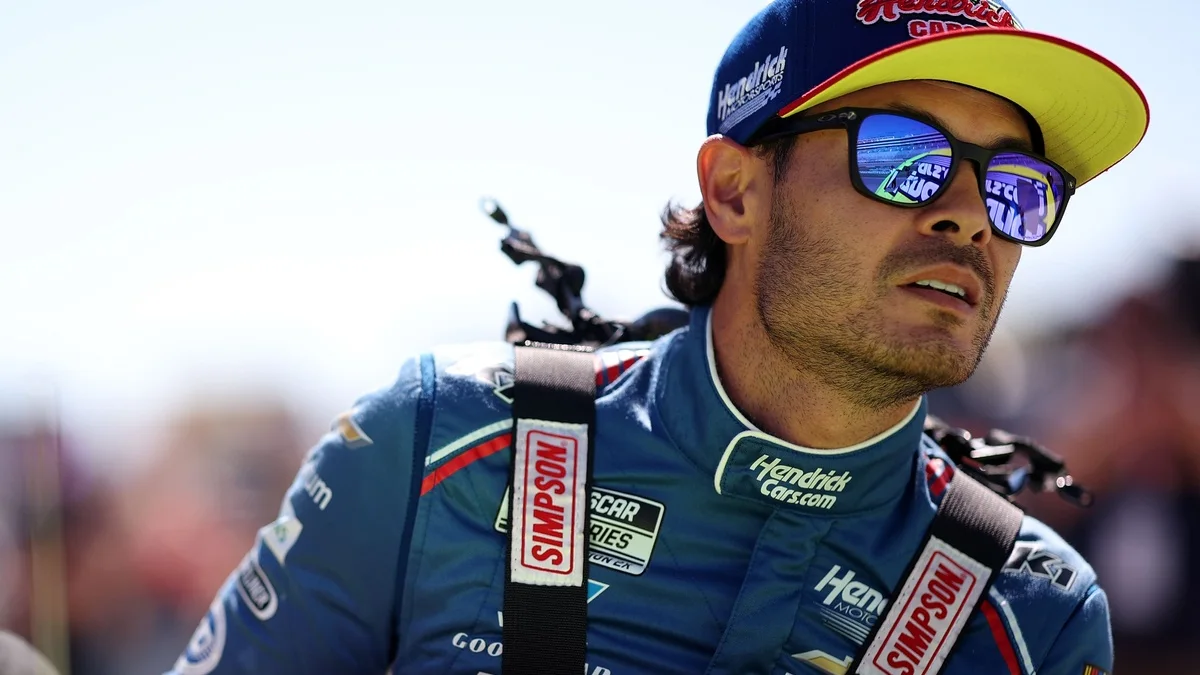
The purpose of stage points and the impact they have on the championship has been a growing debate in recent weeks. NASCAR brought back the Chase format (with some alterations) after 13 years away, which was before stages were ever a part of NASCAR.
At Kansas, Kyle Larson was the first driver to earn maximum points this year -- 55 for the race win, 20 for winning both of the stages, and one for the fastest lap bonus.
Excluding the jump between first and second, one stage point is the equivalent to one position on track. To put it simply, 20 stage points and a 22nd place finish would be equal to a second place finish with no stage points.
Is that too powerful? Larson was asked about just that Saturday at Las Vegas Motor Speedway.
"I don't know," he began. "I mean, I haven't put a whole lot of thought into that. I've just recognized throughout the Chase, especially, that it just seems very, very important. I think I mentioned it on (the Dale Jr. Download podcast), and correct me if I'm wrong, I could be off, but I think Ryan Preece has finished in the top-10 every race in the Chase (actually three top tens in the last four races). But he's probably got five-ish stage points in the Chase, and he's not made any ground up, it seems. He's probably got one of the better average finishes out of all of us, yet he's stuck because others get good stage points, a rotor failure, a crash or whatever, and they earn almost as many points as he does.
"So, yeah, I see the upside of stages because people want to argue that you should be rewarded for running up front all race long. But then, there's also the side of it that you should be rewarded for just good, consistent finishes, even more than what it is right now. A team like his might not qualify in the top-15 -- you've got to just grind your way through the race, and you just run 11th in every stage. And then, you squeak into the top-10 and it's like you've not really gained much on the guys that got a DNF.
"So, I don't know. And I've scored the most stage points by a lot, I think, but I don't know. I just think we're the only series that gives out those little participation awards in competition."
Kyle Larson, Hendrick Motorsports, Denny Hamlin, Joe Gibbs Racing
But what do the numbers tell us? Preece ranks 14th of 16 Chase drivers in stage points scored over the last four races, and yet is one of just seven Chase drivers to have at least three top tens in the first four Chase races.
However, if you were to erase stage points completely from the last month of racing, Preece wouldn't actually be any further up the standings than he is right now. Remember, there was also a staggered points reset, so Preece began the Chase 100 points behind before the postseason even got underway. Things would just be a bit closer overall, and Larson wouldn't have the equivalent of a race win's worth of stage points alone, but the alternate timeline where the 2026 Chase doesn't feature stage points doesn't look dramatically different than reality.
Larson would still lead Hamlin, but it would be 14-point advantage instead of 26 points. The only significant change of more than a single position is Blaney, who falls two positions from fifth to seventh without the buffer of stage points paired with his recent DNFs.
Here's a breakdown of stage points scored by the Chase drivers through the first four races of the ten-week championship battle:
Larson - 58; Hamlin - 46; Blaney - 45; Logano - 45; Bell - 44; Briscoe - 25; Cindric - 25; Gibbs - 22; Wallace - 21; Hocevar - 19; Byron - 17; Reddick - 15; Elliott - 9; Preece - 8; Buescher - 1; Suarez - 0
Watch: Hamlin on Chase points battle: 'It's a numbers game'
To read more Motorsport.com articles visit our website .
Topics in this story
Gathered from external sources. Rights to this text belong to whoever originally published it.