Fernando Alonso says 'I still feel as fast as anybody' as he confirms he will stay in F1 in 2027 with Aston Martin
Fernando Alonso commits to staying in Formula 1 with Aston Martin for at least one more year. - and explains why to BBC Sport.
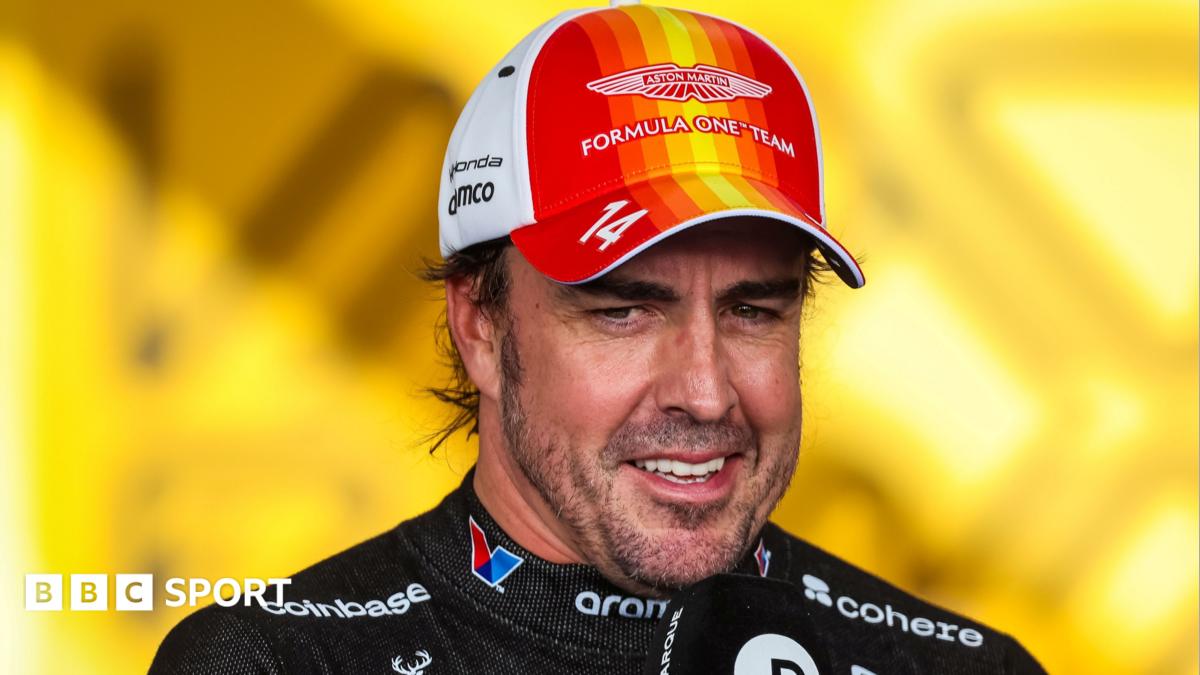
Fernando Alonso has committed to staying in Formula 1 with Aston Martin for at least one more year - and says the biggest single reason for his decision is because he "still feels fast".
The 45-year-old Spaniard has been weighing up his future all year. And while, like Max Verstappen, he has been outspoken in his criticism of the new hybrid engines introduced in 2026, his love for the sport has won out.
"First, this is my life," Alonso told BBC Sport in his only English language interview about his decision, which was announced on Tuesday. , external
"I have this in my blood and I keep racing and I keep enjoying and this is a way of life, in a way.
"Probably for me the biggest, or the clearest thing to keep racing is I still feel self-confidence that I have something extra.
"And when I think about stepping down or taking a different role in the team or not driving the car or whatever, in a way I feel it should not be like that because I still feel as fast as anybody. So let's have another go."
His own personal performance was only one factor at play in Alonso's decision, he explained in an extensive and open conversation.
Alonso also considered the new rules, and the competitiveness of his team, which has been close to rock bottom for most of this season.
'I'm at peace with this period of time that I'm anonymous'
Alonso is regarded as one of the all-time F1 greats, and has created an iconic status over a career that dates back to 2001.
And he continues to reject any suggestion that he has lost any of his ability.
"When I jump in the car, in free practice, I will see some people braking late in a corner, locking up the front tyres here or there, making mistakes there," Alonso says.
"I feel that I'm OK. Or, I'm faster than them.
"So when I get changed and I go back home, even if I'm P18, in a way I feel some satisfaction and pride inside, even if it should not be the case because we are not competitive.
"How will I be in the living room, watching TV, thinking that I can do better? That will be my feeling now. When that changes, if I see that I lost abilities, I lost speed, I lost reflexes, I lost something, then I will be happy to watch from my living room the race.
"At the moment, I feel it was not the time because I'm better than that guy. I'm better than that other guy. I will think like that. And I cannot stop racing if I still think like that."
Alonso has only had a couple of chances this year to prove his point that he's still as good as he ever was. One was at the Dutch Grand Prix, when he finished ninth, holding at bay the faster cars of Alpine's Pierre Gasly and Racing Bulls' Yuki Tsunoda in the final stint.
I suggest to him that it was a typical Alonso drive, proof to those who doubted that he still has it. But he says it will have had no impact on the audience.
"You only prove to people when you are in the podium or you are on TV," he says. "That's where eyes are open, and people remember suddenly that you're still on the grid.
"So now I'm at peace with this period of time that I'm anonymous, and no one knows that we're still there and we're still fast.
"We are preparing ourselves for the moment of truth and that will be a surprise for everybody again."
Carrying on despite his dislike of modern F1 cars
Along with Max Verstappen and Lando Norris, Alonso has been one of the drivers most critical of the 2026 rules.
Drivers feel the new hybrid engines, which have a near 50-50 split between internal combustion and electrical power, have diminished F1's challenge.
The key problems are the fact the cars run out of half their energy long before some corners, a process known as "derating", and that some of the sport's most demanding corners have been neutered because they are used to charge the batteries.
Alonso, as is his way, has produced some particularly pithy turns of phrase this season to express his unhappiness.
He has called F1 the "battery world championship". He has described fast corners as "the charging station for the car" and said that "the chef could drive the car" in a particular corner in Bahrain that used to be a major challenge.
And he's been dismissive of the increased number of overtaking moves created by offsets in energy levels between cars, calling them "avoidance actions".
How did he square all that with deciding to keep racing these cars he dislikes so much?
"That's a good question," he says, "because that was the hardest thing for me."
He says he hopes the changes being made to change the power ratio to 60-40 in two steps by 2028 "will make things a little bit easier".
"This year, there have been some good races and some bad races," Alonso says. "Maybe some of the shorter circuits that you had the battery until the braking point are changing the way you perceive the driving.
"And some of the circuits like Silverstone, Spa, Suzuka, they were very bad, you know, because they derate and things like that.
"Maybe even for next year they can tweak a little bit the battery power to have a little bit maybe less battery for longer or something like that because F1 at the moment is not natural driving.
"Reaching the top speed in the middle of the straight, it goes against the driver instinct of braking late and going on power earlier. It seems that if you want to drive these cars fast, you ended up going slower and that's not the way it should be."
Alonso says that, as something of an elder statesman, he "feels some responsibility also in this regard to help the sport" make the right decisions for the future.
And the willingness of governing body the FIA and commercial rights holder F1 to accept there is a problem and make changes to address it has also been a reassurance.
"It does help that the sport keeps chasing ideas and talking to the drivers and the teams (about) how to make things better, even for the next set of regulations," he says.
"This gives me also some hope that I will enjoy more the driving next year than I did this year."
It has been a dismal year for Aston Martin, whose car has been uncompetitive, while Honda's engine has been the worst in the field on the Japanese manufacturer's official return to F1.
But a massive update to the car for the Hungarian Grand Prix cut something like two seconds off lap times, offering hope for next season.
A key influence in Alonso's decision was Adrian Newey, whose arrival as managing technical partner in March 2025 delayed the start of work on this year's car, the first of a cascading series of issues that led to this year's performance.
Alonso has been waiting his entire career to work with the man regarded as the greatest technical mind of his generation, perhaps ever. So giving up after just one, highly compromised, year together felt senseless.
"This team has all the ingredients to have success in the future," Alonso says, "and I didn't feel that this was the moment to leave. It was the moment to keep on going, giving a second chance to Honda as well to fix their problems as well and stay together with the team.
"Adrian was probably the biggest contributor to this. We didn't start it right this year but things are moving in the right direction and he's capable of changing things very quickly.
"Aston is my family. I know Lawrence (Stroll, the owner) and Lance (Stroll, Alonso's team-mate) for many, many years. We keep open conversations, many different topics, every week. And that will be the case also for next year."
Honda's engine upgrade, which debuted at the Dutch Grand Prix at the end of August, was not especially convincing.
Alonso has bad memories of Honda from his time with McLaren from 2015-17, and he admits living through a similar experience again "has been difficult".
But major steps have been taken to address the internal issues at the company and Alonso says: "They are moving in the right direction. There are no guarantees that next year the engine will be completely fixed but all the changes that are happening in Honda made sense, so I have faith.
"The trust that I have in the team, it didn't change even throughout this difficult year. In the future, I don't know how long it's going to take, but it will be a successful team, and I want to be part of it."
There was one final factor - family. Alonso became a father this year when his partner, the Spanish television presenter Melissa Jimenez, gave birth to their son, Leonard, in March.
Has that had any effect on his approach to life and his career?
"I would say not," Alonso says. "I was (initially) thinking yes, and I tried to think about, family first, what will be the best for my son next year if I have this tight calendar or not and things like that.
"But then quickly I realised that it was not really a key factor. This year it was difficult for him to travel; he's only six months old now. But I think next year he will come to 50% of the races or more.
"So I could even enjoy my life more, travelling around the world with my son. That's a huge privilege that I will hopefully enjoy next year.
"Racing next year, it was my natural, final decision. I will be racing in any car, even when I stop Formula 1, but F1 is still in my blood.
"One more year made all the sense in the world for now."
"I see that it would not be only one year, but I don't have any pressure to think about it."
Topics in this story
Gathered from external sources. Rights to this text belong to whoever originally published it.