Singapore Grand Prix: Heat hazard declared for fourth time this season
The Singapore Grand Prix is declared a heat-hazard race, the second weekend in a row that the designation has been used in Formula 1.
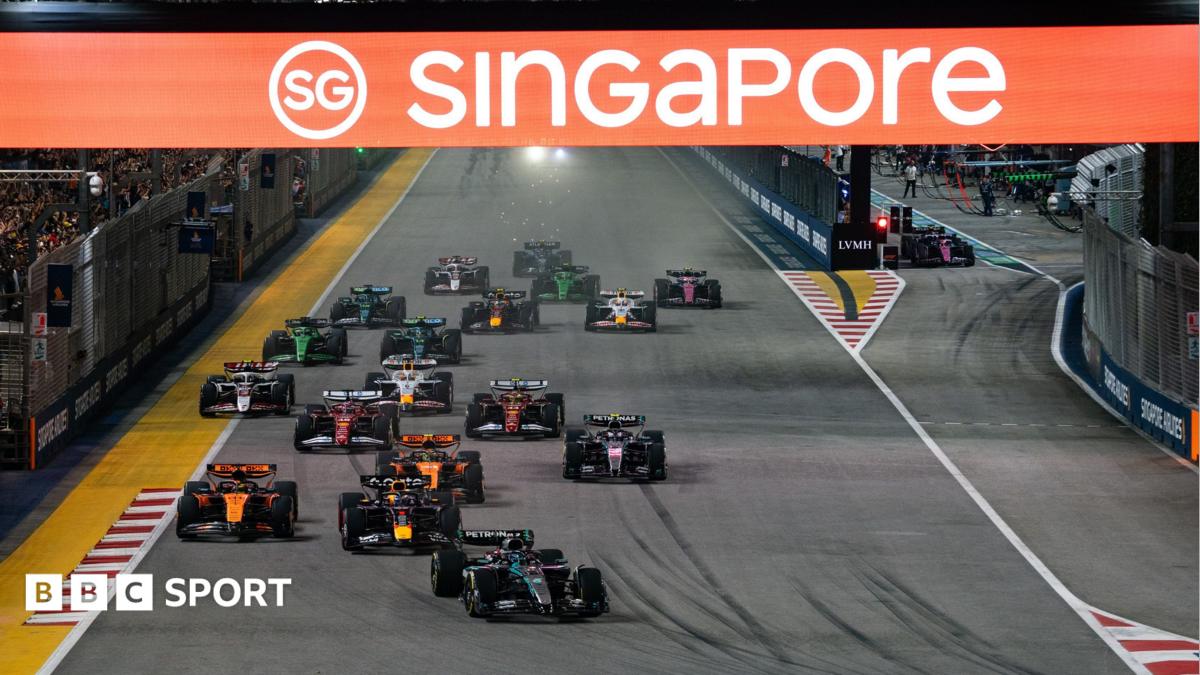
The Singapore Grand Prix has been declared a heat-hazard race, the second weekend in a row that the designation has been used in Formula 1 and the fourth time this year.
The definition allows teams to fit cooling devices to their cars that pump liquid through a vest worn by the driver to manage temperatures in the cockpit.
A heat hazard is an official status for an event where it is forecast that temperatures will exceed 31C at some point during the race. It was first introduced in 2025.
This year's race is also being held amid air-quality issues as a result of smog caused by fires in Indonesia. F1 is monitoring the situation, which also applied at last weekend's Bahrain Grand Prix in Malaysia, but does not currently consider it a cause for major concern.
Singapore is close to the equator and has long been known as one of the most demanding for drivers - in 2024, George Russell and Lewis Hamilton were treated for heat exhaustion after the race.
Temperatures in the city are always in the 31-33C region across the race weekend, with high humidity and a chance of rain every day.
The race is held at night, but temperatures remain in the region of 30C even after dark.
A cooling kit is not mandatory, but any driver who chooses not to use it has to carry 5kg of ballast in their car to ensure he does not have a competitive advantage.
The system uses a cooling tank and pump, usually situated in the car's nose, that delivers a cooled liquid, such as glycol, through a system of pipes in a fireproof top worn under their overalls.
Some teams and drivers prefer not to use the system because of two key compromises.
It is difficult to keep the liquid cool enough for long enough so that it lasts for an entire grand prix - a problem exacerbated in Singapore because it is the longest race of the year.
And some drivers find the cooling top uncomfortable in the tight confines of the cockpit.
If the liquid cannot be kept cool, it reverts to car temperature, which is considerably higher than ambient. It is not unusual for temperatures in an F1 cockpit to rise above 40C.
Red Bull's Max Verstappen said: "For me, it's not needed. Yes, it's hot, but it's not sauna. And with this cooling vest, you have these stupid cables in your car, so it's just limiting your movement as well.
"Even if it would work for one and a half hours, like cool, cool, I don't need it. It doesn't work anyway for one and a half hours. I've never had it in any category that has worked for one and a half hours."
Ferrari's Charles Leclerc added: "Ideally, if I can have an even better cooling vest, I will always take it. Let's say that for 15-20 laps it works pretty well. But then after, for the rest of the race, you are quite warm, just like you are without the cooling vest. So at least I'm getting 15-20 laps, and I'm already grateful of that.
"It's not that I feel like every driver on the grid is not physically fit to do a whole race.
"However, to be at your 100% at the end of a race, or from the middle of the race here, where you lose so much water and you are dehydrated, for sure we leave something on the table there."
Mercedes are one of the teams who have decided against running the system because they preferred to devote the resource that would have been involved in making it robust enough to last a race into car performance.
Governing body the FIA has granted teams an allowance under the cost cap of $50,000 (£38,000) if they can make a system that keeps the liquid cool for an entire grand prix, and a further $75,000 (£57,000) if they could make the top comfortable.
Mercedes deputy team principal Bradley Lord described the allowance as "small", adding: "We didn't believe that allowance was sufficient for us to be able to develop a solution that would be robust enough to last for the entire race."
Singapore follows the Austrian, Italian and last weekend's Bahrain Grand Prix in Malaysia in being declared a heat-hazard race this year.
The Austrian and Italian races were held amid the Europe-wide heatwave that led to record temperatures across the continent.
The temperatures in Malaysia and Singapore are comparable with typical temperatures in south-east Asia. Had the heat-hazard designation existed before 2025, they would have fallen into that category numerous times in the past.
Topics in this story
Gathered from external sources. Rights to this text belong to whoever originally published it.