Arizona Cardinals GM explains Jacoby Brissett, Marvin Harrison Jr. trades
The Arizona Cardinals have made two notable trades in the past month. Could more be coming ahead of the trade deadline?
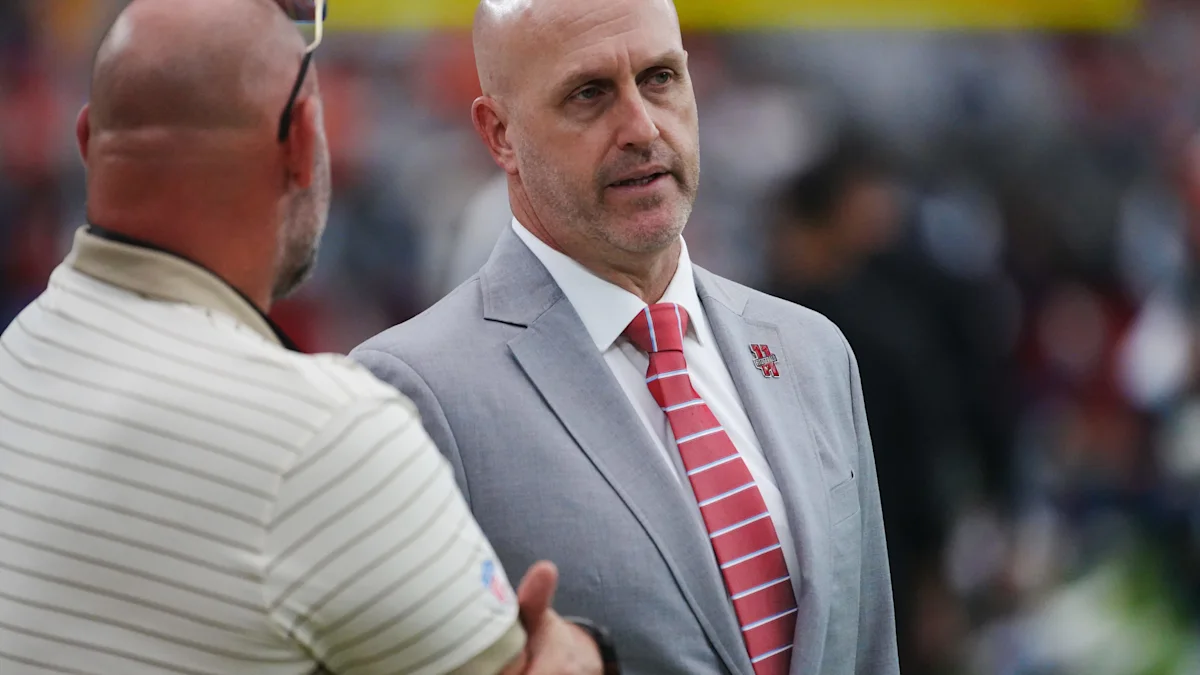
It's been a busy month for Arizona Cardinals general manager Monti Ossenfort.
First came the organization's decision to trade Marvin Harrison Jr. to the Houston Texans , back on Oct. 11. Then, four weeks later, Ossenfort sent quarterback Jacoby Brissett to the Baltimore Ravens , parting ways with the player who had started 20 consecutive games for Arizona.
Holding his first press conference since those moves, Ossenfort described the Brissett trade as "a little bit of a perfect storm of a lot of things."
One of those elements was the draft compensation. Ossenfort confirmed that Arizona is sending Brissett and its 2027 fifth-round pick to Baltimore, in exchange for the Ravens' 2027 fourth-round pick and 2028 seventh-round pick.
While the fourth-round pick is the key piece of draft capital, the balance of the overall compensation is equivalent to a late fifth or early sixth-round pick. That is the typical trade value for a journeyman quarterback of Brissett's caliber.
See photos of Jacoby Brissett's time with the Arizona Cardinals
The Ravens did not previously have their own pick in the fifth or sixth round, necessitating the creative package for Brissett, which came together after they lost both Lamar Jackson and Tyler Huntley to injury.
"Baltimore was dealing with their own set of injury issues that happened with them on Sunday," Ossenfort said. "So then discussions started there. And then continued over the next couple of days."
At the same time, Cardinals head coach Mike LaFleur decided to start Gardner Minshew and demote Brissett to third-string quarterback . That effectively ended Brissett's tenure in Arizona, even before the trade.
"As the team is built, Jacoby's in that third role and an opportunity came to trade him for some value," Ossenfort said.
The other element at play is the development of third-round rookie quarterback Carson Beck. Beck is now the Cardinals' backup quarterback, meaning he will get full reps with the scout team in practice. Previously, he and Minshew had been splitting those opportunities.
"Part of this is it allows us to continue Carson's development," Ossenfort said. "And I think when you have a quarterback situation the way it was constituted here for the first couple months of the season, it's hard to always find reps and development. There's only so much practice time to go around."
Both Ossenfort and LaFleur declined to commit to Beck starting games this season, although LaFleur has previously acknowledged that "it'd be nice to know what we've got right there" when asked about Beck.
"The practice reps is first and foremost," LaFleur said. "He'll be able to rack that up. But not paving a way for anything."
Ossenfort explains Marvin Harrison Jr. trade
As with the Brissett trade, the Cardinals' decision to deal Harrison only crystallized when "an opportunity presented itself," in Ossenfort's words.
In that case, the opportunity was a second-round pick, which is currently slated to be near the top of that round, as the Texans sit at 2-5.
But it was also, Ossenfort acknowledged, a product of how Harrison's role had changed over the past year. Prior to the trade, he had just five catches on 13 targets, as he fell behind Trey McBride and Michael Wilson in the Cardinals' offensive pecking order.
"Marv's role evolved into what it was for us," Ossenfort said. "And so, at that point, we had to decide: should we go forward and is it gonna come out of that role, is it gonna be different? Or … we're getting offered something that we think is pretty valuable here, do we pivot and take that? And that's the decision that we made."
Harrison, the No. 4 overall pick in 2024, finished his Cardinals career with just 1,578 receiving yards in 33 games.
Ossenfort broadly pushed back on the notion that the Cardinals missed with their draft pick of Harrison.
"Sometimes those expectations that are put on players are unfair," Ossenfort said.
Marvin Harrison Jr.'s Arizona Cardinals career at a glance
Still, he acknowledged that it was not the ending the organization envisioned for Harrison's career in Arizona.
"A lot goes into that," Ossenfort said. "It really is never about one thing. … A lot of reasons why it didn't work out. Probably can't get into all of them. But I will definitely say it wasn't for lack of effort from anybody's part. I think the world of who Marvin is as a person."
With the NFL trade deadline looming on Nov. 10, Ossenfort left open the possibility for more trades.
"I don't really know," Ossenfort said. "We'll see how that works out."
In explaining the uncertainty regarding any potential moves, Ossenfort pointed to the progression of the Cardinals' previous two trades.
"Everybody says, well, this guy's being shopped," Ossenfort said. "A lot of times that's just not accurate. It really comes down to — as in these cases of the trades that we just made — is someone going to get aggressive and try to make it happen? And otherwise, it's a lot of talk and a lot of, 'Hey, maybe, maybe not.'"
In the case of Harrison, the Cardinals reportedly held discussions with other teams for two weeks leading up to the trade, but a deal only got across the finish line once a second-round pick was on the table. And in the case of Brissett, the Ravens' injury situation necessitated immediate action.
So far, that sense of urgency has not yet arrived with any of the Cardinals' other potential trade candidates, including edge rusher Josh Sweat and safety Budda Baker.
"Let's see how things get serious," Ossenfort said. "And obviously deadlines have a way of making people get serious."
Topics in this story
Gathered from external sources. Rights to this text belong to whoever originally published it.