Make No Mistake, Caleb Durbin Was No Red Sox Success Story This Season
Most considered Caleb Durbin to be a fine contributor to the Boston Red Sox this season. He wasn't.
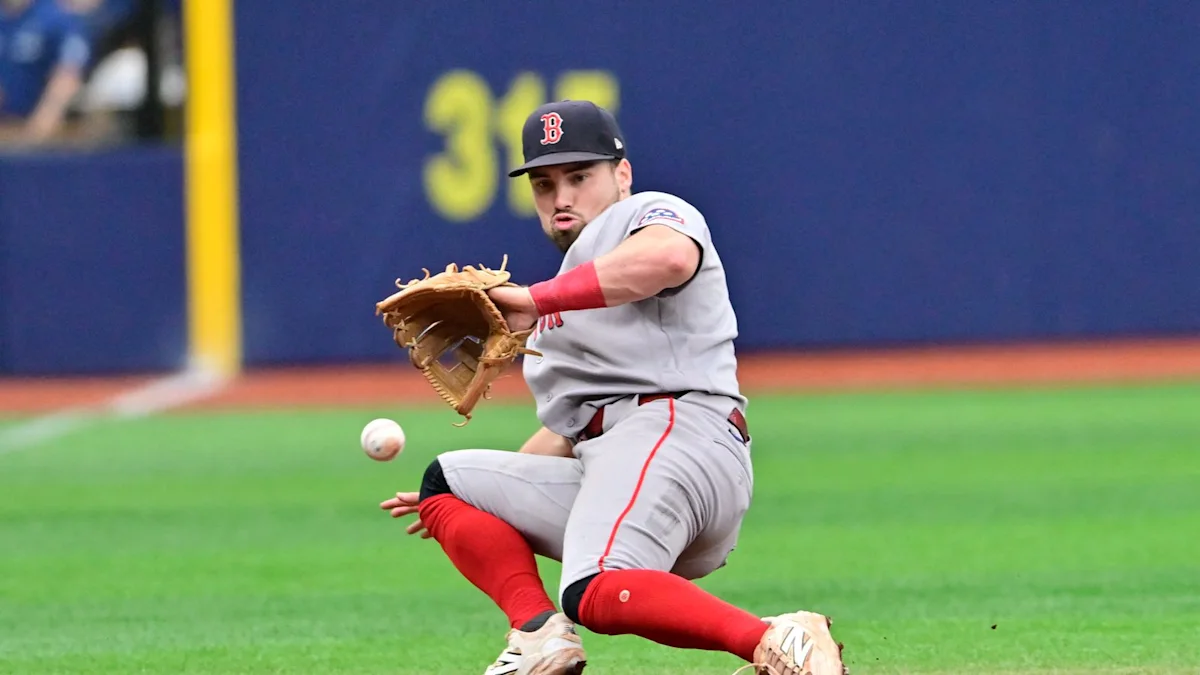
If there's one undeniable quality Craig Breslow has demonstrated, it's his ability to prematurely declare victory on personnel moves.
It happened last year when Breslow nearly dislocated his elbow patting himself on the back over signing rookie Kristian Campbell to an extension, only for Campbell to fall into a months-long slump that led to him spending all of this season in Triple-A. Then it happened this year, with Breslow and the rest of the Boston Red Sox brass all but taunting their own fans over younger, cheaper third baseman Caleb Durbin apparently outperforming Alex Bregman and Rafael Devers , Durbin's predecessors in the hot corner at Fenway Park.
Although Durbin cooled off at the plate after a strong June, the general opinion of the 26-year-old's play this season was that his sterling glove and solid, though not spectacular, bat provided value to a squad that fit the former 14th-round pick's scrappy persona. Had he indeed provided both of those things, then it's a useful balance. The problem is, that wasn't the case at all.
While Durbin was excellent defensively, in the end he chipped in very little offensively. With the Red Sox eliminated after Wednesday's Game 2 loss to the New York Yankees in the AL Wild Card Series, it can be definitively stated that what Durbin gave the Red Sox this season honestly wasn't good enough.
The overall numbers tell a mixed story. He batted .248 with a .332 on-base percentage and slugged .378. He hit 13 home runs and stole 20 bases. As middling as those statistics are, somehow he compiled 4.4 WAR under Baseball Reference's criteria, which is the number his defenders will cling to. Considering how slowly Durbin got started, the fact that he was able to raise his batting average to almost .250 is a credit to him, isn't it?
Rather than Durbin's poor start being an outlier in an overall successful season, in fact the few scorching weeks he used to pull his stats back to respectability were the the outliers , while the struggles were the norm. He posted a .963 OPS in June and hit six home runs -- 46% of his season total -- in that same month. Burrowing down further, the bulk of his production came during a pair of two-week stretches from May 28 to June 10 and June 18 to June 30. In the former, he went 15-for-44 (.340) in his at-bats. In the latter, he went 19-for-45 (.422)! He collected more than a quarter of his total hits in less than a month's worth of games.
None of this should have been surprising, except perhaps to the analytics-averse players in the Red Sox clubhouse. Durbin never has made good contact or hit the ball hard. Batters of that nature -- like Durbin's partner on the left side of the infield, Trevor Story -- are prone to hot streaks when their dying quails happen to fall where the fielder's aren't. But producing offense through weak contact isn't sustainable.
In layman's terms, Durbin hits with a wet rolled-up newspaper. In scientific terms, Durbin was at the bottom of the league in exit velocity at 83.1 mph and in hard-hit percentage at 25%. His bat speed is in the bottom 12%. His 88% whiff rate might be shrugged off if he complemented the swings and misses with the occasional dinger, but alas.
These aren't acceptable numbers for a corner infielder who plays half his games at Fenway Park. A third baseman on a successful Red Sox team needs to be regularly above an .800 OPS, either by slashing base hits like Bill Mueller and Wade Boggs or being a long-ball threat like Devers and Mike Lowell. The pattern to pitching Durbin has developed: crank fastballs that he can't catch up to. And there's frankly no use to a right-handed corner infielder who can't hit a fastball over the Green Monster.
Durbin is a nice complementary player. If he played second base, he might even be considered valuable. But after a mediocre first season in Boston that was far worse than most fans are willing to admit, Durbin has done nothing to exorcise the demons of the infamous Devers trade or the decision not to re-sign Bregman. If anything, he's confirmation of just how much the Red Sox need a hitter of their caliber -- and how difficult it is to find a replacement when you let not only one but two get away.
Topics in this story
Gathered from external sources. Rights to this text belong to whoever originally published it.