From introduction to skeet gun at 13 to Asian Games bronze: Parinaz Dhaliwal’s journey of precision, perseverance and the right support
NEW DELHI: For Parinaaz Dhaliwal, success in skeet shooting is about much more than hitting targets.
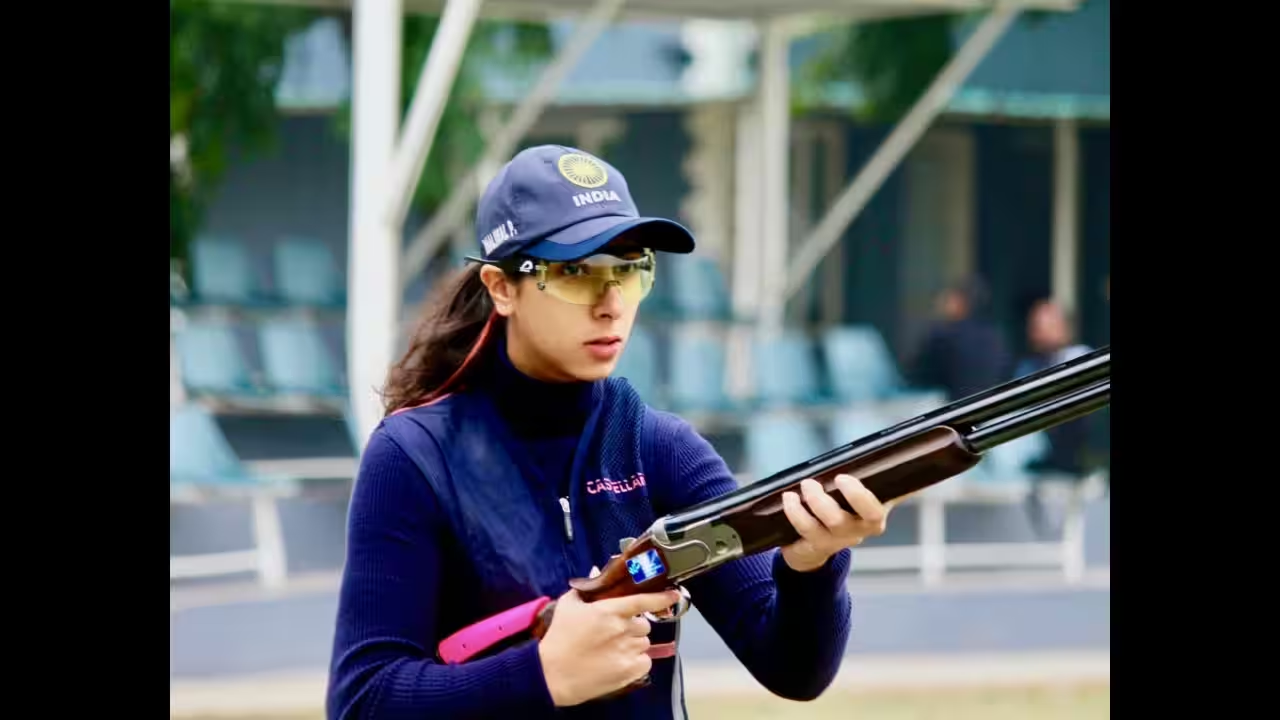
NEW DELHI: For Parinaaz Dhaliwal, success in skeet shooting is about much more than hitting targets. It is a combination of technical precision, mental strength, financial backing and the ability to find balance under pressure. After years of investing in her game, the Asian Games medallist believes experience, the right coaching environment and an unwavering support system have helped her take significant strides forward.When Parinaaz looks back at her journey in shooting, she does not attribute her progress to one competition, one coach or one breakthrough moment. Instead, she sees it as an evolution shaped by years of training, international exposure and lessons learnt along the way. The bronze medal in the women’s skeet team event at the Asian Games 2026 at Aichi-Nagoya in Japan alongside Raiza Dhillon and Maheshwari Chauhan, was a significant milestone in that journey.“It was bits of everything, to be honest,” she says, reflecting on the difference between her previous Asian Games appearance and the latest campaign. “You evolve with every single competition. You learn something or the other. You win or you don’t win, but you always learn.”The medal was the culmination of a more comprehensive preparation programme, one that she believes made a tangible difference. Ahead of the Games, the Sports Authority of India (SAI), in coordination with the National Rifle Association of India (NRAI), organised two preparatory camps. The first, held in Aug, focused on fundamentals, while the Sept camp concentrated on fine-tuning and final preparations.The support structure, she says, was also stronger than before, with foreign coaching expertise and a larger team of support staff contributing to the preparations.An important part of that preparation was the presence of her personal coach, Anthony, an Olympic medallist from France. She received permission from the federation to have him join the national camp and accompany her to Japan, where he worked alongside national coaches and foreign coach Riccardo Filippelli.For her, the arrangement was about more than technical advice. A personal coach who has worked with an athlete over an extended period understands the individual beyond the shooting range, including their habits, temperament and response to pressure.“My personal coach might have seen my tantrums or might have seen a lot,” she says with a laugh. “He has seen various sides of me because I train with him a lot more than I do with my national coach.”She is particularly appreciative of the cooperation between the coaches, describing the atmosphere as one without ego or insecurity. Anthony, she adds, was equally conscious of respecting the national coaching structure.Her introduction to shooting began well before she took up skeet seriously. Growing up around firearms, she was familiar with the sport, and her father, Ratandeep Dhaliwal, encouraged her to learn how to use a weapon. At Mayo College Girls’ School in Ajmer, she participated in open-sight shooting competitions and school-level events.When she turned 13, her father suggested that she explore shotgun shooting. She initially tried trap, but it was an unexpected session at the skeet range that changed her trajectory.During a week at home to prepare for a state competition, her mentor, Amarjang Singh Sidhu, suggested that she try a station of skeet. She hit a couple of targets and immediately found herself drawn to the discipline.“I looked at my dad and said, ‘Papa, I think I want to do skeet.’ He was like, ‘Huh?’” she recalls.Her father discussed the decision with her grandfather, and by the following day, she had a skeet gun.“It turned out to be a great decision,” she says. While she remains close to several trap shooters, skeet is the discipline she finds more engaging. The experience reinforced a lesson she considers fundamental to sporting success: an athlete must enjoy what they do.Behind the medals, however, lies a challenge that is often overlooked: the financial demands of competitive shooting.Shotgun shooting, she explains, can be particularly expensive, making financial stability and institutional support crucial for aspiring athletes. Equipment, training and travel can place a substantial burden on families, while sponsorships often arrive only after an athlete has established a record.Despite having competed at the previous Asian Games, she says she relied on her family to fund her development for years, even while working with internationally accomplished coaches, fitness professionals and sports psychologists.She is grateful for the backing, but is equally conscious of the sacrifices that preceded it. Her father had travelled with her to competitions and camps, both in India and abroad. This year, however, he stepped back from travelling because her grandparents were unwell and needed family support.“I said, for me and for my mental sanity, it’s just better that you are at home with my grandparents. And I’m fine,” she says, drawing on the independence she developed during her years at boarding school.For young shooters, she believes, understanding the financial realities of the sport is as important as recognising their own potential.Parinaaz’s preparation has evolved beyond technique and equipment. Over the past three years, she has worked extensively on fitness and the technical aspects of her shooting, while also consulting a sports psychologist based in the UK.At the elite level, she believes, every component matters. “You cannot leave anything unattended at all,” she said.One incident from the World Cup in Lonato, Italy, illustrates the importance she places on mental preparation. After the first four rounds, she was uncertain about her standing and found herself worrying about the competition. Anthony responded by taking her out for dinner rather than allowing her anxiety to dominate the evening.She was initially concerned about losing sleep ahead of the following morning’s round. Her coach, however, believed that continuing to dwell on the competition would be counterproductive.The evening continued with a walk by the lake and gelato, helping her shift her attention away from the scoreboard and reconnect with the reasons she had taken up shooting.Anthony, she said, believes strongly in maintaining balance and reminding athletes why they compete in the first place.The next day, she shot a perfect round of 25, her best of the competition, which helped her reach a shoot-off.“These are the small things that coaches with experience can teach you,” she said.At the Asian Games, the women's team faced a difficult opening day, but the athletes concentrated on their individual routines rather than becoming distracted by the collective result.Skeet may have a team component, but the discipline demands individual accountability. Each shooter must execute their own process, manage pressure and remain focused on the target in front of them.The team's positive atmosphere helped them persevere, while the men's skeet team also produced a strong finish. India ultimately returned with medals in both the men's and women's team events.For her, the result reflected not only individual ability but also the value of a supportive environment in which athletes and coaches worked towards a common objective.She also believes India's development in skeet coaching needs greater attention. While the country has several accomplished coaches in trap, she sees a relative shortage of experienced specialists in skeet. International coaches, despite their high fees, can offer technical knowledge and an understanding of competitive pressure acquired through years at the highest level.At the same time, she acknowledges that being an accomplished shooter does not automatically make someone an accomplished coach. Coaching, she says, is a discipline in itself.Looking ahead, she intends to continue building on the progress she has made through competition experience, technical refinement and mental preparation. Her latest Asian Games performance is a milestone, but not the end of the journey.For a shooter whose career began with a spontaneous decision at 13, the larger lesson remains remarkably simple: excellence comes from getting the fundamentals right, learning from every competition and finding the people who help you become better.And perhaps that is what defines Parinaaz’s journey best. The targets may be fleeting, but the work behind each shot is anything but.Stay updated with the latest Asian Games 2026 news, check the Asian Games medal tally and complete Asian Games schedule.Get the latest Sports News and Live updates. Download the TOI app.
Topics in this story
Gathered from external sources. Rights to this text belong to whoever originally published it.