Max Verstappen vs Valentino Rossi: How their GT3 cars compare
The pair will race in the top-level Pro category during Saturday’s GT World Challenge Europe finale
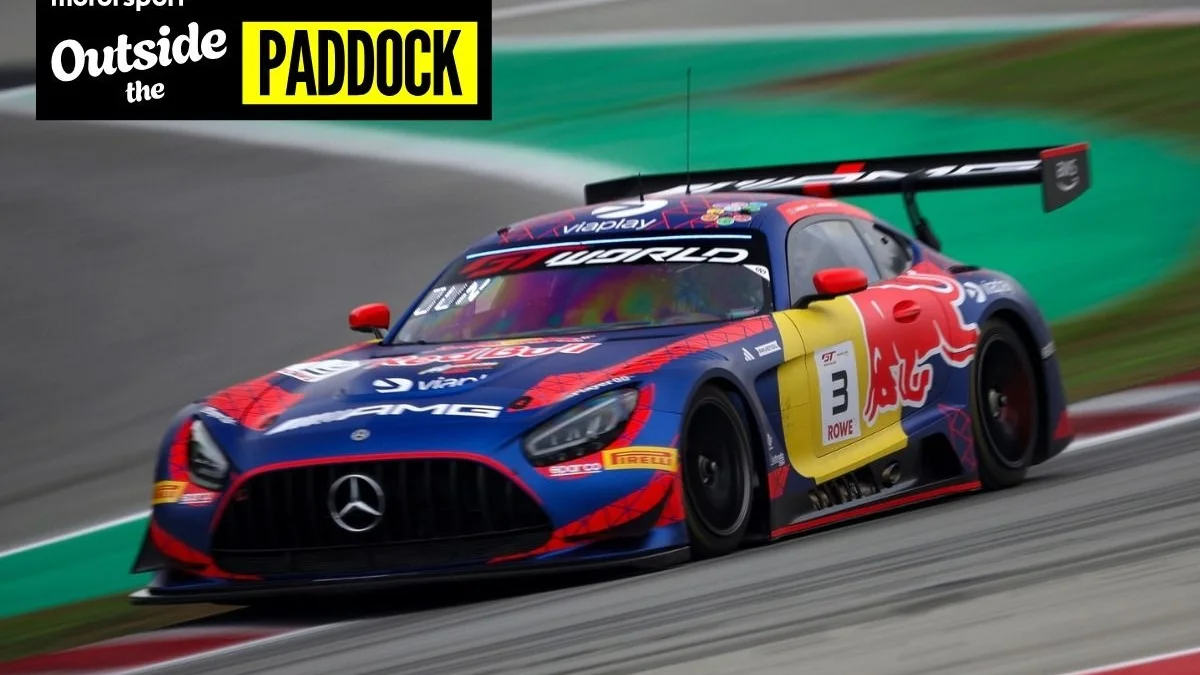
Max Verstappen's Mercedes-AMG and Valentino Rossi's BMW is very different cars with a different number of turbos and a totally different soundtrack. But the rulebook is designed to make them equally fast. The two drivers will race this Saturday at Portimao in the final round of the GT World Challenge Europe Endurance Cup, but how do their weapons of choice compare?
It's a 61-car grid this weekend with Verstappen stepping in because regulars Jules Gounon and Daniel Juncadella are committed to the World Endurance Championship round at Barcelona. This means the Formula 1 ace and MotoGP legend will be going head to head in the top-level Pro category.
The Mercedes-AMG Team Verstappen Racing entry fields a Mercedes-AMG GT3 EVO with drivers Chris Lulham and Ben Barnicoat, managed on track by 2 Seas Motorsport. The team moved to Mercedes for 2026 after originally racing Aston Martins.
Powering the car is the M159, a naturally aspirated 6.3-litre V8 engine. The unit delivers approximately 550 horsepower, though power outputs adjust according to Balance of Performance regulations, which function to standardise performance across the GT3 category.
The layout is rear-wheel drive with a front-mid-mounted engine, a six-speed sequential gearbox and a weight of about 1,285kg, also set by BoP.
Rossi's No. 46 BMW M4 GT3 EVO, run by Team WRT, takes a different approach. Its P58 is a 3.0-litre (2,993cc) twin-turbo straight-six derived from the road car's engine, producing "up to 590hp" before BoP. It uses a six-speed Xtrac gearbox, measures 5,020mm long with splitter and wing on a 2,917mm wheelbase, and stops with 390mm front discs and six-piston calipers, plus 380mm discs at the rear. Rossi's co-drivers are BMW factory pair Max Hesse and Neil Verhagen.
Since its 2025 debut, the EVO has prioritised accessibility, durability, and cost-effectiveness over raw pace. The M4 GT3 has accumulated over 70 victories across its racing career, including victories at the 2023 Spa 24 Hours endurance race and the 2022 DTM championship.
On paper, then, the BMW has more power, but the BoP aims to neutralise that advantage, so neither car carries any advantage. Both vehicles employ front-mounted engines with rear-wheel drive and sequential transmissions, and they both employ 390mm front brakes. What really separates them is the engine note: a booming V8 versus a higher-pitched turbo six.
#46 Team WRT, BMW M4 GT3 EVO: Max Hesse, Valentino Rossi
Verstappen's GT3 record is short but impressive. Verstappen achieved victory in his debut race on 27 September 2025 at the Nurburgring NLS9 event, sharing a Ferrari 296 GT3 with Lulham and controlling the race from the opening lap to finish ahead by more than 20 seconds.
At the 2026 Nurburgring 24 Hours he led in the No. 3 Mercedes until a driveshaft failure struck with about three hours left. Sister car No. 80 went on to win - Mercedes' first victory there since 2016.
The 47-year-old Rossi, a nine-time motorcycle world champion, has competed in GT3 racing with Team WRT since 2022. Originally he drove Audis, but moved to BMW machinery from 2023 and has driven with the marque since.
His record includes three consecutive wins at the Misano Sprint, his home race, across 2023, 2024, and 2025, all achieved driving the M4. In addition to this, he scored multiple top-three finishes in the 2024 and 2025 LMGT3 seasons in the World Endurance Championship's GT3 category.
Rossi himself seems to know what he's up against. " Max Verstappen is going to be a huge problem because the bloke is just so incredibly fast," he said. With the machinery levelled by BoP, he's not wrong.
To read more Motorsport.com articles visit our website .
Topics in this story
Gathered from external sources. Rights to this text belong to whoever originally published it.