Traverse City Horse Shows bring Olympians to Michigan, dollars to area
Three hours from Detroit is a 12-week horse show that brings Olympians and young equestrians to compete, then enjoy the summer life in Traverse City.
WILLIAMSBURG — Claire Francis returned to the barn beaming from her trail ride with her horse Rolland on the grounds of Flintfields Horse Park, the home of Traverse City Horse Shows .
A nice lady had agreed to ride with 13-year-old Claire after Rolland got nervous that they were alone on a hillside trail.
Claire, a Bloomfield Hills resident, had no idea the nice lady who rode with her, and gave her an oral history of the showgrounds in the process, was an Olympian.
"Margie Gold-something," Claire said later, trying to recall her new friend's name.
"Margie Gold-something" is Margie Goldstein Engle, one of the most accomplished equestrian show jumpers in United States history, and a trailblazer for women in the sport. Engle, now 68, has won over 250 Grand Prixs, the highest caliber of classes. She represented the United States in the 2000 Sydney Olympics and came in second in the World Equestrian Games.
That's the beauty of the Traverse City Horse Shows — a girl from the Detroit area can go for a trail ride next to a legend.
It's also a place where Michiganders who know nothing about horses can come watch amateur and professional riders compete up to an Olympic level in the hunter-jumper discipline of equestrian sports, winning prize money in the hundreds of thousands of dollars per class.
Most big horse shows in the country, like those in Kentucky and Florida, date back 50 or more years. In the last decade, Traverse City Horse Shows has grown from a four-week regional summer event to a 12-week international destination, attracting riders from across the world seeking top prize money and competition, but also a taste of summer life in Michigan.
They come for the show, rent houses and apartments on the Grand Traverse Bay, and spend their summers competing, boating and dining at Traverse City's array of restaurants.
The growth of the show in such a short time span has been part of a shift in the show jumping world from a traveling circus that picked up and went to a different regional show every week over the summer, to a one-stop shop of intense competition and lakeside life.
It has also been an economic boon to local communities in Williamsburg and Acme townships, Traverse City and Grand Traverse County.
In 2021, the show had an estimated local direct economic impact on the region of over $120 million, according to a study the show commissioned. The total economic spending on the show itself and in the region was about $350 million, the study determined.
The show took off during the COVID-19 pandemic, leaning into the advantages of an outdoor sport that already had social distancing baked in. It has also leaned on word-of-mouth in the everybody-knows-everybody world of top show jumping.
The show culminates Sept. 20 with its biggest class of the year, the $340,000 Longines Fédération Equestre Internationale Jumping World Cup. The class will bring at least nine of the world's top 30 riders to Michigan to end the summer, including U.S. Olympic silver medalists Kent Farrington and Karl Cook, ranked Nos. 1 and 24 in the world, respectively.
And yet, beyond seeing riders in their breeches at Meijer, many in the area and throughout Michigan still barely know the show exists, and some who do are not thrilled with how insular it is.
130 acres, 15 rings and up to 2,000 horses
Traverse City's horse show sits on 130 acres of land in a rural township about 20 minutes from the city.
Driving down Bates Road, just north of Route 72 and about two miles from the Turtle Creek Casino, a passerby would barely know the horse park is there. Only the gravel entrance with a gazebo and the backs of barns and tents are visible from the street.
But down the gravel driveway, the view opens up to seven pristine competition rings and seven practice rings, eight permanent barns and enough stalls for almost 2,000 horses.
There's dust, dirt and mud, but also immaculately cut grass, show rings with perfectly dragged footing, and elaborate show jumps painted bright colors with anything from giant sunflowers to swans attached.
In the early morning, the warm-up rings are full of riders and horses, all passing each other while walking, trotting and cantering in what looks like choreographed chaos as they work their horses ahead of the day.
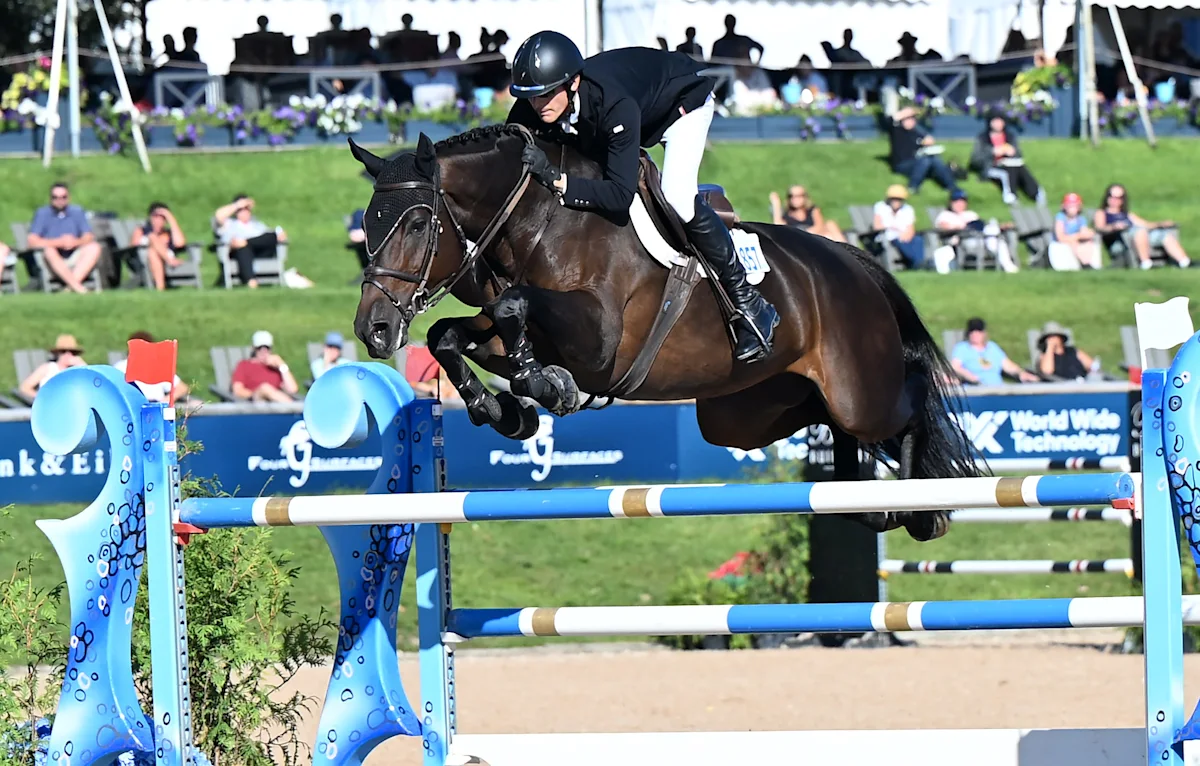
Later, those same rings fill with riders in tailored coats and breeches, horses with tightly braided manes and bonnets over their ears, popping over white wooden jumps of varying heights as they prepare for the show ring.
During a class, one rider at a time steers their horse over a combination of obstacles, some 2 or 3 feet tall for the more intermediate-level riders, and others towering above 5 feet for the advanced and professional equestrian.
Farmland became home to a 'destination horse show'
Just two decades ago, those 130 acres were farmland until they were sold to a woman named Karin Flint.
Flint was on the board for the Motor City Horse Show, Detroit's biggest showjumping event. Founded in 1934, it ran until 2000 at the Bloomfield Open Hunt, when the club had to sell much of the land that held the show.
That brought an end to Detroit's show, and the region couldn't start another because a rule required top-rated shows to be at least 250 miles from another show. The Motor City show had been around long enough that it didn't matter, but any new show had to be far north to stay in Michigan because of an existing show in northern Indiana.
"I said, well why don't we go up north and see if anyone wants to come up?" Flint said in a phone interview with The News.
She partnered with show managers Dean and Alex Reinheimer to run a new show for Michigan, this time in Chums Corner, an unincorporated area in Grand Traverse County. A few years later, Flint bought the farmland in Williamsburg where the show now sits, and it became Flintfields Horse Park.
Flint said the show was family-friendly, including a playground, a bonfire night where everyone brought food to grill, and live music shows.
Dean Reinheimer said the vision was for a "destination horse show."
"I wanted to only have enough stuff to show 'til 5, and then I wanted to be done," he said. "Then people had five hours of lake time."
The first year, the riders were mostly from Michigan. Over a few years, it started attracting higher-level riders who were traveling from show to show across the Midwest during the summer. Many were based in Florida or California, seeking milder weather for themselves and their horses.
But families also saw the benefit, he said. They could take their kids salmon fishing, golfing, boating on days when there was no horse show.
Flint said the show started to grow beyond what she felt they could manage.
"That's kind of why I let it go, because I had a feeling it wanted to get bigger," she said.
Flint is still in the horse world — she owns the horse that just won a world championship last month in Para Dressage, for riders with disabilities. But she said she's proud of what came of the small, boutique-type horse show she started in Michigan.
"I watched all the kids grow up, and now they're all jumping Grand Prixs," she said.
Morrissey family takes over the Traverse City Horse Shows
When he received a call in 2015 about the opportunity to run a horse show in Michigan, Matt Morrissey had never been to Traverse City.
But the Cleveland-based Morrissey family had a long history of horse show management. His great-uncle founded Cleveland's horse show, which brought the first Grand Prix to North America in 1965.
Morrissey, 46, who runs the show with his father, Michael Morrissey, saw the same potential to make the Traverse City show a destination for riders and families.
"When you think about other shows around the country, they're in the middle of nowhere, most of them," he said. "So you have the horse show but nothing else really to do. This is the perfect family vacation for a family that has one or two kids that ride and other kids that don't."
For the first five years, the Morrisseys ran the horse show and had a lease-to-own option on the property. They purchased it outright in 2019, allowing them to start making major investments into the property — the kind that would attract top talent, including permanent barns instead of tents, expanded VIP areas, and top footing. Yes, the quality of the dirt matters for show rings.
Word started to spread that riders no longer had to go from show to show every week to compete against top talent. They could just come to Michigan and stay for a while.
The show grew to five weeks, then six, bringing in more prize money, which brought in more riders, which allowed for bigger prizes, more sponsorships and more investments in infrastructure.
They had no idea their biggest catalyst would be a pandemic.
It's not easy to ride a horse within 6 feet of another person.
So when the COVID-19 pandemic shut down just about everything across the country and in Michigan, the Morrisseys thought they had a good case for keeping a horse show going.
"Did we wrestle with it? Absolutely," Morrissey said.
But with the help of lobbyists and the top names in the equestrian world, the show was able to help urge Gov. Gretchen Whitmer to allow outdoor recreation events to be held, minus spectators, through the summer of 2020.
They were one of the only shows to open across the country, so the Morrisseys saw an opportunity. They created a 12-week schedule for the show, starting around July.
Riders came from all across the country, as Traverse City became their only option to compete during the pandemic summer. Many of them, Morrissey said, have kept coming back since.
"It was the start of all of our growth here," he said.
Morrissey said they put several protocols in place, including wearing masks even outside, limiting places to gather and keeping everything open-air.
Morrissey said the success that year and in 2021 "surprised us."
"We had the goal and the hopes of building this equestrian community, not just the show but the surrounding area, people committing to this area," he said. "But we didn't think it would happen this quickly."
Margie Goldstein Engle spent her career traveling across the United States and Europe showing horses at the top level. YouTube is full of old videos of her pulling off daring feats, like clearing a 7-foot jump . Her lifetime winnings total over $4 million.
But when she found Traverse City, she started setting up camp. It was more cost-effective and easier on everyone not to travel so much. She brought two horses this year, Jack and Dicas.
"To be able to go someplace and rent a house and be in at least a semi-normal environment, it's nice to be in one place for a little bit," Engle said in an interview from the fairgrounds in late July. "And it's nice the horses don't have to ship around quite so much."
A Miami native, Engle spends her winters in Wellington, Florida, arguably the horse capital of the U.S. But she and her husband, veterinarian Steve Engle, now spend the warmer months in Traverse City.
"It feels kind of like a summer home to us now," she said.
She's become an icon of the show, her rounds drawing rapt silence from the crowd and then an eruption of cheers when she rides well.
The Morrisseys also have a reputation for running a tight ship, Engle said. That attracts top talent.
"They know they're going to come here and it's going to be good footing and it's going to be run properly and they'll have good course designers, good jumps, (and will be) run efficiently," Engle said.
Olympians and Grand Prix riders find reasons to come to Traverse City
Erynn Ballard, currently ranked 30th in the world and a member of Canada's 2024 Paris Olympic team, is a frequent face and name at the showgrounds.
Ballard said she and her business partner brought about 60 horses to the show this year to ride and sell.
She said it's the perfect place to develop younger horses and riders, with so many different classes offered throughout the summer.
"If I travel around the world and I just go to the biggest horse shows, then the rest of it suffers a little bit," Ballard said. "And honestly, this is what I love."
During an early August Saturday Grand Prix, Ballard and Engle were both bested by a rider from Dusseldorf, Germany, just in town for the week, who planned to return in September after he got married.
Rupert Winkelmann could have stayed in Kentucky, where he usually spends his summers showing on the competitive circuit there. But he and his fiancée just like coming to Traverse City, and called it "built for horses."
"It's what we're looking for in a horse show," he said. "It ticks all the boxes."
Another draw, he noted, is the prize money. The class he won was worth $116,000, which is then split among the top finishers.
"For them to have such a prize purse the whole summer, it says a lot," he said.
Jen Markee, executive director of the North American Riders Group, said her organization rates various shows on the quality of their product, and Traverse City's always rates high. That's made it even more popular, she said, and some weeks, the show is now bursting at the seams with horses and riders.
The show has more work to do to accommodate the demand, she said, noting the top riders know which weeks not to come because of how busy it will be.
While the show itself takes up just 130 acres, its growth and popularity are beginning to impact the land around it.
Riders and trainers are starting to buy land around the show to have a home base in Traverse City to run their operations from Michigan during the summer.
Across the street from the show is a new development called Grand Prix Village. Top-level equestrians have bought plots of land to build barns, rings or grassy areas for horses to run.
A mile from the showgrounds, Angela Swanson and her husband recently purchased 80 acres that used to be a winery about a mile from the showgrounds.
Originally from Chicago, Swanson is now based in Florida for the winter but said they wanted to make Traverse City their summer home.
"It's a small town, but it's got great restaurants, it's got a great culture, there's a lot of different things to do, everybody's really friendly up here," she said.
Grand Traverse County Commissioner Darryl Nelson lives about half a mile from the entrance to the showgrounds. He's always loved being their neighbor, he said, although it was a few years before he came out to watch the show.
"It's just amazing," he said. "It was just an old farmstead, and now you feel like you're in Europe."
Nelson and his wife make money every summer renting their house out to riders and others associated with the show. He and his wife live in their RV on the property for about six weeks while his house is occupied.
Nelson also sits on the Cherry Capital Airport authority's board, and said the horse show has helped increase the number of direct flights to and from Traverse City.
The county, he said, has been able to give more tax breaks to developers to build new apartments or other projects in the region because of the money spent in the area over the summer.
"Not much of that money is from residents; it's people that are bringing that money in and spending it in our community," he said. "That's huge."
Nelson said some are unhappy to see the development in the area, which is not uncommon in rural areas near cities. Property values have risen in the area, which has made those looking to sell happy, he said. Locals looking to buy near the show, he said, might have a harder time.
Horse show 'feels like a lockout,' local realtor says
Still, not everyone said they feel the benefit from the influx of money from the horse show.
One realtor in town, Katy Bertodatto, said she regrets the show isn't more "collaborative" with the community.
"Whatever the reason, it feels like a lockout," she said. "... I know that the people up here would appreciate a more collaborative environment."
Bertodatto rents summer homes and said most of the horse show clients go through brokers associated with the show. The show feels insulated, both in its rural location and economic impact, she said.
"I would say the horse show kind of focuses on taking care of the horse show," she said.
Morrissey said they have a concierge on site during the show to aid with any needs, and have a few designated partners that have been vetted to help show attendees with things like housing. That started after a few attendees got scammed with rentals that weren't anything like what had been promised, he said, but they aren't exclusive deals. Attendees are free to book housing any way they prefer. The show also has an on-site campground, which books up early.
Morrissey said the show is committed to benefiting the community. The show is free to attend any day except for the Grand Prix, where admission is $15, and all the money goes toward a local charity. Each week is a different charity, and representatives come to accept a check in the ring during the show and promote their organization.
The show also sources as much of its labor and materials locally as possible, including wooden shavings for the bedding of horse stalls and hay, all from Michigan.
"To have that impact every year is something that the county, that northern Michigan can count on," Morrissey said.
Labor is harder, he said. They hire about 200 people every summer, but less than half are local. Many of the jobs at a horse show are specialized, including course designers, judges, farriers, and veterinarians, and have to be brought in from elsewhere. This year's course designer came from Germany.
Any food for sale at the show is from a local business, he said, including food trucks selling everything from coffee and lemonade to Mexican burritos.
The Traverse City horse show has not only brought Olympians to Michigan every year, but it's also given local riders a chance to show off their skills.
As an attorney with two young children, Traverse City resident Lauren Trible-Laucht always found time to ride horses, but rarely had a chance to show.
The Traverse City show gave her a way back into the ring.
"I'm just so spoiled that it's in my backyard," she said.
The 46-year-old now spends several weeks of the summer with her horse, Carerra Z, showing at Flintfields Horse Park. She is what's known as an "adult amateur" in the sport — someone in it just for fun.
On a typical day, Trible-Laucht will drive to the showgrounds in the morning, learn her course of jumps, help groom and tack her horse, and then climb into the saddle to warm up and show.
By 2 p.m., she's ready to head out to her kid's soccer practice.
"We're all just sort of having fun," said Trible-Laucht, who grew up in Rochester. "We know we're not going to the Olympics."
Trible-Laucht said this year was one of the first times her parents and other family came to the show. So many people who live in the area still don't know about the show or that they can come see it, she said.
"I think people are really surprised when they come up here, and they see the whole facility, and they see what it is," Trible-Laucht said.
Traverse City Pony Club president Cassandra Rossbach said she's lived in the area for 10 years and didn't know the show existed until her daughter started riding ponies a few years ago.
Now they bring the pony club kids to the show every year to see what they could do if they keep working on their riding — and to watch Olympians in their own town.
"You don't think of your little city, Traverse City, to bring in these international riders and international horses that are actually flown here," she said.
Riders from Metro Detroit are also finding their way up to Traverse City for the summer season.
Dori Dwan, an 11-year-old from Birmingham, rode her pony, Finn, in the show this summer, her second year there.
Last year, Dori said she got more nervous before each class. Now, she's more comfortable and helps the other new kids to the show get used to everything.
"It's really cool because you get to see really nice horses jump, and it's just really fun and they have really cool rings," Dori said.
Dori came to the show with her barn, Hillside Farm, which operates out of the Bloomfield Open Hunt with trainer Heather Irvine.
Irvine said she used to take students all across the country during the summer. Now they all drive three hours north and stay there for a week, a weekend or the full summer.
"Everybody's welcome," she said. "The thing that's great about this horse show is even if you're not real advanced, they have enough classes that you can get your feet wet, get started."
Engle's kind act 'epitomizes' Traverse City show experience, mother says
Claire Francis, the 13-year-old who rode the trails with Engle, also trains with Irvine. Irvine is a tough teacher, Claire said. But if she's feeling nice on a day off from the show, she'll take the kids tubing on her boat on the lake.
Claire said she loves coming to the show for the fun summer activities in addition to riding her horse.
"I love it so much," she said. "I love how it's outside… I love how there's fresh air everywhere, and I can take my dad there." Her dad is allergic to horses. Claire and Rolland were even crowned champions in their division one week this summer.
Her mother, Amy Francis, noted she's sometimes on thin ice with her daughter's school for pulling her out for horse shows.
But the lessons she has learned and the community she has built have been worth it, she said.
"Everybody's together up there, everybody cheers each other on," Francis said. "It's a great environment. Every penny spent in this sport is worth it to my husband and I. And I just love that, just watching her grow up there."
She said Engle taking in her daughter on a trail ride "really epitomizes the spirit of the show."
Claire was glad for the special opportunity to learn from a Show Jumping Hall of Fame inductee.
"I didn't know every single detail about the trail, and now I do," she said. "And I didn't know I met someone famous, and now I do."
Topics in this story
Gathered from external sources. Rights to this text belong to whoever originally published it.