How J.J. Sullinger's gift of a kidney saved fellow Buckeye Terence Dials
Former Ohio State Buckeye Terence Dials was in need of a kidney transplant. His former teammate, J.J. Sullinger, answered the call. Here's how.
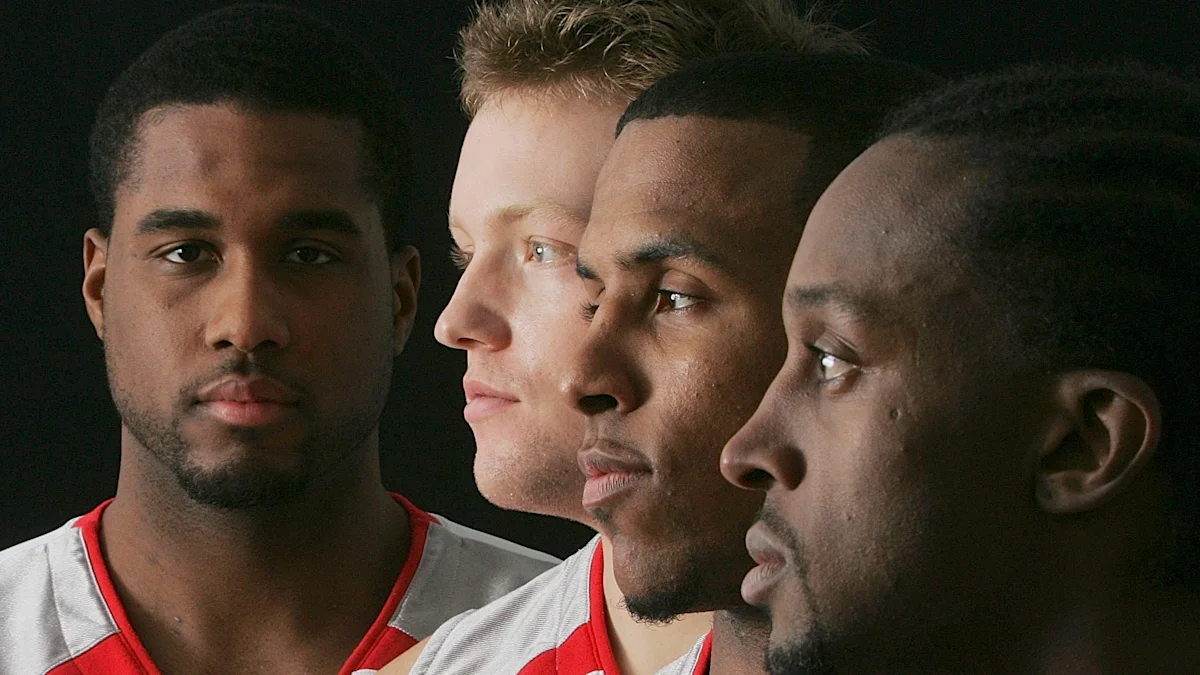
James Sullinger, who played at Ohio State during the Thad Matta era and helped revive the program's fortunes, has always had a way with words.
Once, during his four-year tenure, the former Buckeye more commonly known as "J.J." entertained with a story about why he wore scarlet tights as part of his uniform, claiming he felt the chill of the ice at the Schottenstein Center seeping through its hardwood covering. As the Buckeyes were finishing off a Cinderella run to the 2006 Big Ten title , he told reporters, "They hate us because they ain't us."
Yes, outspoken and possessing a megawatt smile, Sullinger has always had a way with words.
The word brotherhood? He was part of a group of players that long described each other as brothers, but it hits a little differently for him now.
On Oct. 12, Sullinger and best friend and former teammate Terence Dials checked into the hospital for a kidney donation. Sullinger was the donor, Dials the recipient. The two men met as adversaries in AAU basketball during high school and quickly became best friends in college. They now share a bond that goes deeper than any platitudes about brotherhood.
It took a year's worth of work for Sullinger to be able to save Dials' life . Asked to describe what that brotherhood means to him now, Sullinger had to compose himself and grasped at an answer.
"Words don't really do it justice, so when I tell you I knew I was going to do this, it just doesn't hit for me the way it should," he said. "The best way for me to explain this is Terence has always been a brother to me. My dad calls him [his] No. 4 [son]. It's always been like that. This just solidifies it. I don't like taking the credit because I just feel like this is something I was supposed to do. If I was able to do it, I was going to do it.
"I'm just grateful that I was able to do it."
Dials knew he was on this trajectory for roughly a decade. During the time when he was playing professionally, a routine medical checkup revealed slightly elevated creatinine levels, which led to a referral to a nephrologist. Kidneys don't repair themselves once their production starts to decline, so the best he could hope for was to keep things stable as long as possible with a combination of diet and exercise.
It was about five years ago that Dials' doctor told him a transplant was inevitable. During the summer of 2025, his Glomerular Filtration Rate (GFR) was low enough that Dials was placed on the national transplant list. He received a link to a website that he could share with anyone he wanted, hoping it would speed up the process of finding a compatible and willing donor.
"I told my family and friends and I just remember J.J. being like, 'I want to do this,' " Dials said. "He was like the first one to jump at it. I had two immediate matches with my brother (Michael) and J.J. That's how the process started with us."
It took less than two weeks for Sullinger to be identified as a match. He signed up so quickly that he belatedly realized he hadn't even discussed it with his wife, who gave her wholehearted approval regardless.
Finding a match and being cleared for surgery were two distinctly different milestones in the process.
Dials was informed that he had received two matches, but the hospital could not share the identities of the potential donors. His brother and Sullinger chose to keep Dials abreast of the latest developments.
That included the two men submitting to tests, scans and all kinds of bloodwork to minimize the risk for complications on either side. In Sullinger's case, there were a few causes for concern. Tests showed he was prediabetic and his blood pressure was high enough that he was forced to make some lifestyle changes in an effort to get to a place where he could be deemed healthy enough to donate.
"I stopped drinking alcohol," he said. "They didn't ask me to do that, but I felt like I needed to. I started really focusing on getting my heartrate up in the gym as opposed to just lifting weights. Diet too. But the biggest thing they asked me to do was start getting more rest. I've really been concentrating on my sleep and trying to get [at least] eight hours a night."
In essence, Sullinger trained for a year to be allowed to donate. At one point, Sullinger wore a portable blood pressure machine for 48 hours that randomly checked him and recorded the results. He also learned that he had two other good friends also in need of kidney transplants.
"I hope that this story is told in a way that helps someone or catapults someone to consider donating or somebody telling their story so they're made aware that they need a kidney," he said. "I think it's important to talk about."
In late September, more than a year after Dials first started his search for a donor, Sullinger got a simple email informed him all tests were done and they could move forward. He followed up: Did this mean they could schedule the surgery?
Once he got his reply, Sullinger sent Dials a text telling him he was going to stop by the Schottenstein Center to see him. Hired as director of professional development for the men's basketball team in 2019, Dials is now starting his third season as the program's recruiting coordinator. His former teammate frequently stopped by to check on the current team, so Dials had no idea about the news he was about to receive.
At the arena where they once played together, Sullinger delivered the news face-to-face.
"I'm like, 'I'm full-go, baby. It's time,' " Sullinger said. "He was shocked. We looked at each other and he won't tell you he was crying, but I know he was crying. It was a special moment between two brothers, man. We got a chance to hug it out, dap up and solidify the start of all of this."
Said Dials: "We embraced each other and hugged. We were in shock a little bit."
The surgery took place Oct. 12 at University of Cincinnati hospital. What Dials said felt like five minutes to him was roughly a five-hour procedure, and when he woke up in the recovery room, he learned something surprising about his new kidney.
"The lady came in and she said, 'I don't know if you're into scientific stuff but once the doctor put in the kidney, it started pumping blood going through immediately,' " he said. "That's not normal. Normally it takes a while for the blood to start circulating through. She was amazed by it."
Before long, both donor and recipient made their way back home to begin the recovery process. For Dials, that has meant a lot of isolation, rest and doctor's appointments. While on medication to prevent transplant rejection, Dials said his immune system is compromised to the point where he's not allowed to be in contact with anyone under the age of 14 because they have not had all their necessary vaccinations yet.
He's allowed to take walks around his neighborhood, but his only other trips are to visit his doctor. While there, he has to wear a mask. Every day, Dials has to report his blood pressure, temperature and weight multiple times. His hope is to be back at work sometime in December.
Sullinger said because they went through his abdominal muscles to remove the kidney, he has little core strength at the moment but otherwise, he is feeling better day by day. He was among a group of about 20 former players in attendance for Ohio State's home exhibition game against Butler on Oct. 25, there to see Matta, who was being recognized at halftime for his offseason retirement and 502 career victories.
When Matta was given the microphone, neither Sullinger nor Dials, who was watching from home, knew what was about to happen.
"Maybe the greatest thing I've seen in my coaching career happened a few weeks ago," Matta told the crowd. "A few weeks ago, James Sullinger gave his kidney to his teammate, Terence Dials."
Standing off to the edge of the group, Sullinger said he momentarily blacked out while covering his face as the emotions washed over him. At home, Dials said he couldn't hear what Matta said but had a pretty good idea by Sullinger's reaction.
"Coach Matta, man. He has a funny way of never making it about him," Sullinger said.
Both men had been in frequent communication with Matta and his wife, Barbara, but neither knew he was going to talk about the transplant. With the news now public, Dials and Sullinger said their phones quickly began to light up with messages of support.
The outpouring has been humbling, Dials said.
"As of [Matta's speech], Buckeye Nation stepped up and started sending me all types of messages via social media or the ones that have my phone number reached out," he said. "To all the people who stepped up, I thank them. It's great that Buckeye Nation is getting behind us."
The timing of it all resonated with Dials on another personal level. Exactly one year to the day of the Butler game, former Ohio State football player Nick Mangold passed away at the age of 41 shortly after publicly disclosing a battle with kidney disease. When he passed, Dials said it emphasized the situation he was in and the hope for a donor sooner rather than later.
"That's a peer of mine who I went to school with," Dials said. "I knew him. He dealt with the same thing and when he had a cry for help at the 12th hour, that really hit home that that could happen to me if I don't get a kidney. That was a reality punch, a gut punch like, 'Man, I hope one of these go through.' "
Only two individuals tested were found to be a match for Dials. It might have happened in time, but his brother was ultimately never cleared to donate.
"The real hero of this story is J.J.," he said. "I'm just the recipient. He's the one who had a selfless act. This is the most selfless act you can do. If anything, he's the hero in this, and I want him to get all the accolades and praise because this is what he deserves. He did not have to do it, and he did. Thank him.
"Words aren't enough for what he did for me."
Maybe this time, one word is sufficient: brotherhood.
Ohio State men's basketball beat writer Adam Jardy can be reached at ajardy@dispatch.com , on Bluesky at @ cdadamjardy.bsky.social , on Instagram at @ cdadamjardy or on Twitter at @ AdamJardy .
Topics in this story
Gathered from external sources. Rights to this text belong to whoever originally published it.